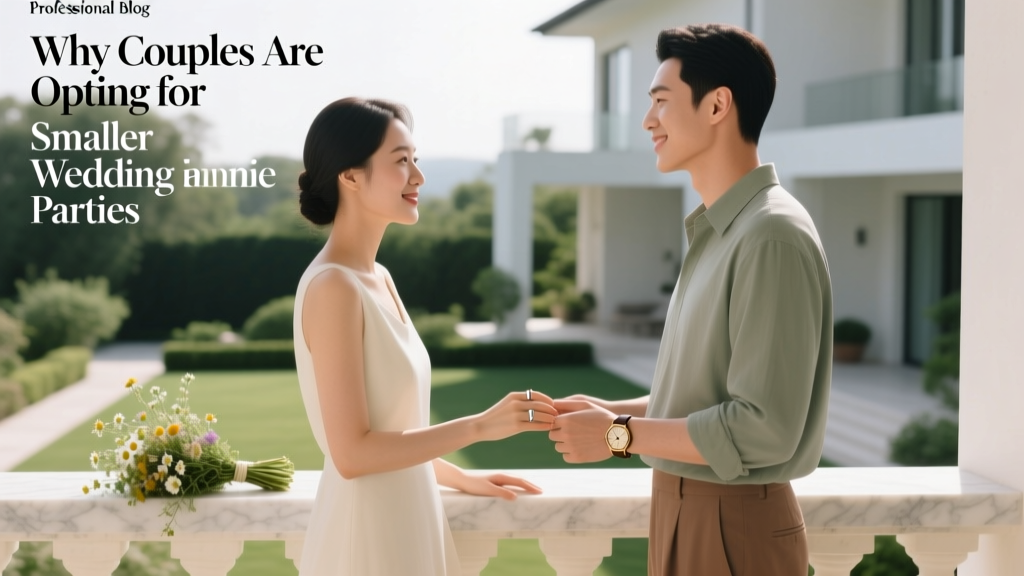
Why Couples Are Opting for Smaller Wedding Parties
Why Couples Are Opting for Smaller Wedding Parties
If you’ve noticed more couples choosing one maid of honor and one best man (or skipping a wedding party entirely), you’re not imagining it. The “big bridal party” era—matching dresses, seven groomsmen, and a packed head table—isn’t the default anymore. Engaged couples are asking a very practical question: Do we really need a large wedding party to have a meaningful wedding?
This matters because your wedding party affects so many parts of wedding planning: budget, stress levels, timelines, relationships, photos, and even the overall vibe of the day. And if you’re trying to plan a wedding that feels personal (and not like a production), your wedding party size is one of the easiest levers to pull.
Q: Why are couples opting for smaller wedding parties?
A: Couples are choosing smaller wedding parties to reduce costs and stress, avoid complicated friend-group politics, and create a more relaxed, intimate wedding experience. Smaller wedding parties also match current wedding trends—micro weddings, destination weddings, and nontraditional ceremonies—where flexibility matters more than tradition.
Q: Is it “rude” to have a small bridal party?
Not at all. Modern wedding etiquette is very clear on this: you’re allowed to design a wedding that fits your budget, relationships, and comfort level. Having fewer bridesmaids and groomsmen (or none) is widely accepted, and most guests understand that wedding planning today comes with real constraints.
As wedding planner “Elena Wright” of Cedar & Vine Events puts it: Couples aren’t being less thoughtful—they’re being more intentional. A smaller wedding party often means the couple can be more present and less pulled in ten directions.
Q: What’s driving the trend toward smaller wedding parties?
1) Budget reality: wedding party costs add up fast
Even if you’re not paying for attire, a larger wedding party can drive expenses in sneaky ways: bouquets and boutonnieres, hair and makeup, thank-you gifts, transportation, rehearsal dinner costs, getting-ready space, and extra time (which can increase photography coverage).
Many couples are also aware that being asked to be a bridesmaid or groomsman can be expensive for friends. Between attire, travel, showers, and bachelor/bachelorette events, the total can feel like a lot. Couples aiming for considerate wedding etiquette often choose smaller groups so they’re not unintentionally putting financial pressure on loved ones.
Real-couple perspective: We started with eight people each and realized we’d be asking friends to spend hundreds—maybe more—just to stand with us. We cut to three each and it felt immediately more manageable for everyone,
says “Jasmine,” who planned a 90-guest wedding in Chicago.
2) Less stress and fewer logistics on the wedding day
A smaller wedding party makes timelines smoother: fewer people to wrangle for photos, fewer moving parts during the ceremony processional, fewer schedules to coordinate for hair and makeup, and fewer opinions to navigate during planning. If you’ve ever tried to get a group of ten people anywhere on time, you get it.
Photographer “Marcus Lee” shares: With smaller wedding parties, we can get the formal portraits done quickly and spend more time capturing candid moments. Couples end up with photos that feel more real and less rushed.
3) Friend-group politics: the “who do we include?” problem
Large wedding parties can create pressure to “balance” friendships: coworkers vs. childhood friends, college friends vs. new friends, siblings vs. best friends. Smaller wedding parties can actually feel fairer because the criteria becomes clearer: only the closest relationships, period.
It also reduces the risk of hurt feelings. If your wedding party is tiny, people often interpret it as a practical choice—not a ranking of friendships.
4) The rise of modern wedding formats
Current wedding trends have shifted toward intimate, experience-forward celebrations. Micro weddings, backyard weddings, city hall ceremonies, restaurant receptions, and destination weddings often don’t naturally fit a large bridal party. Even couples hosting more traditional weddings are borrowing that “edited” approach—fewer people, more meaning.
Also, many couples now prioritize guest experience (great food, great music, comfortable pacing) over pageantry. A smaller wedding party helps keep the focus on the ceremony and celebration rather than the production.
Q: What does “small” mean—are we talking zero, two, four?
Small looks different for different couples. Here are common approaches:
- Just a maid/matron of honor and best man: Simple, classic, still traditional.
- Two to four per side: A sweet spot for many couples—enough support without heavy logistics.
- Mixed-gender wedding party: “Bridesmates,” “groomswomen,” and choosing people based on closeness rather than gender norms.
- No wedding party: Couples still do getting-ready photos and special moments with close friends—just without formal titles.
Q: How do traditional families feel about smaller wedding parties?
This depends on your family culture, but it’s increasingly common—even in traditional circles. If you anticipate pushback, framing matters. Instead of “We don’t want a bridal party,” try:
- “We want a calmer day and a simpler timeline.”
- “We’re keeping it small so we can be more present.”
- “We’re focusing our budget on guest experience.”
You can also reassure family members that special people will still be honored—through readings, toasts, getting-ready time, corsages/boutonnieres, or a private thank-you note and gift.
Q: What are real-world examples of smaller wedding party setups?
Scenario A: Traditional ceremony, modern wedding party size
“Lena and Sam” wanted a classic church ceremony but kept their wedding party to two each. They still did a full rehearsal dinner, formal portraits, and a head table—just smaller. Result: it looked timeless and felt relaxed.
Scenario B: Destination wedding with a “no-pressure” approach
“Priya and Dylan” chose no formal wedding party for their Mexico wedding. Close friends still joined for a welcome dinner and sat in the first row. Priya says, It removed so much pressure. Our friends could enjoy the trip without feeling like they were ‘on duty.’
Scenario C: Big guest list, small inner circle
“Carla and James” hosted 180 guests but kept their bridal party to three each. They invited additional friends to do readings and help with the guest book. That way, more people felt included without expanding the wedding party.
Q: How do we choose who to include without hurting feelings?
Here are practical, etiquette-friendly tips:
- Pick by role, not history: Who is actively in your life now? Who will support you through planning and on the day?
- Set a cap early: Decide “two each” or “three total” before listing names. A clear limit reduces guilt.
- Communicate consistently: If asked, keep it simple: “We’re keeping the wedding party very small.” No long explanations.
- Offer other meaningful roles: Ceremony reading, usher, witness, speech, getting-ready hang, or hosting a shower (only if they offer).
- Be mindful with social media: Don’t over-post “wedding party-only” events if you’re worried about feelings. Share thoughtfully.
Q: What if we have uneven sides—like one person vs. four?
Uneven wedding parties are completely normal now. You have options:
- Embrace it: Walk solo, or have two attendants walk together. Photos can be arranged beautifully either way.
- Stand in a semi-circle: Rather than rigid “his side/her side,” group everyone closer to the couple.
- Skip the paired processional: Have attendants enter individually, then the couple enters together.
Most guests won’t think twice—especially when your ceremony feels heartfelt and your wedding party looks comfortable.
Q: Edge cases couples worry about
- “Do we have to include siblings?” No. Some couples do out of tradition; others don’t for very valid reasons. Consider offering a sibling a special role (reading, toast, or getting-ready time) if you want to honor them without adding titles.
- “What if we already asked too many people?” It’s awkward to un-ask. If invites are already out, keep your word and adjust logistics: shorten photo time, simplify attire expectations, and consider a more casual rehearsal dinner.
- “Can we skip bridesmaids but still do a bachelorette?” Yes. Keep it inclusive: invite close friends without tying it to a formal wedding party title.
- “Will a smaller wedding party look ‘less impressive’?” Not if your day is well planned. Intimacy reads as confident, not lacking.
Conclusion
Smaller wedding parties are popular because they’re kinder on budgets, calmer on the timeline, and easier on relationships—while still giving you the support and meaning you want. If a small bridal party fits your personalities and your wedding vision, you’re not breaking etiquette. You’re making a thoughtful choice that many modern couples are making right alongside you.
More Articles
 Red Wedding Scene: Game of Thrones’ Shocking Betrayal
 Are Church Weddings Legally Binding? (2026)
 Wedding Gift Thank-You Notes: 7 Heartfelt Ways (2026)
 Candid Wedding Photos: Real Storytelling Tips (2026)
 How to Remove Wedding Dress Creases Safely
 Who Popularized White Wedding Dresses? (2026)
 Wedding Thank-You Etiquette: 7-Step Checklist (2026)
 Black at Indian Weddings: Rules, Nuances & When It’s OK
 Catholic at Non-Catholic Wedding: Permission & Guidance
 Was Jamar Goff at Paige Drummond's Wedding?