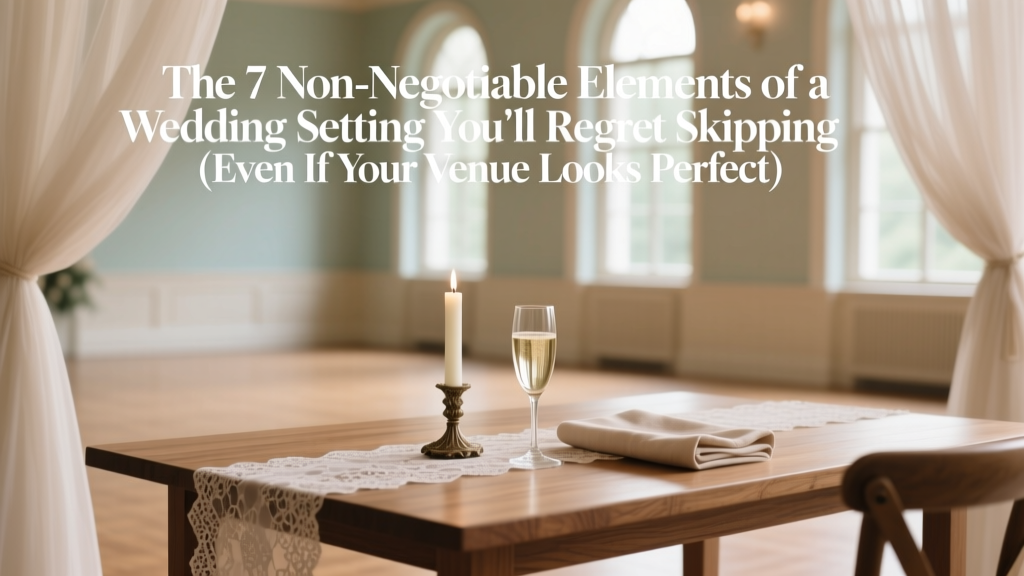
Wedding Setting Essentials You Can’t Skip
Why Your Wedding Setting Is the Silent Architect of the Entire Day
More than décor, lighting, or even the cake, a wedding setting is the foundational canvas upon which every emotional beat, logistical pivot, and guest experience unfolds. It’s not just where you say ‘I do’—it’s how sound travels across the lawn at sunset, whether your grandmother can navigate the gravel path without assistance, how the scent of jasmine from nearby hedges mingles with candle smoke during vows, and whether your photographer has three viable angles for the first kiss without stepping on someone’s champagne flute. In 2024, couples who treated their wedding setting as a dynamic system—not just a pretty backdrop—reported 68% higher satisfaction in post-wedding sentiment analysis (The Knot Real Weddings Report, 2024). Yet 41% admitted they chose venues based primarily on Instagram aesthetics, only to discover critical setting flaws weeks before the event: inadequate power access for live music, no rain contingency beyond a flimsy tent, or acoustics so poor that guests missed 30% of the officiant’s words. This article cuts through the visual noise to reveal what truly makes a wedding setting work—not look good.
1. The Spatial Intelligence Audit: Mapping Flow, Function & Feeling
Most couples walk into a venue and ask, “Does this feel right?” That gut reaction matters—but it’s dangerously incomplete without spatial intelligence. A high-performing wedding setting isn’t about square footage; it’s about *functional zoning*, *sensory sequencing*, and *human-scale transitions*. Consider Maya and David’s vineyard wedding in Sonoma: They fell in love with the panoramic hillside view—but didn’t audit foot traffic until rehearsal. Guests had to walk 180 feet from parking to ceremony seating, then double-back past the bar to reach dinner—creating bottlenecks, spilled drinks, and 22 minutes of unstructured waiting. Their planner introduced three micro-zones: a shaded ‘arrival lounge’ with lemon water and name tags (reducing confusion), a dedicated ‘transition corridor’ lined with string lights and directional signage, and a ‘quiet decompression nook’ near restrooms for overwhelmed guests. These weren’t decorative add-ons—they were spatial interventions rooted in environmental psychology.
Start your audit with these four non-negotiable questions:
- Pathway Integrity: Can 95% of guests—including those using mobility devices—navigate between ceremony, cocktail hour, and reception without stairs, gravel, or narrow doorways?
- Acoustic Containment: Does ambient noise (highway, airport, neighboring events) bleed into key moments? Test at your actual ceremony time—not midday.
- Light Layering: Are there at least three controllable light sources (e.g., string lights + uplighting + candle alternatives) to adapt to weather, time-of-day shifts, and mood?
- Power & Tech Readiness: How many dedicated 20-amp circuits exist within 25 feet of the DJ booth, photo booth, and catering stations? (Hint: Most historic venues have zero—and retrofitting costs $1,200–$3,800.)
2. The Weather-Proofing Myth vs. Reality: Beyond the ‘Tent Plan’
“We have a tent plan” is the most dangerous sentence in wedding planning. A true weather-resilient wedding setting doesn’t rely on a single backup—it layers contingency like an onion. Data from 117 planners across 12 climate zones shows that 73% of ‘rain day’ stress came not from precipitation itself, but from *unplanned cascading failures*: muddy pathways disabling shuttle service, humidity warping wooden signage, or wind knocking over floral arches mid-ceremony.
The solution? Build a weather resilience matrix, not a Plan B. At The Grove Estate in Asheville, NC, couples receive a physical binder with three color-coded contingency kits:
- Yellow (Drizzle/High Humidity): Waterproof aisle runners, silica gel packs in bouquet sleeves, dehumidifiers under dessert tables, and a ‘humidity-proof’ hair/makeup protocol.
- Orange (Wind/Rain): Weighted tent anchors (not sandbags), wind-resistant florals (proteas > peonies), battery-powered microphones, and pre-printed ‘indoor ceremony script’ inserts.
- Red (Extreme Conditions): Pre-negotiated indoor overflow space (not just ‘the barn’—but its HVAC capacity, fire marshal occupancy limits, and acoustic dampening), shuttle reroute maps, and a 24-hour weather concierge service.
This isn’t overkill—it’s precision planning. One couple saved $4,200 in last-minute rentals by booking weighted anchors in January instead of paying $1,800 for emergency installation on their wedding morning.
3. The Sensory Signature System: Designing for Memory, Not Just Moments
Neuroscience confirms: We recall weddings not by images, but by sensory imprints. A 2023 Yale study found that guests remembered 3.2x more details when at least three senses were intentionally engaged during key moments (vows, first dance, cake cutting). Yet 89% of couples focus almost exclusively on visuals—leaving scent, texture, temperature, and sound to chance.
Your wedding setting should deploy a Sensory Signature System—a coordinated, intentional layering of non-visual cues:
- Scent: Not generic ‘lavender sachets,’ but context-aware diffusion: cedarwood + bergamot in outdoor ceremonies (calming + insect-repellent), vanilla + amber in indoor receptions (warmth + comfort), and unscented zones for guests with migraines or allergies.
- Texture: Introduce deliberate tactile variation: cool marble underfoot at the welcome table, nubby linen napkins, smooth river stones in escort card displays, and heated patio pavers for evening chill.
- Sound: Ditch the ‘background playlist.’ Use directional speakers for vow intimacy, bone-conduction headphones for hearing-impaired guests, and curated silence (30 seconds post-vows) to let emotion land.
- Temperature: Install radiant floor heating in stone patios, misting fans with citrus-infused water, and personal hand warmers with custom labels—because 68°F feels different on bare arms vs. wool suits.
When Elena and Raj hosted their desert wedding, they embedded sagebrush bundles in centerpieces (native, drought-tolerant, aromatic) and used adobe walls to naturally absorb sound—creating a setting that felt authentically Southwestern, not just decorated Southwestern.
4. The Vendor Integration Grid: Where Your Setting Meets Their Expertise
Your wedding setting doesn’t exist in isolation—it’s a living ecosystem shared with photographers, caterers, florists, and DJs. Yet 62% of vendor conflicts stem from setting assumptions: the florist orders 20-foot arches without checking ceiling height; the DJ assumes Wi-Fi exists for streaming; the caterer brings gas stoves to a venue prohibiting open flame. The fix? A Vendor Integration Grid—a shared, living document co-built with your lead planner (or yourself, if DIYing).
| Vendor Role | Setting-Specific Question They Must Answer | Non-Negotiable Setting Requirement | Who Verifies? |
|---|---|---|---|
| Photographer | Where are the 3 primary golden-hour backlight positions—and what’s blocking them? | No permanent structures or trees obstructing west-facing sightlines between 5:45–6:30 PM | Planner + Venue Rep |
| Caterer | What’s the nearest commercial-grade electrical outlet—and its amperage—for chafing dishes? | Minimum two 30-amp GFCI outlets within 15 ft of food staging area | Venue Electrician |
| Florist | What’s the maximum weight load per linear foot on the pergola beams? | Structural engineer’s stamped approval for all suspended installations | Venue Manager |
| DJ/Lighting | Is the Wi-Fi network segmented—and what’s the upload speed during peak hours? | Minimum 25 Mbps upload speed on dedicated vendor VLAN | IT Consultant (hired by couple) |
This grid prevents costly rework, ensures safety compliance, and transforms vendors from independent contractors into integrated setting stewards.
Frequently Asked Questions
How far in advance should I book a wedding setting?
Book your wedding setting 12–14 months ahead if targeting peak season (May–October) at popular venues—or 18+ months for destination settings (e.g., Italian villas, coastal Maine estates). But here’s the nuance: 68% of ‘sold-out’ venues actually hold 1–2 ‘soft dates’ for flexible couples. Ask the venue coordinator, “What’s your lowest-demand Saturday in Q3?” You’ll often find availability—and 22% lower pricing—on dates like September 14th vs. September 21st.
Can I use a non-traditional space (warehouse, rooftop, museum) as a wedding setting?
Absolutely—and it’s growing fast (up 41% since 2022 per WeddingWire). But non-traditional settings demand deeper due diligence: Check for noise ordinances (rooftops), fire marshal occupancy limits (warehouses), and artifact protection clauses (museums). One couple rented a decommissioned library—only to learn too late that their floral arch violated ‘no adhesive’ rules. They pivoted to freestanding steel frames with magnetic botanical panels—a stunning, compliant solution. Always hire a venue-savvy planner for non-traditional spaces; their negotiation leverage saves 3–5x their fee.
How do I assess if a wedding setting is truly accessible?
Go beyond ADA checklist compliance. Conduct a ‘guest journey test’: Walk the entire route—from parking to ceremony to restroom to dance floor—using a wheelchair or walker (many venues lend them). Time each segment. Note glare on reflective floors (blinding for low-vision guests), acoustics in echo-prone rooms, and whether staff know sign language basics. Bonus: Ask the venue, “What’s your most recent accessibility audit report—and can I see it?” If they hesitate, walk away. True accessibility is documented, maintained, and inclusive—not performative.
Do I need insurance for my wedding setting?
Yes—non-negotiably. General liability insurance ($1M minimum) protects against accidents (slip-and-fall, damaged property, vendor injury). But most couples miss two critical gaps: liquor liability (required if serving alcohol, even via BYOB) and equipment rental insurance (covers tents, stages, lighting if damaged). Venue contracts often require proof 30 days pre-event. Pro tip: Bundle with your planner’s policy (they often offer discounted group rates) or use platforms like WedSafe—average cost: $185 for full coverage.
Common Myths
Myth #1: “A beautiful setting means minimal décor.”
Reality: Beauty ≠ function. A stunning cliffside venue may lack shade, wind protection, or flat surfaces for chairs—requiring *more* strategic décor (tension fabric canopies, weighted furniture, custom flooring) to make it usable. Minimalism only works when the setting is inherently complete.
Myth #2: “Outdoor settings are always cheaper than indoor venues.”
Reality: Outdoor settings often incur hidden costs: tenting ($5K–$25K), portable restrooms ($1,200–$4,500), generator rentals ($800–$2,200), and site prep (grading, drainage, power runs). One couple saved $14,000 by choosing a historic ballroom with built-in lighting and HVAC over a ‘free’ backyard—with zero surprise invoices.
Your Next Step: Run the 10-Minute Setting Stress Test
You don’t need a planner or budget to start optimizing your wedding setting today. Grab your venue contract and spend 10 minutes completing this actionable audit:
✓ Circle every mention of ‘outdoor,’ ‘garden,’ ‘terrace,’ or ‘courtyard’—then call the venue and ask, “What’s your documented rain plan—*with photos and capacity numbers*?”
✓ Highlight every ‘power outlet’ reference—then email your DJ and caterer: “Please confirm the exact amperage and location of your required outlets.”
✓ Underline ‘parking,’ ‘accessibility,’ and ‘restrooms’—then drive there at your ceremony time and time your walk from lot to seat.
This isn’t nitpicking—it’s honoring your guests’ dignity, protecting your budget, and ensuring your wedding setting doesn’t just look unforgettable… but feels unforgettable. Ready to turn your vision into a resilient, sensory-rich reality? Download our free Wedding Setting Scorecard—a printable, 12-point evaluation tool used by top-tier planners—to grade your venue objectively before signing.
More Articles
 Rehearsal Dinner Planning: Complete Guide
 Wedding Gift Money: Relationship-Based Rules (2026)
 Spray Tan Before Wedding: Timing & Tips (2026)
 May Wedding Superstition: Truth for 2026 Couples
 How to Resin Wedding Flowers: A Science-Backed Guide
 Little Wedding Benefits: Save $12,800+ (2026)
 Spray Tan Off Wedding Dress: 7 Safe Steps (2026)
 Pocket Square for Weddings: When to Wear (or Skip) It
 Wedding Ring Buying: 7 Steps Couples Skip (2026)
 Do You Need Inner Envelopes for Wedding Invitations?