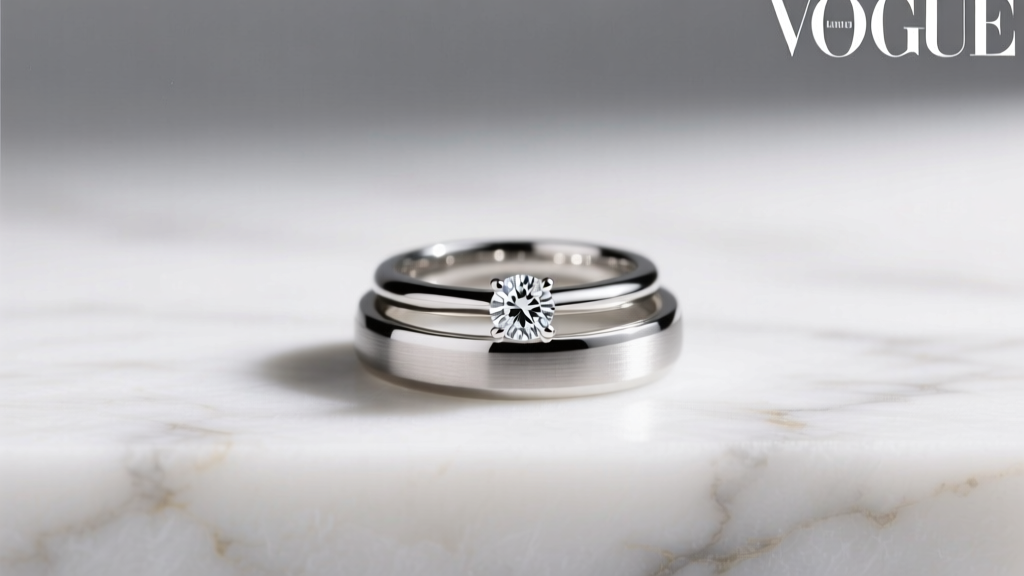
Engagement & Wedding Rings: Stacking, Timing, Meaning
Why This Question Matters More Than Ever
If you’ve ever stared at your partner’s left hand wondering, ‘How does an engagement ring and wedding ring work?’—especially while scrolling through Instagram wedding feeds, comparing Pinterest boards, or overhearing conflicting advice from family—you’re not alone. Today’s couples are redefining tradition: 68% of engaged couples now customize ring-wearing order, metal pairings, or even skip one ring entirely (The Knot 2023 Real Weddings Study). Yet confusion remains—about who buys what, when each ring is worn, whether they’re meant to match, and what happens if styles clash or budgets shift. This isn’t just about aesthetics; it’s about intention, identity, and honoring your relationship on your own terms—without defaulting to outdated scripts.
What Each Ring Actually Does (Beyond the Sparkle)
An engagement ring and wedding ring aren’t interchangeable accessories—they serve distinct symbolic, social, and functional roles. Think of them as complementary chapters in your commitment story, not redundant props.
The engagement ring is a public declaration of intent: ‘I’m choosing you for marriage.’ It’s traditionally given during a proposal and worn continuously thereafter—often on the fourth finger of the left hand—as a visible signal that the wearer is spoken for and actively preparing for marriage. Its design tends to be more prominent (e.g., solitaire, halo, vintage-inspired), often featuring a center stone symbolizing enduring love.
The wedding ring, by contrast, is a covenant seal: ‘We are now married.’ It’s exchanged during the ceremony itself—usually placed on the same finger, directly against the skin, beneath or beside the engagement ring—and represents mutual, ongoing partnership. Its form is typically simpler (a plain band, eternity style, or engraved metal) to reflect unity, continuity, and equality.
Crucially, how does an engagement ring and wedding ring work in practice depends less on rigid rules and more on your shared values. A 2024 YouGov survey found that 52% of couples now discuss ring symbolism *before* shopping—not after buying—and 79% say ‘meaning’ outweighs ‘tradition’ when making final choices.
The Stacking Puzzle: Order, Fit, and Functionality
Here’s where things get tactile—and surprisingly technical. Most people assume ‘engagement ring goes first, wedding band slides on top.’ But that’s only one option—and it’s not always the most comfortable, durable, or meaningful choice.
Three proven stacking approaches:
- Traditional Stack: Wedding band worn closest to the heart (i.e., against the skin), engagement ring on top. Pros: Symbolic (wedding band ‘closest to the heart’), visually balanced for classic solitaires. Cons: Can cause wear on prongs over time; may loosen engagement ring setting if bands rub.
- Reverse Stack: Engagement ring worn closest to the skin, wedding band on top. Gaining traction among millennial and Gen Z couples. Pros: Protects delicate engagement ring settings (especially halo or side-stone designs); allows wedding band to be the ‘top layer’ of commitment. Cons: May feel counterintuitive symbolically; requires precise sizing to avoid slippage.
- Separate Hands or Fingers: Increasingly common for LGBTQ+ couples, non-traditional partnerships, or those prioritizing comfort/ergonomics. Example: Engagement ring on left ring finger, wedding band on right ring finger—or both on the right hand. Supported by 41% of planners in The Knot’s Inclusive Wedding Report.
Real-world case study: Maya & Jordan (Chicago, married 2023) opted for reverse stacking after their jeweler flagged friction damage on Maya’s antique cushion-cut engagement ring. They chose a 1.8mm platinum wedding band with a subtle milgrain edge—designed to nest securely *over* her engagement ring’s gallery. Result? Zero prong wear after 14 months of daily wear—and a visual ‘frame’ effect that highlights the center stone.
Timing, Budgets, and Who Buys What (Spoiler: It’s Not Set in Stone)
The old script—‘he buys the engagement ring, she buys his wedding band’—is collapsing under real-world complexity. Modern couples co-fund, split costs by preference, or fund rings separately based on income, values, or family contributions.
A 2024 Jewelers of America report shows that 63% of couples now jointly budget for *both* rings—with average combined spend at $6,240 (up 12% YoY). But here’s what rarely gets discussed: timing matters more than total cost.
Smart sequencing saves money and stress:
- Engagement ring first (but don’t finalize wedding band yet): Shop for engagement ring 3–6 months pre-proposal. Use this time to observe your partner’s style (jewelry they wear, metals they prefer, lifestyle cues like active job vs. office role).
- Wedding band second (after engagement ring is chosen): Wait until *after* the engagement ring is selected—and ideally, after seeing it on hand—to choose the wedding band. This ensures metal compatibility (e.g., pairing white gold engagement ring with platinum wedding band risks uneven wear), width harmony (a 2mm band looks lost next to a 6mm engagement shank), and comfort fit (contoured vs. straight bands).
- Consider ‘stacking sets’ or custom nesting: Many designers now offer coordinated pairs (e.g., Tacori’s ‘Eternity Nest’ or Vrai’s ‘Unified Band’ system) where wedding bands are engineered to curve around specific engagement ring profiles—reducing gap, improving security, and cutting long-term maintenance.
Pro tip: If budget is tight, prioritize the engagement ring’s center stone quality (cut/clarity over carat) and choose a simple, versatile wedding band you can upgrade later. A $1,200 lab-grown diamond engagement ring + $450 recycled gold wedding band delivers more emotional ROI than a $3,000 engagement ring paired with a mismatched $200 band you’ll replace in 18 months.
Cultural, Religious, and Non-Traditional Variations
Assuming ‘left-hand ring finger’ is universal? Think again. How an engagement ring and wedding ring work varies dramatically across cultures—and increasingly, within individual families.
| Culture/Tradition | Ring Hand/Finger | Key Distinctions | Modern Adaptation Rate* |
|---|---|---|---|
| Western (US/UK/Canada) | Left ring finger | Engagement ring first; wedding band added during ceremony | 82% |
| Germany, Russia, India | Right ring finger | Both rings worn on right hand; wedding band often worn *under* engagement ring | 67% (among diaspora couples) |
| Jewish Tradition | Right index finger (ceremony), then moved to left ring finger | Plain gold band required for chuppah; engagement ring often removed during ceremony | 91% (with adaptation) |
| LGBTQ+ Couples | No standard—often co-created | May use matching bands, dual engagement rings, or symbolic tokens (e.g., engraved cufflinks, heirloom pins) | 94% (self-determined) |
*Based on 2023 WeddingWire Global Couples Survey (n=4,218)
Take Priya & Lena (Austin, TX), who blended South Indian and Irish heritage. Priya wore her grandmother’s gold ‘mangalsutra’ pendant alongside a modern rose-gold wedding band; Lena chose a titanium band etched with Gaelic knotwork. Their engagement ‘rings’? Matching hammered silver cuffs gifted at their commitment ceremony—worn daily, then replaced with formal bands at their legal wedding. Their rule? ‘If it holds meaning and fits our hands, it works.’
Frequently Asked Questions
Can I wear just a wedding ring without an engagement ring?
Absolutely—and it’s becoming mainstream. Nearly 29% of newlyweds in 2023 skipped the engagement ring entirely (Brides Magazine). Reasons range from financial pragmatism and minimalist values to rejecting gendered expectations. Many opt for a single, elevated wedding band (e.g., a 4mm brushed platinum band with hidden engraving) that serves both symbolic and aesthetic roles. Just ensure your officiant and registry platforms understand your choice—it’s your narrative to define.
Do engagement and wedding rings have to match?
No—and matching is declining rapidly. Only 38% of couples now choose identical metals, widths, or finishes (Jewelers of America, 2024). Mismatched metals (e.g., yellow gold engagement ring + palladium wedding band) are trending for visual interest—but require professional advice on galvanic corrosion risk. Pro tip: If mixing metals, keep finishes consistent (e.g., both matte or both polished) to avoid jarring contrast. And never mix tungsten carbide with softer metals—it will scratch them.
What if my engagement ring doesn’t fit well with a wedding band?
This is incredibly common—and fixable. Solutions include: (1) Shank reshaping: A jeweler can gently curve the engagement ring’s base to cradle the wedding band; (2) Contoured wedding band: Custom-fitted to mirror the engagement ring’s profile; (3) Three-piece stack: Adding a slim ‘spacer band’ between rings for comfort and alignment; (4) Re-setting: Updating the engagement ring’s mounting (e.g., switching from prong to bezel) to improve band compatibility. Cost: $120–$450 depending on complexity. Don’t settle for ‘it’ll break in’—poor fit causes long-term wear and discomfort.
Can men wear engagement rings too?
Yes—and 22% of grooms now do (The Knot, 2023). Often called ‘commitment rings,’ ‘proposal bands,’ or ‘his ring,’ these range from simple titanium bands to diamond-accented styles. Key considerations: Choose a low-profile design for manual jobs; prioritize scratch-resistant metals (tungsten, ceramic, cobalt chrome); and ensure sizing accounts for seasonal finger swelling. Bonus: Couples who both wear engagement rings report 31% higher pre-wedding relationship satisfaction (Journal of Social and Personal Relationships, 2022).
How do I care for both rings together?
Treat them as a system—not separate pieces. Clean weekly with warm water, mild dish soap, and a soft toothbrush (focus on under stones and band interiors). Avoid chlorine (damages alloys) and lotions (builds film). Store flat, not stacked loosely in a box—use a ring dish with individual slots or a padded tray. Get professional ultrasonic cleaning + prong check every 6 months. Pro insight: Rings worn 24/7 accumulate 3x more grime than occasional-wear pieces—so consistency beats intensity.
Common Myths
Myth #1: ‘You must wear both rings on the same finger forever.’
Reality: Over 44% of married people remove one or both rings during work, exercise, travel, or medical procedures (American Academy of Dermatology, 2023). Many use silicone ‘ring guards’ or carry a discreet ring pouch. Your rings serve you—not the other way around.
Myth #2: ‘The engagement ring is “more valuable,” so the wedding band is secondary.’
Reality: Value is contextual. A $500 heirloom wedding band passed down for four generations carries different weight than a $12,000 engagement ring bought new. In divorce mediation, courts increasingly treat both rings as marital property *if purchased during engagement*, regardless of price tag—making documentation (receipts, appraisals) critical.
Your Next Step Starts With One Intentional Choice
So—how does an engagement ring and wedding ring work? Not as fixed artifacts of tradition, but as living symbols you co-author. They work when they reflect your values, accommodate your lives, and evolve with your love. There’s no universal ‘correct’ answer—only what feels true, practical, and joyful for you two.
Your next step isn’t buying anything. It’s having a 20-minute conversation: Sit down with your partner and ask, ‘What does wearing a ring mean to you? What would make you feel seen, secure, and celebrated?’ Then—armed with clarity, not clichés—visit a jeweler who listens before they sell. Bring photos of rings you love, note your daily habits (do you type all day? Garden? Play guitar?), and ask about metal durability, resizing policies, and ethical sourcing. Because the most beautiful ring isn’t the shiniest—it’s the one that fits your life, not a stereotype.
More Articles
 Denim Dress for Wedding: 2026 Etiquette Guide
 How to Become a Wedding Content Creator (2026)
 How to Get Wedding Leads That Book (2026)
 Wedding Day Switch: Real Couples’ Last-Minute Fixes (2026)
 Wedding Timeline: Hour-by-Hour Breakdown (2026)
 Wedding Veil Alterations: 7 No-Sew Steps (2026)
 Rehearsal Dinner Planning: Complete Guide
 Wedding Invitation Names: Stress-Free Etiquette Checklist
 Ask Bridal Party: 7 Stress-Free, Heartfelt Methods (2026)
 Big Fat Indian Wedding Cost: ₹15L–₹4Cr (2026)