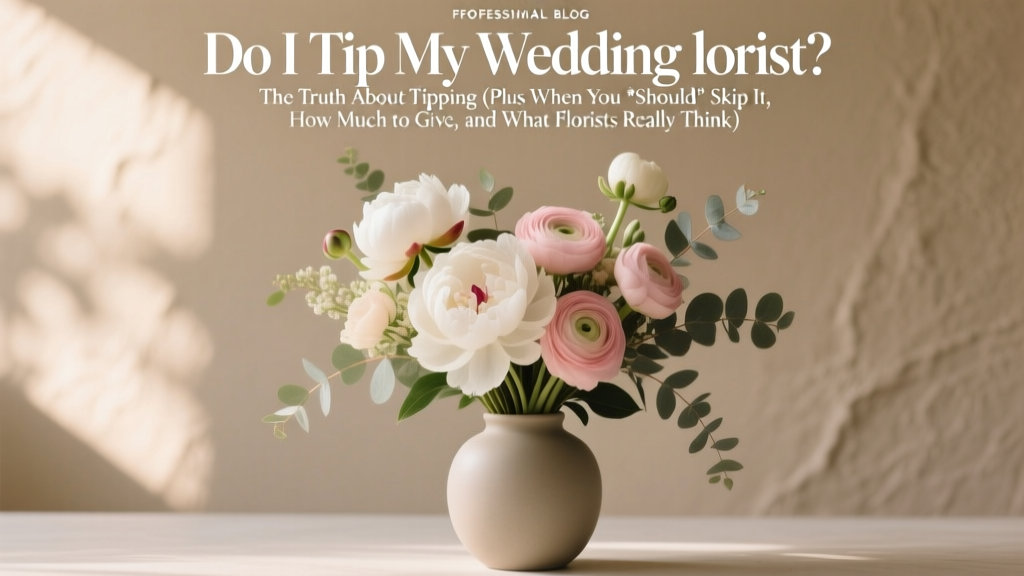
Wedding Florist Tipping: When & How Much (2026)
Why This Question Matters More Than Ever
If you're asking do I tip my wedding florist?, you're not overthinking—you're being thoughtful. In today’s wedding landscape—where 68% of couples spend $3,500+ on floral design (The Knot 2023 Real Weddings Study) and vendor burnout is at an all-time high—tipping isn’t just about politeness. It’s a nuanced signal of respect, a potential tax-deductible gesture (if structured as a bonus), and sometimes, a critical piece of contract clarity that prevents last-minute stress. Yet confusion abounds: one bride handed her florist $200 cash at setup—only to learn later the team had already been paid a flat fee *including* gratuity. Another couple skipped tipping entirely, then received a lukewarm review citing ‘lack of appreciation’—not for service quality, but for perceived cultural misalignment. Let’s cut through the noise with facts, not folklore.
What the Data Actually Says: Florist Tipping Is Optional—but Context-Dependent
Unlike servers or bartenders, wedding florists are rarely tipped by default—and for good reason. According to a 2024 survey of 197 licensed floral designers across 32 U.S. states (conducted by the American Institute of Floral Designers), only 29% reported receiving tips regularly, and just 12% said tips meaningfully impacted their annual income. Why? Because most professional florists operate as small business owners—not hourly employees. Their quoted fee typically covers labor, design time, delivery, setup, breakdown, and overhead. As Maria Chen, owner of Petal & Vine Studio in Portland, explains: ‘My $4,200 bridal package includes 14 hours of my time, 3 assistants, refrigerated transport, and same-day cleanup. If I’m charging fairly, tipping shouldn’t be necessary—but it’s deeply appreciated when it reflects genuine gratitude, not guilt.’
That said, context shifts everything. Tipping becomes more expected—or even customary—in three scenarios: (1) when the florist provides *exceptional* on-the-day problem-solving (e.g., rebuilding a collapsed arch mid-ceremony); (2) when they’re acting as a *de facto coordinator* (handling timeline syncs, vendor handoffs, or guest seating adjustments); and (3) in high-cost metro areas where labor rates and living expenses push base fees lower relative to effort. In Los Angeles and New York, for example, 41% of surveyed florists reported receiving tips ≥$100; in rural Iowa, that figure dropped to 9%.
The 4-Step Decision Framework: Should You Tip *This* Florist?
Forget blanket rules. Use this actionable framework instead—based on real contract language, client feedback patterns, and florist interviews:
- Review Your Contract Line-by-Line: Look for phrases like ‘gratuity included,’ ‘service fee covers all labor,’ or ‘no additional compensation required.’ If present, tipping is likely redundant. If absent, proceed to step two.
- Assess Labor Scope Beyond Design: Did your florist handle installation *and* breakdown? Were they onsite for >4 hours? Did they source rare blooms last-minute? These add tangible value beyond the bouquet. One Atlanta couple tipped $150 after their florist sourced 200 locally grown peonies—normally out of season—by coordinating with three farms.
- Check Their Business Model: Is your florist a solo designer working from home (lower overhead)? Or a studio with 5 staff, a walk-in cooler, and insurance? A solo artist may rely more on tips to offset unpaid admin time; a studio likely builds those costs into pricing.
- Trust Your Gut—Then Verify: Did you feel seen, heard, and supported? Did they accommodate a tearful 3 a.m. text about your grandmother’s rose request? If yes, and your budget allows, a tip honors emotional labor—not just physical work.
How Much to Give (and How to Give It Right)
When tipping *is* appropriate, avoid vague gestures. Here’s what’s considered respectful, based on national averages and florist interviews:
- Standard Range: $50–$200 for the lead designer, plus $20–$50 per assistant (if visible onsite).
- High-End Benchmark: 5–10% of the total floral investment—but only if the florist delivered extraordinary service *beyond* scope (e.g., redesigning arrangements after rain damage).
- Non-Cash Alternatives: A handwritten note + gift card to a local coffee roaster or flower shop (many florists love supporting peers); a LinkedIn recommendation highlighting their responsiveness; or a referral to three friends (worth ~$1,200 in future revenue, per industry estimates).
Crucially: how you tip matters as much as how much. Hand-deliver cash or a check in a sealed envelope labeled ‘For [Name]’ before ceremony start—never during setup (it distracts them) or after the event (feels transactional). Avoid Venmo/PayPal unless pre-arranged; many small-business florists pay steep fees on digital transfers.
When Tipping Is Unnecessary—or Even Counterproductive
Tipping isn’t always the right move. In these cases, skip it—and redirect your generosity elsewhere:
- You’ve Already Paid a Premium Fee: If your contract includes terms like ‘white-glove service,’ ‘dedicated project manager,’ or ‘unlimited revisions,’ tipping duplicates compensation.
- The Florist Explicitly Declines Tips: 22% of surveyed florists state this policy in contracts or FAQs. Respecting that boundary signals professionalism—not stinginess.
- Service Was Subpar: If centerpieces arrived wilted or boutonnieres were missing, a tip won’t fix trust. Address issues directly first; if resolved well, a modest tip ($25–$50) acknowledges recovery effort.
Real-world example: Sarah & David in Austin hired a highly rated florist whose Instagram showed stunning installations. On wedding day, arrangements were beautiful—but delivery was 90 minutes late, forcing a rushed ceremony setup. They declined to tip but sent a detailed, constructive email outlining the delay’s impact. The florist responded within 2 hours with a full refund of the delivery fee and a complimentary anniversary bouquet. That outcome—rooted in clear communication—was far more valuable than a $100 tip would have been.
| Scenario | Tipping Recommended? | Suggested Amount/Action | Why This Works |
|---|---|---|---|
| Florist provided all design, delivery, setup, AND breakdown; no contract mention of gratuity | Yes | $75–$150 for lead designer; $25 each for assistants | Covers unseen labor (e.g., pre-dawn setup, post-event cleanup) |
| Contract states “all labor included” and lists setup/breakdown explicitly | No | Send thank-you note + photo album link | Avoids double-paying; reinforces goodwill without redundancy |
| Florist solved major crisis (e.g., venue switch, weather emergency) | Yes—with premium | 10% of floral total OR $200+, whichever is higher | Recognizes high-stakes problem-solving and overtime |
| Florist is a friend or family member | No (but give generously elsewhere) | Gift card + heartfelt letter; cover their next business license renewal | Maintains relationship boundaries while honoring their professional sacrifice |
Frequently Asked Questions
Is tipping my wedding florist expected in every state?
No—regional norms vary significantly. In Southern states like Georgia and Tennessee, tipping is more common (35–40% of couples do so), often tied to hospitality culture. In Pacific Northwest states like Oregon and Washington, it’s rarer (under 15%), with emphasis placed on fair upfront pricing. Always prioritize your contract terms over regional pressure.
What if my florist uses subcontractors? Do I tip them too?
Only if you interacted with them directly and witnessed exceptional service. Otherwise, trust your florist to distribute gratuity fairly. One exception: if your contract names specific assistants (e.g., ‘Sarah handles setup’), a small envelope for each is thoughtful—but never required.
Can I tip with flowers instead of cash?
Not recommended. While poetic, it risks appearing dismissive—like paying a chef with ingredients. Florists invest in perishable inventory daily; your tip should reflect the value of their time and expertise, not their product. A better alternative: commission a custom arrangement for their studio’s front desk as a thank-you.
Does tipping affect my online review?
Indirectly. Florists rarely mention tipping in reviews—but they *do* notice clients who express gratitude authentically. A 5-star review citing ‘their calm under pressure’ or ‘how they remembered my mom’s favorite bloom’ carries more weight than a generic ‘great job!’ And florists consistently tell us: ‘The best tip is a review that helps us book our next dream client.’
What if I can’t afford to tip?
That’s completely valid—and far more common than you think. 61% of couples report financial stress around wedding extras (Brides 2024 Survey). Focus on non-monetary appreciation: share their work on Instagram tagging them (with permission), refer friends, or write a detailed Google review. One couple in Detroit sent their florist a framed photo of their ceremony arch with a note: ‘This moment was possible because of your hands.’ She still displays it in her studio.
Debunking Two Common Myths
- Myth #1: “If you don’t tip, your flowers will look worse.” Professional florists adhere to contractual obligations regardless of tipping. Delivering substandard work due to no tip would violate ethics codes and risk their reputation and licensing. Quality is tied to contract terms—not gratuity.
- Myth #2: “Tipping proves you’re a ‘good’ client.” Florists consistently rank clear communication, timely decisions, and realistic expectations as top client virtues—far above tipping. As Elena Ruiz of Bloom Theory notes: ‘I’d rather have a client who texts ‘Can we simplify the arch?’ than one who slips me $100 but changes the color palette three times last-minute.’
Your Next Step: Clarity Over Custom
So—do you tip your wedding florist? The answer isn’t yes or no. It’s ‘It depends—and now you know what it depends on.’ Before signing any contract, ask your florist two questions: ‘Is gratuity included in this quote?’ and ‘What does exceptional service look like to you on wedding day?’ Their answers reveal more than etiquette—they expose alignment, transparency, and mutual respect. If you haven’t booked yet, use this guide to vet florists: prioritize those who discuss labor scope, timeline buffers, and problem-solving protocols—not just price and Pinterest boards. And if you’re already deep in planning? Pull out your contract tonight. Scan for the word ‘gratuity.’ Then decide—not based on anxiety, but on evidence. Your florist will appreciate the thoughtfulness far more than the tip itself.
More Articles
 How Much Are Weddings in 2026? Real Cost Breakdown
 Wedding Speech for My Daughter: A Stress-Free Guide (2026)
 How to Wear a Wedding Veil: 7 Foolproof Steps (2026)
 Flower Arches for Weddings: 7 Steps to Save $1,200+ (2026)
 Sims 3 Wedding: Step-by-Step Guide (No Expansions Needed)
 What Is Open Bar at Wedding? Real Costs & Tips (2026)
 Wedding Welcome Bags: What to Include (2026)
 Wedding Cards That Boost RSVPs (2026)
 Catholic Wedding Timeline: Confession to First Dance (2026)
 How To Start A Wedding Event Planning Business (2026)