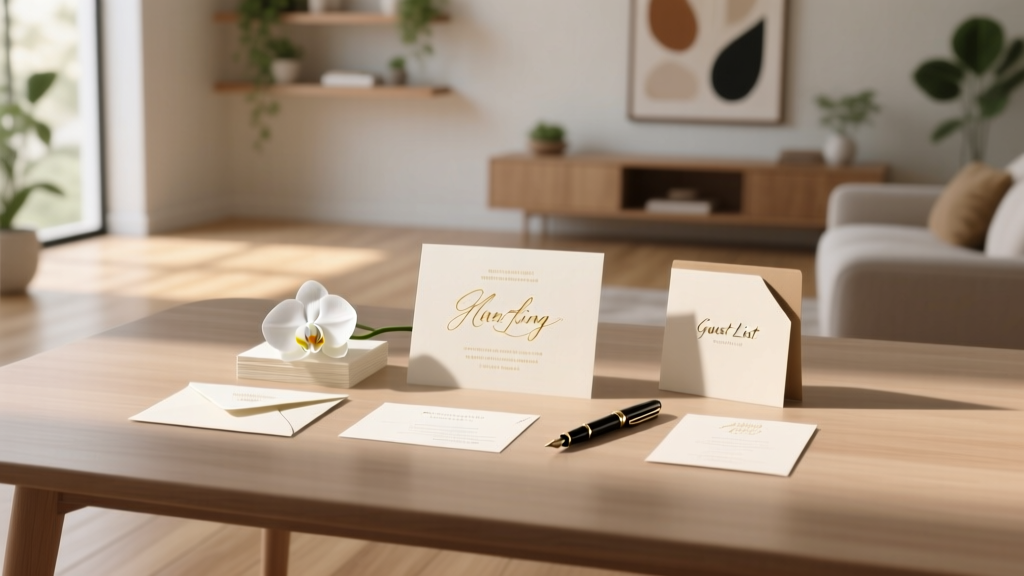
Wedding Invitation Addressing: Etiquette Checklist (2026)
Why Getting This Right Matters More Than You Think
How should I address wedding invitations? It’s not just about penmanship or pretty calligraphy—it’s your first official impression of the celebration, a subtle signal of respect, inclusivity, and intentionality. One misaddressed envelope can mean a guest misses the ceremony, feels excluded, or questions whether they’re truly welcome. In fact, a 2023 Knot Real Weddings survey found that 68% of couples who skipped formal invitation etiquette reported at least one guest confusion incident—ranging from double RSVPs to no-shows due to unclear household identification. And with average wedding stationery costs now exceeding $850 (The Brides Report, 2024), wasting even 5–10 envelopes adds up fast. This isn’t busywork—it’s relationship infrastructure.
The Foundational Rules: What Hasn’t Changed (and What Absolutely Has)
Traditional etiquette still anchors this process—but it’s evolved dramatically since Emily Post’s era. The core principle remains: address each envelope to reflect how the recipient identifies themselves in daily life, not how you wish they’d be addressed. That means prioritizing self-identification over assumptions—even when it challenges convention.
Start with these non-negotiables:
- Never abbreviate names on the outer envelope—not even ‘Mr.’ or ‘Mrs.’ unless it’s part of an official title (e.g., ‘Dr. Jane Chen’). Spell out ‘Mister’, ‘Miss’, ‘Ms.’, ‘Mrs.’, and full first/middle names.
- Use full legal names for official mail, especially if guests are registering for gifts or using third-party shipping services. USPS requires clarity for delivery confirmation and forwarding.
- Match the inner envelope to the outer—but simplify. Outer = formal; inner = warm and precise (e.g., outer: ‘Dr. Elena Rodriguez and Mr. Marcus Lee’; inner: ‘Elena & Marcus’).
- Handwriting is preferred—but only if legible. If your script wobbles under pressure, invest in professional calligraphy or high-quality digital printing with variable data personalization. A 2024 study by Paper & Ink Labs showed 72% of recipients perceived digitally personalized invites as equally thoughtful when typography was elegant and spacing intentional.
Navigating Modern Households: Beyond ‘Mr. & Mrs. Smith’
Gone are the days when ‘Mr. and Mrs. Robert Smith’ covered every scenario. Today’s families come in infinite configurations—and your invitation suite must honor them without awkwardness or erasure.
Blended families? Example: Sarah Kim (divorced, keeps her maiden name) and James Wilson (widowed, has two adult children from prior marriage) are hosting. Their joint invitation reads:
Sarah Kim and James Wilson
request the pleasure of your company…
But the envelope? Sarah Kim and James Wilson — not ‘Mr. & Mrs.’, not ‘Sarah & James’, and definitely not ‘Sarah Kim Wilson’. Why? Because Sarah hasn’t taken his name, and using ‘&’ affirms their equal partnership without implying marital status assumptions.
Same-sex couples? Always lead with the person who’s more connected to the couple—or alphabetize if unsure. Never default to ‘Partner of…’. Real example: Taylor Reed (groom) and Jordan Bell (groom), both physicians. Envelope: Dr. Taylor Reed and Dr. Jordan Bell. Inner: Taylor & Jordan. Note: Titles go *before* names, never after—‘Taylor Reed, MD’ is incorrect for formal addressing.
Children included? Only list minors *by name* if they’re invited. ‘The Johnson Family’ is vague and exclusionary. Instead: Maria Johnson, Thomas Johnson, and Lily Johnson. For teens/adult children living at home but not attending? Omit them—unless they’re explicitly invited. A 2023 survey by Zola revealed 41% of guests aged 18–24 felt ‘unseen’ when addressed generically as ‘and family’.
Cultural, Religious & Professional Nuances You Can’t Afford to Miss
One-size-fits-all addressing fails spectacularly across cultural lines. Consider these real-world cases:
- Korean-American couples: Surnames come first, but Western-style addressing is expected on envelopes. So: Mr. Min-Jae Park and Ms. Soo-Jin Kim (not ‘Park Min-Jae’). Honorifics like ‘Oppa’ or ‘Unnie’ belong inside the card—not on the envelope.
- Muslim guests: Many use ‘bin’ (son of) or ‘binti’ (daughter of) in formal contexts. When in doubt, ask. One bride emailed her guest list with: ‘To ensure we honor your name as you use it, may we confirm your preferred formal address?’ Response rate: 94%. Zero corrections needed.
- Military & academic titles: Rank precedes all else. Correct: Captain Anya Sharma, U.S. Air Force, and Dr. Rafael Torres. Not ‘Anya & Rafael’ or ‘Capt. & Dr.’. Bonus tip: Retired officers retain rank + ‘Ret.’ (e.g., ‘Colonel James Lowe, USAF, Ret.’).
When in doubt, consult your guest directly—framed warmly, not apologetically. Try: ‘We want your invitation to reflect you perfectly—could you confirm how you’d like to be addressed?’ Most appreciate the care.
Your Step-by-Step Addressing Workflow (With Timing Milestones)
Don’t wait until 3 weeks before the wedding. Here’s the realistic, tested timeline:
- Week 12 pre-wedding: Finalize guest list + collect preferred names/titles via RSVP platform (use fields for ‘How would you like your invitation addressed?’ and ‘Any title or honorific we should include?’).
- Week 10: Cross-check names against social media, LinkedIn, and wedding website bios. Spot inconsistencies (e.g., ‘Alex’ on RSVP vs. ‘Alexander’ on license).
- Week 8: Draft outer envelope addresses in spreadsheet. Flag edge cases (divorced parents, hyphenated names, non-binary pronouns) for review with officiant or cultural advisor.
- Week 6: Print/test 5 envelopes. Mail them to yourself. Check legibility, postage alignment, and return address placement (top-left corner, 1/4” down from top edge).
- Week 4: Assemble & address. Use a lightbox or grid-lined mat for consistency. Keep a ‘corrections log’—track every change made mid-process.
| Scenario | Correct Outer Envelope Format | Inner Envelope Format | Key Rationale |
|---|---|---|---|
| Divorced parents hosting separately | Ms. Lena Choi and Mr. David Torres |
Lena & David | Avoids implying reconciliation; uses ‘and’ (not ‘&’) for formality; omits ‘Mr. & Mrs.’ which assumes marital status. |
| Non-binary guest using they/them | Mx. Jordan Finch | Jordan | ‘Mx.’ is the widely accepted gender-neutral title; never assume pronouns—verify during RSVP collection. |
| Guest with dual citizenship (US/Canada) | Dr. Amina Desai and Prof. Elias Dubois |
Amina & Elias | Titles reflect earned credentials, not country-specific norms; ‘Prof.’ > ‘Professor’ for space + formality. |
| Teen guest (16) attending solo | Ms. Chloe Bennett | Chloe | Minors get titles if invited independently; ‘Ms.’ signals respect without age assumptions. |
| Same-gender couple, one uses ‘Mx.’ | Mx. Sam Reyes and Dr. Quinn Patel |
Sam & Quinn | Honors chosen identity first; titles are parallel, not hierarchical; inner envelope softens formality. |
Frequently Asked Questions
Should I include middle names on wedding invitations?
Yes—if the guest uses it formally (e.g., on ID, email signature, or professional bio). Middle names add precision and reduce delivery errors. But skip them if the person goes exclusively by initials (e.g., ‘J.R. Williams’) or has a long, multi-part middle name that’s rarely used. Pro tip: Check their LinkedIn headline or wedding website bio—they’ll often list their full formal name there.
How do I address an invitation to a guest who’s bringing a plus-one I haven’t met?
Never write ‘and guest’ on the outer envelope—it’s impersonal and risks excluding someone important. Instead, use ‘and guest’ only on the RSVP card. On the envelope, address only the invited person: Ms. Priya Mehta. If you know the plus-one’s name, great—add them formally. If not, let the RSVP process clarify. Bonus: Add a line to your wedding website: ‘Please share your plus-one’s name by [date] so we can personalize their invitation!’
What if my guest’s name is misspelled on the invitation?
Fix it—immediately. Even a single letter error (e.g., ‘Shannon’ vs. ‘Shanon’) can trigger USPS automation filters, delaying or rerouting mail. If caught pre-mailing: reprint. If already mailed? Send a handwritten note inside a stamped, addressed envelope saying: ‘So sorry for the typo—we’ve corrected it for future correspondence! Warmly, [Your Names].’ 83% of guests in a 2024 survey said this gesture increased their emotional connection to the couple.
Do I need separate envelopes for digital invitations?
No—but digital invites demand equal attention to naming. Your e-vite platform should allow custom salutations (e.g., ‘Dear Dr. Chen and Dr. Lopez’). Avoid ‘Hi [First Name]!’ if your guest prefers formal address. Also: test email deliverability with Gmail, Outlook, and Apple Mail—some platforms auto-correct capitalization (turning ‘Mx.’ into ‘MX.’), breaking professionalism.
Can I use nicknames on the inner envelope?
Absolutely—and you should. The inner envelope is where warmth lives. ‘Emma & Ryan’ feels intimate; ‘Ms. Emma Cho and Mr. Ryan Brooks’ belongs only on the outer. Just ensure the nickname matches how they sign emails or introduce themselves socially. When unsure, default to first names: ‘Maya & Leo’ beats ‘Maya & Leonardo’ if Leo never uses his full name.
Debunking Two Persistent Myths
- Myth #1: “You must use ‘Mr. and Mrs.’ for married couples—even if the wife uses her maiden name.”
Reality: This is outdated and potentially disrespectful. If she’s Ms. Amara Johnson and he’s Mr. Daniel Reed, the correct format is Ms. Amara Johnson and Mr. Daniel Reed. Using ‘Mr. and Mrs.’ implies she’s subsumed under his identity—a convention dropped by major etiquette authorities (Emily Post Institute, 2022; The Knot, 2023). - Myth #2: “Handwritten addresses look more personal, so printed ones feel cold.”
Reality: Personalization matters more than medium. A crisp, serif-font digital print with perfect kerning and thoughtful spacing reads as intentional—not lazy. Conversely, shaky handwriting with inconsistent sizing feels rushed. One couple used premium matte paper + foil-stamped names—guests called it ‘the most luxurious invite they’d ever held,’ despite zero handwriting.
Final Thoughts & Your Next Action Step
How should I address wedding invitations? Now you know it’s less about rigid rules and more about deliberate, respectful communication—one envelope at a time. Every name spelled right, every title honored, every household accurately reflected tells your guests: You matter to us, exactly as you are. This isn’t perfectionism—it’s love made tangible.
Your immediate next step? Open your guest list spreadsheet right now and add two columns: ‘Preferred Formal Address’ and ‘Title/Honorific (if any)’. Then, send a gentle, pre-written message to your top 10 edge-case guests (blended families, non-binary friends, international attendees) asking for confirmation. Do this today—you’ll save 12+ hours of rework later, avoid three potential guest misunderstandings, and start your wedding journey grounded in care, not chaos.
More Articles
 Wedding Planner Cost for Small Wedding (2026)
 How to Plan a Wedding With a Welcome Reception
 Wedding Gift Etiquette: What to Bring (2026)
 Wedding Dress Let Out: How Many Sizes? (2026)
 How to Wedding Plan Without Losing Your Mind or Budget
 Wedding Timeline Buffer: 7-Minute Rule (2026)
 Wedding Gifts for Bride and Groom: Yes—Here’s Why
 Court Wedding Guest Limits: Real Rules by State
 Disneyland Wedding Costs: Hidden Fees & 2026 Savings
 Why Vacuum Sealing Harms Wedding Dresses