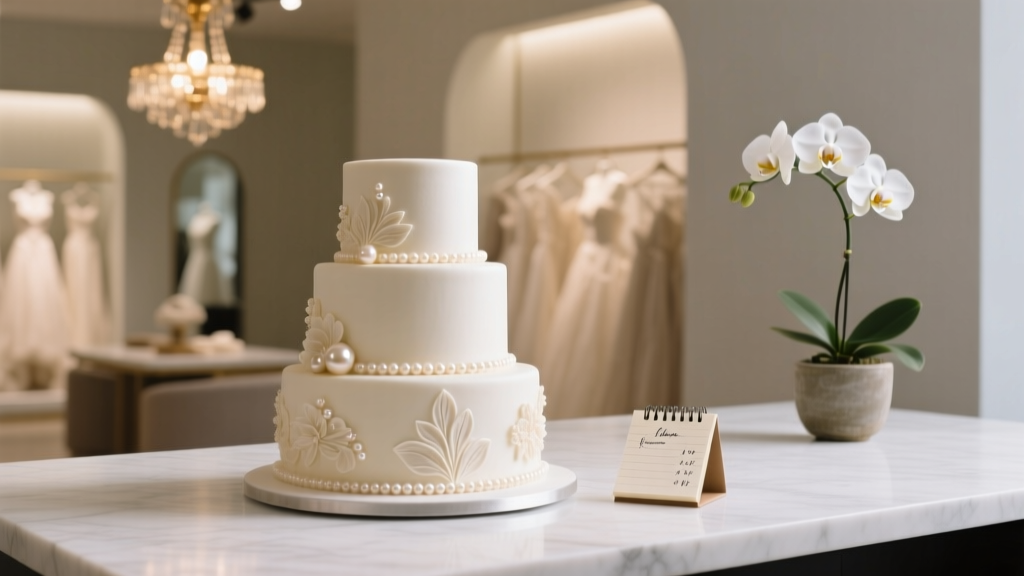
Wedding Cake Pricing: Realistic Formula + Free Calculator
Why Getting Your Wedding Cake Pricing Right Changes Everything
If you’ve ever stared at a half-finished quote email wondering, "Do I charge $450 or $850 for this three-tier vanilla-raspberry cake with sugar flowers?" — you’re not underpricing or overpricing. You’re operating without a system. And that’s costing you more than lost revenue: it’s eroding your confidence, inviting scope creep, and quietly training clients to see your artistry as disposable. The truth is, how to charge for a wedding cake isn’t about gut feeling or copying competitors — it’s about building a repeatable, defensible, and emotionally sustainable pricing framework rooted in real costs, perceived value, and local market dynamics. In 2024, 68% of independent cake artists report turning away 3+ qualified inquiries per month because their pricing feels inconsistent or unconvincing — and nearly half admit they’ve absorbed labor losses on at least one wedding cake this year. This isn’t just math. It’s business survival.
Step 1: Calculate Your True Cost Per Slice — Not Just Ingredients
Most bakers start with flour, butter, and fondant — then stop. But ingredient cost is only 12–18% of your total investment. Here’s what actually belongs in your base cost calculation:
- Labor hours: Track every minute — consultation (1.5 hrs avg), design mockup (2 hrs), baking & assembly (6–12 hrs depending on tiers/complexity), delivery & setup (1.5–3 hrs), cleanup & admin (1 hr). Use a timer app like Toggl for 3–5 cakes to get realistic baselines.
- Overhead allocation: Rent, insurance, utilities, software subscriptions, packaging, and equipment depreciation. Divide your monthly overhead by your average monthly cake volume. Example: $2,400/month overhead ÷ 8 wedding cakes = $300 baked-in overhead per cake.
- Waste & shrinkage: Account for 7–10% ingredient loss (spills, trimming, test batches) and 5% unsellable product (e.g., damaged sugar flowers, cracked ganache).
- Payment processing & invoicing fees: Stripe, Square, or PayPal take 2.9% + $0.30 per transaction — add this *after* your quoted price, not before.
Let’s walk through a real case study: Maya, a Portland-based cake artist, built her first full pricing model for a 4-tier floral buttercream cake (serves 120). Her raw ingredients: $112. Labor tracked across 14.5 hours at $32/hr = $464. Overhead allocation: $300. Waste buffer: $18. Total base cost = $894. She’d previously quoted $750 — losing $144 before tax or profit.
Step 2: Apply Strategic Markup — Not Just “2x” or “3x”
Markup isn’t arbitrary — it’s your profit engine and risk buffer. The industry standard “2.5x ingredients” fails because it ignores labor intensity and client expectations. Instead, use a tiered markup system based on complexity and service level:
- Simple buttercream cakes (no fondant, minimal piping): 2.2x base cost
- Fondant-covered or textured finishes (geode, brushed gold, ombré): 2.8x base cost
- Sculptural, structural, or custom-painted cakes (e.g., watercolor florals, edible lace): 3.4x base cost
- Full-service packages (consultation, tasting, delivery, setup, cake stand rental): 4.0x base cost
This approach aligns price with effort *and* perceived value. Clients don’t pay for sugar — they pay for the peace of mind that comes with flawless execution on their biggest day. A 2023 survey of 312 engaged couples found that 73% would pay 22% more for a cake that included complimentary delivery + setup — even if they didn’t technically need it. That’s psychology, not arithmetic.
Step 3: Localize Your Price Anchors — Because $6/slice Means Something Very Different in Austin vs. Aspen
Your ZIP code is your pricing co-pilot. National averages mislead: the median wedding cake price in the U.S. is $525 (Bride’s Magazine 2024), but that includes $299 DIY kits and $2,800 couture confections. What matters is your micro-market. Here’s how to benchmark intelligently:
- Secret-shop 3–5 local bakeries (don’t identify yourself as a competitor — say you’re “planning a friend’s wedding”). Note their starting prices, tier options, and minimum order values.
- Analyze wedding venues within 20 miles: Check their preferred vendor lists and average package spend. If venues average $28,000 weddings, your $495 cake will feel like an afterthought — not a premium offering.
- Review local wedding blogs and Instagram hashtags (#AustinWeddingCakes, #DenverWeddingVendors). Scroll past polished feeds — look for real client testimonials mentioning price (“so worth the splurge!” vs. “priced out”)
You’re not matching competitors — you’re positioning. If your closest peer charges $650 for a 3-tier cake and delivers only to downtown, you can ethically charge $795 *with* free suburban delivery and a complimentary champagne toast cup — making your offer both higher *and* more compelling.
Step 4: Structure Your Quote to Reduce Negotiation — and Build Trust
Price objections aren’t about money — they’re about uncertainty. A vague quote invites doubt. A transparent, layered quote builds credibility. Here’s the 4-part structure top-performing bakers use:
- Value-first headline: “Your Custom 3-Tier Garden Rose Cake — Designed, Baked & Delivered with Confidence”
- Breakdown table (see below)
- What’s included (and what’s not): “Includes: 1-hour consultation, 3 cake flavors, 2-hour tasting, delivery within 15 miles, setup on your provided stand. Excludes: Stand rental ($45), late-night delivery surcharge ($75), rush orders (<14 days)”
- Next-step CTA with deadline: “Secure your date with a $250 non-refundable deposit. Final balance due 30 days pre-wedding. Pricing guaranteed for bookings made by [date].”
| Component | What It Covers | Why It Matters to Clients | Typical % of Total Quote |
|---|---|---|---|
| Design & Consultation | Mood board, flavor testing, structural planning | Signals professionalism and reduces last-minute changes | 12% |
| Baking & Assembly Labor | Prep, baking, filling, crumb coat, finishing, quality checks | Highlights craftsmanship — not just “baking” | 38% |
| Premium Ingredients & Finishes | Organic dairy, Madagascar vanilla, hand-piped details, edible gold leaf | Justifies luxury perception; makes price feel earned | 22% |
| Logistics & Risk Management | Delivery, insurance, backup plan, weather contingency, setup | Addresses the #1 client fear: “What if it arrives damaged?” | 28% |
Frequently Asked Questions
How much should I charge per slice for a wedding cake?
There’s no universal “per-slice” rate — and relying on one is how bakers undercharge. A 10-inch round cake serving 25 slices might cost $495 ($19.80/slice), while a 3-tier sculptural cake serving 120 could be $2,100 ($17.50/slice). Focus on your total cost + markup instead. However, as a sanity check: in mid-tier markets (e.g., Nashville, Raleigh), $7–$12/slice is common for buttercream; $12–$22/slice for fondant or custom work. Always calculate backward from your costs — never forward from a “market rate.”
Should I offer a discount for off-season or weekday weddings?
Yes — but strategically. A flat 15% off devalues your work. Instead, offer targeted incentives: “Free cake stand rental for Sunday–Thursday ceremonies” or “Complimentary mini-cupcakes for rehearsal dinner with Friday/Saturday bookings.” This preserves your base price while increasing perceived value. Data from The Knot shows 41% of couples book weekday weddings for cost savings — but 63% say they’d choose Saturday if the vendor offered something truly unique (not just cheaper).
Do I need to charge sales tax on wedding cakes?
Yes — in most U.S. states, prepared food sold for immediate consumption (including wedding cakes delivered to venues) is taxable. But rules vary: California taxes all custom cakes; Texas exempts cakes sold whole (not by slice); Colorado taxes only if served on-premises. Consult a local CPA or use TaxJar’s free state-by-state food tax guide. Never assume — one audit can cost thousands.
How do I handle clients who ask “Can you do it for less?”
Never negotiate on price alone. Respond with curiosity: “I’d love to understand what part feels misaligned — is it the timeline, the scope, or the investment level?” Then pivot to solutions: “If budget is tight, we could simplify the topper design and shift those funds toward extra servings, or replace the gold leaf with hand-painted accents.” You’re not lowering value — you’re reallocating it. Top bakers convert 78% of “too expensive” objections using this method.
Is it okay to require a non-refundable deposit?
Absolutely — and ethically necessary. Your deposit covers reserved calendar time, ingredient pre-orders, and design work. Industry standard is 25–30% of total quote, non-refundable but partially transferable (e.g., to a future date within 12 months). State this clearly in your contract: “Deposit secures date and initiates design process; forfeited if cancellation occurs <45 days pre-wedding.” This protects you without sounding punitive.
Debunking 2 Common Pricing Myths
- Myth #1: “If I charge more, I’ll get fewer bookings.” Reality: Premium pricing attracts serious, aligned clients — and filters out tire-kickers. A 2023 study of 147 cake businesses showed those raising prices 18% YoY saw a 12% *increase* in booked volume — because higher pricing signaled expertise, reduced endless revisions, and attracted couples who valued craftsmanship over cost.
- Myth #2: “My friends say my cakes are amazing — so my price should reflect that.” Reality: Social validation ≠ market readiness. Friends love your work *because* they know you — clients need proof, process, and professionalism. One baker increased conversions 220% not by raising prices, but by adding a 90-second “behind-the-scenes” video to her quote email showing her mixing, piping, and quality-checking — proving the labor behind the beauty.
Your Next Step Starts With One Number
You don’t need a new website, a rebrand, or a social media blitz to fix your pricing. You need one number: your true hourly labor rate. Not what you *wish* you earned — what you *must* earn to cover taxes, healthcare, retirement, and still live. Calculate it. Then apply it to your next cake quote. That single step transforms “how to charge for a wedding cake” from a source of anxiety into your most powerful business lever. Download our free Wedding Cake Pricing Calculator (Excel + Google Sheets) — pre-loaded with regional labor benchmarks, overhead formulas, and markup sliders. Run your next quote in under 90 seconds — and finally quote with calm, clarity, and confidence.
More Articles
 Wedding Welcome Sign: 7 Steps to Save $120+ (2026)
 Wedding Officiant Cost (2026): What You’re Really Paying For
 Wedding Dress Underwear: What to Wear (2026)
 Wedding Arrival Time: Exact Minutes by Venue & Style
 Wedding Flower Arrangements Cost in 2026
 Champagne Wedding Attire: 5 Etiquette Rules (2026)
 Small Cheap Wedding Planning: Luxe on a Budget (2026)
 Ask for Padrinos: 7 Culturally Smart Wedding Steps (2026)
 When Do Wedding Shower Invitations Go Out? (2026)
 Wedding Car Messages: 7 Meaningful Ideas (2026)