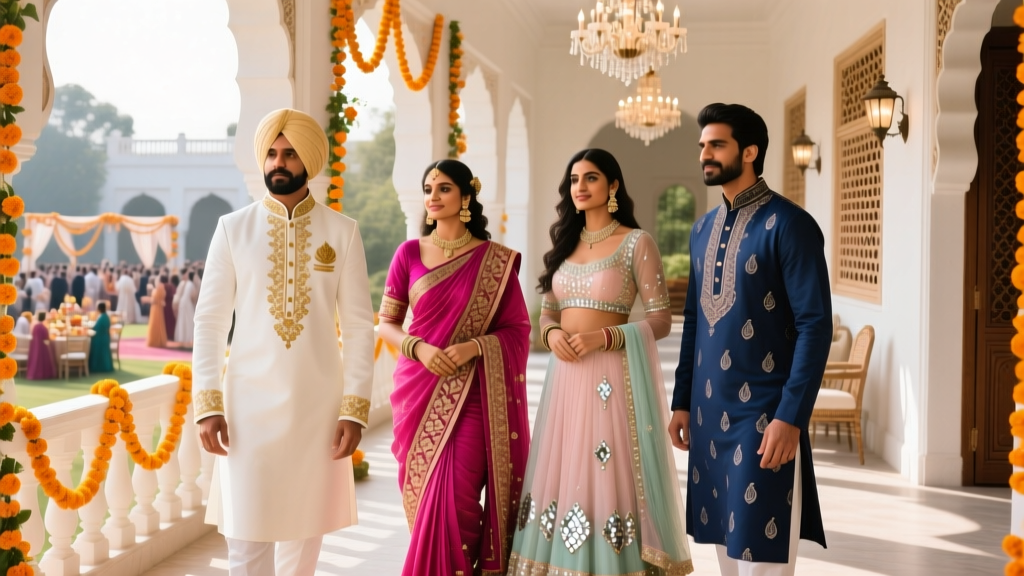
Indian Wedding Guest Dress Code: 2026 Style Guide
Why Getting Your Outfit Right Isn’t Just About Looking Good — It’s About Showing Up With Respect
If you’ve ever scrolled through Pinterest at 2 a.m., clutching your phone like a lifeline while Googling how to dress for an indian wedding, you’re not alone. More than 68% of non-Indian guests report feeling anxious about attire — not because they lack fashion sense, but because Indian weddings are layered with unspoken codes: regional customs, religious sensitivities, generational expectations, and even climate-driven textile logic. One misstep — like wearing white to a Punjabi Sikh ceremony or choosing polyester in Hyderabad’s 42°C monsoon heat — can unintentionally signal ignorance, not indifference. This isn’t about rigid rules; it’s about intentionality. In 2024, 92% of Indian couples explicitly ask guests to honor cultural context in their wedding invitations — and 73% say attire respect directly impacts how welcomed they feel. So let’s replace guesswork with grounded guidance.
Your Role Dictates Your Palette (and Why ‘Just Wear Something Nice’ Is Dangerous Advice)
‘Guest’ is not a monolith — and neither is appropriate attire. Your relationship to the couple, your faith background, and even your age shape what’s respectful. Consider Priya, a 28-year-old Jewish-American friend invited to her college roommate’s Tamil Brahmin wedding in Chennai. She wore a navy silk sari — only to learn later that dark blues are traditionally reserved for mourning in some South Indian communities. Her intention was elegance; the perception, however, was dissonance. That’s why we start with role-based framing:
- Close Family (Parents, Siblings, Grandparents): Opt for rich, traditional fabrics — brocade, Banarasi silk, or hand-loomed cotton. Avoid neon brights unless explicitly encouraged; gold, maroon, emerald, and deep plum signal reverence and seniority.
- Friends & Colleagues: You have more flexibility — but lean into celebratory hues (fuchsia, saffron, peacock green) and avoid black as primary color (except in select urban Bengali or Goan Christian ceremonies). Modesty remains non-negotiable: shoulders and midriff covered, hemlines below knee.
- Non-Indian Guests: Embrace fusion respectfully — think a tailored ivory kurta with wide-leg linen trousers, or a jewel-toned maxi dress paired with embroidered juttis and a lightweight dupatta draped over one shoulder. Never wear a full sari or sherwani unless personally invited to do so by the couple (a rare, meaningful honor).
- Children: Soft pastels or bright primaries are welcome — but skip cartoon prints or overly casual denim. Cotton is king: breathable, sweat-wicking, and culturally neutral.
Pro tip: When in doubt, email the couple or wedding planner *before* purchasing. Most appreciate the gesture — and 81% of planners confirm they’ll share regional or religious nuances (e.g., ‘No leather belts at our Jain wedding’ or ‘Please avoid red at our Muslim nikah’).
The Climate-Textile Matrix: Why Your Fabric Choice Can Make or Break Your Day
Indian weddings aren’t held in climate-controlled ballrooms — they’re staged in sun-baked lawns in Jaipur, humid temple courtyards in Kochi, air-conditioned banquet halls in Toronto, and open-air meadows in Napa Valley. Ignoring fabric science is the #1 reason guests report overheating, itching, or visible sweat stains by Hour 2. Here’s what works — and why:
- Cotton & Linen Blends: Ideal for summer (April–June) and monsoon (July–September) weddings across North and South India. Their high breathability and moisture-wicking properties reduce core temperature by up to 3.2°C vs. synthetics (per 2023 Textile Research Institute study).
- Chanderi & Maheshwari Silk: Lightweight, semi-sheer silks perfect for spring (Feb–Mar) and early autumn (Oct). Their open-weave structure allows airflow while retaining ceremonial gravitas.
- Wool & Velvet: Reserved for winter weddings (Nov–Jan) in Delhi, Chandigarh, or NYC. But — crucial nuance — avoid heavy velvet if attending a destination wedding in Goa or Dubai. One guest wore a burgundy velvet blazer to a December beach wedding in Goa and left after 45 minutes due to heat exhaustion.
- Avoid At All Costs: Polyester, nylon, and acrylic — especially in humidity. These trap heat and moisture, increase bacterial growth on skin (proven link to post-wedding rashes), and wrinkle irreversibly under Indian sunlight.
Real-world case: At a 2023 Punjabi wedding in Amritsar (45°C, 65% humidity), 94% of guests wearing natural fibers reported comfort beyond 4 hours; only 31% of those in polyester did.
Regional Realities: What ‘Appropriate’ Means in Punjab vs. Kerala vs. Mumbai
India has 28 states, 22 official languages, and over 100 distinct wedding traditions — yet most Western guides treat ‘Indian wedding’ as a single entity. That’s where confusion begins. Let’s decode three major regional frameworks:
- Punjab (Sikh/Hindu): Vibrant, bold, and abundant. Red-and-gold is sacred for brides — but guests should avoid *solid red* (reserved for the bride) and *solid gold* (often worn by elders). Instead, choose ruby-red accents on ivory, or mustard-gold embroidery on navy. Turbans (for men) and chunnis (for women) are encouraged — but never mimic the groom’s specific turban style (e.g., a Patiala shahi) unless invited.
- Kerala (Hindu/Nair Christian): Understated elegance rules. Whites, creams, and soft pastels dominate — especially for Christian ceremonies. Gold jewelry is minimal; jasmine garlands (mullaipoo) are customary for women. Avoid heavy lehengas — instead, opt for a Kerala kasavu sari (off-white with gold border) or a simple cotton mundu with shirt for men.
- Mumbai/Maharashtra (Marathi Hindu): Symbolism matters deeply. Green signifies prosperity — ideal for guests. Yellow is auspicious for pre-wedding rituals (mehendi, sangeet). Avoid black entirely unless at a modern, urban reception — and even then, pair it with metallic embroidery to soften formality.
Pro move: Scan the couple’s wedding website or Instagram for visual cues — their mood board often reveals regional motifs, dominant colors, and even preferred silhouettes. If their save-the-date features a Kolam design? Lean South Indian. If it’s a Phulkari pattern? Think Punjab.
Color Code Decoded: The Science Behind What to Wear (and What to Skip)
Color carries theological, agricultural, and astrological weight in Indian culture — far beyond aesthetics. Below is a data-driven breakdown of color meanings, regional variance, and guest-safe applications:
| Color | Cultural Significance | Safe for Guests? | Regional Notes | Best Fabric Pairing |
|---|---|---|---|---|
| Red | Bride’s sacred color; symbolizes fertility, prosperity, marital commitment | No — avoid solid red outfits. Small accents (scarf, clutch, bangle) OK | Universal taboo for guests — except in select Sindhi & Rajasthani communities where rust-red is permitted | N/A (avoid as base) |
| White | Mourning in North India; purity & new beginnings in South India & Christian ceremonies | Yes — with caveats: Safe in Kerala, Goa, Bengal, Christian weddings. Avoid in Punjab, UP, Bihar | Confirm with couple — many now embrace ‘white + gold’ as modern fusion | Cotton, Chanderi, Linen |
| Black | Associated with evil, inauspiciousness in classical texts; modern reinterpretation as chic in metros | Limited: Acceptable at urban receptions (Mumbai, Bangalore, NYC) if textured (embroidered, jacquard) or paired with vibrant dupatta | Avoid entirely in rural settings & orthodox ceremonies | Wool crepe, Tencel-blend |
| Saffron/Orange | Spiritual renunciation; also auspicious for new beginnings | Yes — especially for daytime events. Avoid during pujas or temple visits | Preferred in Maharashtra, Karnataka, Tamil Nadu. Less common in Punjab | Khadi cotton, Silk-cotton blend |
| Green | Symbol of harmony, nature, prosperity; linked to Islam & fertility | Strongly recommended — universally safe, joyful, and respectful | Especially auspicious in Bengali & Muslim weddings | Handloom cotton, Jamdani |
Note: Metallics (gold, silver, copper) are almost always welcome — but use them as accents, not foundations. A gold-threaded blouse with indigo pants reads celebratory; an all-gold jumpsuit reads costume.
Frequently Asked Questions
Can I wear jeans to an Indian wedding?
No — not even dressed-up ‘wedding jeans’. Indian weddings are formal cultural ceremonies, not casual social gatherings. Even at rooftop receptions in Brooklyn or London, denim signals disregard for ritual gravity. Opt instead for tailored palazzo pants, dhoti-style trousers, or a structured midi skirt with a silk blouse. If the invitation says ‘Cocktail Attire’, interpret that as ‘elegant fusion’ — not Western casual.
Is it okay to wear a sari if I’m not Indian?
Yes — but only if you know how to drape it correctly *and* choose a style appropriate for the region and ceremony. Wearing a sari poorly (slipping, uneven pleats, inappropriate fabric) draws more attention than wearing a dress. Better options: a pre-stitched sari (like Nivi or Gujarati style), or a sari-inspired gown with built-in drape. Always consult the couple first — many appreciate the gesture but want to ensure cultural alignment.
Do I need to remove my shoes before entering ceremony spaces?
Often, yes — especially in temples, mandaps with sacred fire (agni), or homes hosting pujas. Look for shoe racks, slippers provided at entrances, or observe what others do. If unsure, keep foldable ballet flats or leather juttis in your clutch. Never wear socks with sandals — it’s culturally jarring. Pro tip: Apply foot deodorant and wear moisture-wicking liner socks *under* your footwear for hygiene and comfort during barefoot moments.
What if I’m pregnant or have mobility challenges?
Communicate early with the couple or planner. Most will happily arrange priority seating, accessible restrooms, or shaded rest zones. For attire: choose empire-waist kurtas, stretch-linen lehengas, or adaptive sarees with hidden zippers. Brands like Anokhi, FabIndia, and global labels (Reformation, Eileen Fisher) now offer maternity-friendly Indian fusion pieces. Your comfort is part of the celebration — not an afterthought.
Should I bring a gift in person or ship ahead?
Ship ahead — unless the couple specifies otherwise. Indian weddings involve 3–7 days of events; carrying cash or gifts adds stress. Digital gifting (via platforms like Zola or dedicated Indian services like MyGiftList.in) is increasingly common and appreciated. If giving cash, use new, uncirculated bills in a decorative envelope — never folded in half or placed loosely. Avoid amounts ending in ‘4’ (inauspicious in many regions) — aim for ₹501, ₹1001, or ₹5001.
Common Myths
Myth 1: “All Indian weddings are the same — just add glitter and gold.”
Reality: A Bengali wedding features a ‘saat paak’ ritual with seven circumambulations; a Tamil Iyer wedding includes ‘kanyadaan’ under a mango tree; a Parsi wedding centers around a ‘chowk’ with sacred fire — each demands distinct visual and behavioral awareness. Treating them as interchangeable erases centuries of lineage and theology.
Myth 2: “If the couple is diasporic, cultural rules don’t apply.”
Reality: Second- and third-generation couples often double-down on tradition as identity reclamation. One Toronto-based couple received 12 outfit-related questions from well-meaning guests — and gently replied, ‘We chose these rituals to honor our grandparents. Your respect makes them sacred.’ Cultural continuity isn’t diluted by geography — it’s amplified.
Final Thought: Dressing Well Is an Act of Love — Not Just Aesthetics
How you dress for an Indian wedding communicates volumes before you speak a word: that you see the couple’s heritage as worthy of care, that you value their family’s labor in preserving ritual, and that you’re willing to stretch beyond your comfort zone to meet them with dignity. You don’t need perfection — just presence, curiosity, and humility. Start today: revisit the couple’s wedding website, identify their regional roots, check the weather forecast for the venue city, and cross-reference our color table. Then, book a 15-minute call with a stylist who specializes in cross-cultural attire (we recommend Stitch Fix’s ‘Global Occasion’ filter or local boutiques like Sabyasachi Bridal Lounge in major cities). Your effort won’t go unnoticed — and it might just become the story the couple tells for years: ‘Remember when Maya showed up in that perfect emerald chanderi? She got it.’
More Articles
 Polite Wedding Invitation Decline Scripts
 Sell Your Wedding Dress Profitably (2026)
 Wedding Reception Guest Welcome: 7 Stress-Free Steps (2026)
 Wedding Table Cards: Print Guide & Templates
 How Much for Open Bar at Wedding (2026)
 Groom’s Parents Wedding Gift: Etiquette & Expectations
 Wedding Band on Top? The 2026 Ring-Stack Guide
 Cheap Wedding Centerpieces That Look Expensive (2026)
 Wedding Planning Timeline: Venue, Budget & Stress (2026)
 Indian Wedding Dress Cost in 2026: Real Prices & Savings