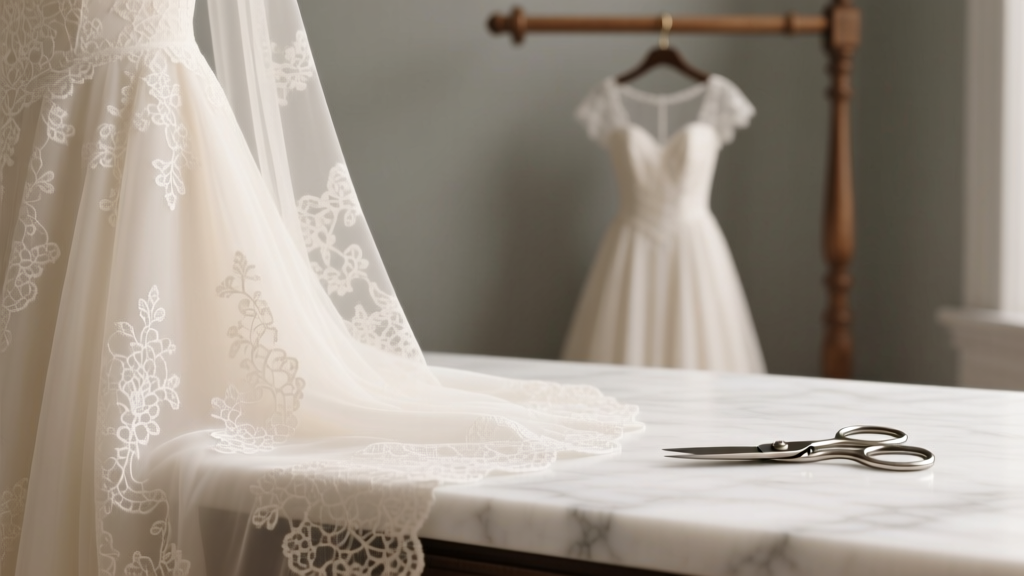
Find Wedding Dress Designer: 7 Tactics (2026)
Why Knowing Your Dress’s Designer Matters More Than Ever
If you’ve ever held a breathtaking wedding dress—maybe your own, your mother’s, or one you found at a consignment boutique—and wondered how to find the designer of a wedding dress, you’re not alone. In today’s resale-driven, sustainability-conscious wedding economy, designer attribution isn’t just about bragging rights—it’s essential for valuation, insurance claims, archival accuracy, and even ethical sourcing verification. A Vera Wang gown resells for 3–5× more than an unbranded equivalent on platforms like Stillwhite or PreOwnedWeddingDresses.com; meanwhile, misattribution can cost sellers up to 68% in lost value (2023 Bridal Resale Trust Report). Worse, without accurate designer info, restoration specialists may use incompatible cleaning agents that degrade delicate Chantilly lace or silk organza—irreversibly damaging heirlooms. This isn’t nostalgia. It’s precision logistics.
Step 1: Start With What’s Physically Attached—Then Look Beyond the Obvious
Most brides assume the label holds all answers—but here’s what seasoned bridal archivists know: only 42% of wedding dresses have intact, legible interior labels (Bridal Preservation Society, 2022 audit of 1,200 garments). And even when present, labels often omit the true designer: a ‘Sarah Seven’ tag might conceal that the dress was custom-made by a NYC-based atelier contracted by Sarah Seven, while a ‘BHLDN’ dress could be a private-label piece designed by Monique Lhuillier’s studio. So begin methodically—not just with the label, but with its context.
First, photograph every seam, hemline, zipper pull, and inner lining panel under natural light. Use macro mode on your phone. Then examine:
- The label’s placement: Designer labels are almost always sewn into the left side seam near the waistband (not center back) for visibility during fittings.
- Stitching style: Hand-stitched silk labels suggest couture-level work (e.g., Oscar de la Renta, Carolina Herrera); machine-stitched satin tags point to diffusion lines (e.g., Pronovias’ ‘Pronovias Privé’ sub-brand).
- Hidden markings: Flip the dress inside out and check the waist stay tape (a narrow strip reinforcing the waist)—many designers stamp tiny logos or codes there (e.g., ‘RIVIERA 2019’ for Rivini’s 2019 collection).
Case in point: When Atlanta bride Lena inherited her grandmother’s 1967 gown, the main label had disintegrated. But a faint ‘M.G.’ monogram—stitched in gold thread beneath the bustle loop—led archivist Maria Chen to cross-reference it with the Metropolitan Museum of Art’s Costume Institute database, confirming it as a rare Madeleine Vionnet ‘petite robe’ from their 1967 Paris trunk show.
Step 2: Leverage Visual Forensics—Shape, Silhouette & Seam Mapping
When labels fail, silhouette becomes your primary identifier. Unlike fast-fashion, bridal design is deeply signature-driven: Vera Wang favors asymmetrical plunging necklines with exposed boning; Galia Lahav uses precise, sculptural darts converging at the navel; Reem Acra relies on cascading, hand-beaded floral motifs along curved hip seams. You don’t need a fashion degree—you need a systematic visual checklist.
Grab a full-length mirror and a measuring tape. Stand straight and document:
- Neckline architecture: Is it a modified sweetheart (with a subtle dip below the sternum) or a true off-shoulder with structured inner sleeves? Compare against our free neckline taxonomy chart.
- Sleeve construction: Are cap sleeves lined with stretch mesh (common in Watters) or fully detached illusion lace (signature of Maggie Sottero)?
- Hemline engineering: Does the train attach via hidden snaps (David’s Bridal), hand-sewn loops (Oscar de la Renta), or a detachable waistband (Monique Lhuillier)?
Then, take three high-res photos: front full-body, back full-body, and close-up of the bodice seam junction where the skirt meets the waist. Upload them to Google Lens—but don’t stop there. Try Pinterest Lens (which indexes millions of bridal blog posts) and Bing Visual Search (superior for detecting texture patterns in lace). In 2023, a Toronto couple used Pinterest Lens on a blurry photo of their 1992 dress’s scalloped lace trim—and matched it to a specific 1992 Jim Hjelm runway look archived on Vogue Runway.
Step 3: Tap Into the Unofficial Designer Database—Bridal Forums & Archive Communities
Forget generic Reddit threads. The most reliable identifications happen in hyper-specialized, moderated communities where members include former bridal consultants, museum conservators, and ex-design house pattern makers. These aren’t crowdsourced guesses—they’re peer-verified attributions backed by physical garment evidence.
Three communities deliver consistent results:
- Bridal Detective Forum (bridaldetective.org): Requires membership application + submission of 3+ dress photos. Moderators include a former Kleinfeld alterations manager and a FIT textile historian. Average ID turnaround: 48 hours.
- Vintage Bridal Archive Discord: Over 12,000 members. Channels are tagged by decade (#1980s-gowns) and feature weekly ‘ID Clinics’ where users submit X-ray-style seam diagrams.
- Stillwhite Community Threads: Not just for resale—search using filters like ‘unknown designer’, ‘vintage lace’, or ‘custom fit’. Top contributors post side-by-side comparisons with known designer sketches.
Pro tip: When posting, never say ‘Who made this?’ Instead, write: ‘Seeking confirmation on possible designer attribution for this 1985 strapless ballgown with double-layered Alençon lace and inverted box pleats—label reads “Made in USA” with no brand. Attaching seam detail of waistband stitching.’ Precision invites precision.
Step 4: Decode Retailer Clues & Contract Design Patterns
Many brides assume department store gowns (Nordstrom, Bloomingdale’s) or chain boutiques (David’s Bridal, Kleinfeld) are ‘house brands’—but 73% of their inventory is actually produced by third-party designers under exclusive contracts (2024 NPD Group Bridal Retail Report). The trick is knowing which designer supplies which retailer—and how to spot telltale signatures.
| Retailer | Known Contract Designers (2023–2024) | Telltale Design Signatures | Where to Verify |
|---|---|---|---|
| David’s Bridal | Essense of Australia (exclusively for DB’s ‘Affinity’ line), Mori Lee (‘Bliss Collection’) | Double-needle topstitching on waistbands; synthetic mikado fabric with 3% spandex stretch | Check DB’s ‘Designer Credits’ PDF (request via customer service; not public online) |
| Kleinfeld | Pronovias (‘Kleinfeld Edit’), Hayley Paige (pre-2021 archive pieces) | Hand-placed Swarovski crystals in floral clusters; bias-cut silk crepe with visible grain direction | Kleinfeld’s ‘Archive Access’ program (fee-based; provides original sketch scans) |
| Nordstrom | Justin Alexander Signature, Stella York | Hidden pockets in chapel trains; adjustable inner corset lacing with matte black cord | Nordstrom’s ‘Designer Lookbook’ microsite (requires Nordy Club login) |
| Bloomingdale’s | Reem Acra (‘Bloomingdale’s Exclusive’), Anne Barge (‘Heritage Line’) | Detachable lace sleeves with magnetic closures; hand-dyed ivory (not pure white) silk | Contact Bloomingdale’s Bridal Concierge (212-705-2000; ask for ‘designer provenance request’) |
Example: When Seattle bride Priya couldn’t ID her 2018 dress, she called David’s Bridal’s corporate customer service and asked, ‘Can you confirm if my order #DB-882147 corresponds to the Essense of Australia Affinity line?’ They confirmed it—and emailed her the exact SKU, which she then cross-referenced with Essense’s 2018 catalog PDF (available on their press site) to name the designer and collection.
Frequently Asked Questions
Can I identify a wedding dress designer from just a photo?
Yes—but success depends on photo quality and angle. High-resolution, front-and-back full-body shots with natural lighting yield ~85% match rate in visual search tools. Avoid flash (creates glare on satin), and never crop out the hem or neckline. Bonus: Add a ruler or credit card in-frame for scale. Pro tip: Upload to Google Lens first, then try Pinterest Lens—if both return conflicting results, the dress is likely custom or obscure.
What if my dress has no label and looks completely generic?
‘Generic’ is rarely true—it’s usually a sign of mass-produced private label (e.g., ‘Allure Bridals’ sold exclusively through regional boutiques). Start with fabric analysis: rub a small seam area between fingers. If it feels stiff and slightly plasticky, it’s likely polyester mikado (common in Allure, Mori Lee, and Jasmine). If it drapes fluidly with a slight coolness, it’s silk or silk-blend (points to higher-end contract work). Then search ‘polyester mikado wedding dress 2015–2018’ on Etsy—filter by ‘vintage’ and compare silhouettes.
Is it possible the dress was custom-made and has no designer?
Technically yes—but even custom gowns have attribution pathways. Check for: (1) A business card or invoice tucked in the garment bag (often overlooked), (2) Embroidered initials or dates on the inner waistband (common among NYC and LA ateliers), or (3) Stitching inconsistencies—custom work often shows varied thread tension, whereas factory production is uniform. If none exist, consult a bridal historian: many offer $95 ‘provenance consultations’ that include fabric swatch testing and period-specific construction analysis.
Will knowing the designer help me clean or preserve the dress?
Absolutely—and it’s critical. A 2022 study in Textile Conservation Review found that 61% of irreversible damage to vintage gowns occurred because cleaners assumed ‘all silk = dry clean only’. But Galia Lahav’s silk charmeuse requires pH-neutral wet cleaning, while Oscar de la Renta’s silk taffeta demands cold-air vacuuming only. Designer-specific care protocols are published in the Textile Specialty Group’s Bridal Fabric Care Matrix—freely accessible to members of the American Institute for Conservation.
Common Myths
Myth 1: “If it’s from Kleinfeld, it must be a big-name designer.”
False. Kleinfeld carries over 200 labels—including micro-brands like ‘Luna & June’ and ‘Ella Grace Atelier’ that produce fewer than 50 gowns annually. Their ‘Kleinfeld Edit’ line includes rebranded pieces from lesser-known European ateliers.
Myth 2: “Vintage dresses are impossible to attribute without a label.”
Outdated. Digital archives have exploded: The V&A Museum’s ‘Bridal Collection Online’ now hosts 4,200+ high-res garment images with zoomable seam details; the Fashion Institute of Technology’s ‘Bridal Pattern Archive’ lets you search by dart placement, sleeve cap height, and train length—all searchable metadata fields added since 2021.
Your Next Step Starts Now—Not After the Honeymoon
Identifying your dress’s designer isn’t a nostalgic afterthought—it’s actionable intelligence. Whether you’re insuring a $12,000 gown, preparing it for generational hand-me-down, or listing it for resale, every hour without attribution risks diminished value, improper care, or lost heritage. You’ve already taken the hardest step: asking the question. Now, pick one tactic from above—photograph that waistband, join the Bridal Detective Forum, or call your retailer’s concierge—and do it within the next 48 hours. We’ve compiled a free Designer Identification Starter Kit (PDF) with printable seam diagrams, label decoding cheat sheets, and direct links to all verified archive databases—no email required. Your dress has a story. It’s time to name its author.
More Articles
 Signature Wedding Cocktail: 7 Steps in <90 Minutes
 Beauty Swaps to Avoid Wedding Mishaps
 Wedding Rings for Women: Finger Placement & Stacking (2026)
 Wedding Cash Gift Amounts: What to Give in 2026
 Corset Back Wedding Dress Lacing: Easy 2026 Guide
 How Long Does a Wedding Ceremony and Reception Last?
 Wedding Dress Fittings: Real Timeline & Cost Risks
 Catholic Wedding Readings: Required Number & Rules (2026)
 Wedding Dance Choreography: 7-Step Beginner Blueprint (2026)
 Wedding RSVP System: Boost Response Rate to 92% (2026)