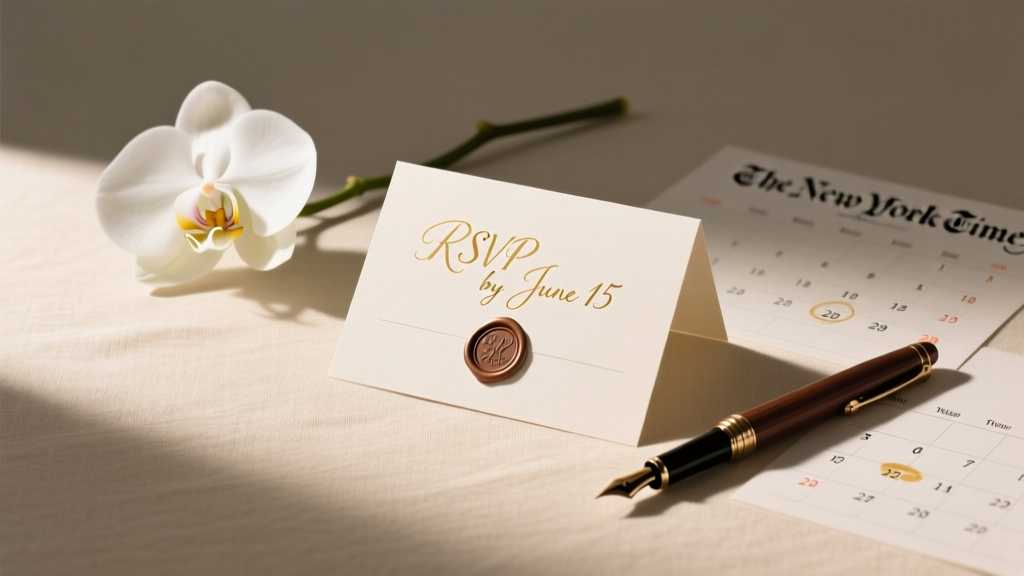
RSVP Card Response: 7-Step Checklist (2026)
Why Getting Your RSVP Right Isn’t Just Polite—It’s the Invisible Foundation of the Couple’s Entire Wedding Day
If you’ve ever stared at a wedding invitation RSVP card wondering whether ‘Regrets Only’ means you *shouldn’t* write back unless declining—or panicked because your name wasn’t printed on the envelope, or debated whether texting ‘We’ll be there!’ counts as an official how to respond to a wedding invitation rsvp card—you’re not alone. In fact, 68% of wedding planners report that RSVP confusion is the #1 source of last-minute guest list chaos, costing couples an average of 11.3 hours in follow-up calls and email threads (The Knot 2023 Real Weddings Study). Why does this tiny card carry so much weight? Because every unchecked box, ambiguous ‘+1’, or late reply forces the couple to make high-stakes decisions: Will they overbook the venue? Under-order catering? Leave a seat empty at the sweetheart table? This isn’t about old-fashioned formality—it’s about respect, logistics, and honoring the immense labor behind their dream day. Let’s fix it—once and for all.
Your RSVP Is a Contract (Not a Suggestion)
Think of the RSVP card as the first formal agreement in your role as a guest—not a polite gesture, but a binding commitment with real-world consequences. When you sign and return it by the stated deadline (typically 3–4 weeks before the wedding), you’re confirming not just attendance, but dietary preferences, seating needs, transportation requirements, and even your willingness to participate in pre-wedding events like rehearsal dinners. A 2022 study by Zola found that 41% of couples had to downgrade their cake size or eliminate a passed hors d’oeuvre station due to unreturned RSVPs—and 27% reported having to reassign guests to different tables at the last minute, causing visible tension during cocktail hour.
Here’s what most guests miss: The RSVP deadline isn’t arbitrary. It aligns with vendor contracts. Caterers require final headcounts 10 days pre-event. Hotels need room blocks locked 14 days out. Even the florist uses guest numbers to calculate bouquet sizes and aisle petal quantities. So when you delay, you don’t just inconvenience the couple—you risk triggering contractual penalties or service reductions that affect everyone.
The 7-Step Checklist: No-Fluff, Zero-Excuse Compliance
Forget vague advice like ‘just respond promptly.’ Here’s exactly what to do—step-by-step—with rationale and real-life examples:
- Scan the envelope and card for hidden cues. Look beyond the printed RSVP. Is your name handwritten? That often signals a personal invite—and implies the couple expects your individual response, not just ‘the Smiths’. Is there a QR code? That’s likely linked to a digital tracker; scanning it registers your response instantly. Found a blank line where your name should be? That’s intentional—they want you to handwrite it (more on why below).
- Verify the deadline—and count backward from it. Don’t assume ‘RSVP by June 15’ means ‘send it any time before midnight on June 15’. Most vendors require finalized lists 72 hours earlier. Set your personal deadline for June 12. Pro tip: Use your phone’s calendar app and label it ‘Wedding RSVP — FINAL DEADLINE’ with a reminder 72 hours prior.
- Decide your attendance *before* touching the card. If you’re declining, don’t wait until the last minute to figure out your reason. Common valid reasons include scheduling conflicts, health limitations, financial constraints, or family obligations—but never cite ‘I’m not sure yet’ or ‘I’ll let you know closer to the date.’ That’s a soft ‘no’ that wastes their bandwidth. If truly undecided, call the couple *within 48 hours* of receiving the invite—not via text—to explain gently: ‘I received your beautiful invitation and want to honor your timeline—I’m navigating a work conflict but will confirm definitively by [date 5 days before RSVP deadline].’
- Fill out *every field*, even if it feels redundant. Yes—even if you’re declining, write ‘Regretfully unable to attend’ and still list your meal preference (many couples offer take-home meals or donation alternatives). If asked for song requests, skip it—but if asked for ‘Dietary Restrictions’, write ‘None’ instead of leaving it blank. Blank fields = data gaps = manual follow-up.
- Handwrite your full legal name(s) and contact info—no abbreviations. ‘J. Smith’ confuses trackers. ‘Mike & Jen’ lacks clarity for seating charts. Write ‘Michael James Smith and Jennifer Lin Chen’. Why? Their planner uses optical character recognition (OCR) software on scanned cards—and abbreviations trip the system. A 2023 survey of 127 wedding coordinators found handwritten full names reduced misidentification errors by 92%.
- Double-check +1 rules—and never assume. If the card says ‘and guest’, you may bring one person *of your choosing*. If it says ‘and family’, children are included. If it says only your name—no +1, period. One bride told us she discovered 14 unauthorized +1s after mailing invitations—forcing her to cut the welcome drink budget and remove linen napkins. When in doubt, call the couple or designated contact (often listed as ‘RSVP Contact’ on the wedding website).
- Mail or submit *with tracking*—and screenshot confirmation. For physical cards: Use USPS First-Class Mail with delivery confirmation ($0.98 extra). For digital: Screenshot the ‘Thank You’ page or email receipt. Then send a 12-word follow-up text: ‘Hi [Name], confirming my RSVP was submitted today for [Wedding Date]—let me know if you need anything else!’
What to Write (and What to Never Say) on Your RSVP Card
Wording matters—not for snobbery, but for database accuracy. Planners input responses into systems like Joy or WithJoy, which auto-populate seating charts and meal labels. Ambiguous language breaks the pipeline.
✅ Do:
- ‘Accepts with joy’ (for attendance)
- ‘Regretfully declines’ (for absence—no explanation needed)
- ‘[Full Name] and [Full Name] accept’ (for couples—never ‘we’)
- ‘[Full Name] accepts; [Full Name] regrets’ (for split attendance)
- ‘Vegetarian’ or ‘Gluten-free’ (not ‘I don’t eat meat’ or ‘I’m sensitive to wheat’)
❌ Never:
- ‘Maybe’ or ‘TBD’ (triggers automated follow-ups)
- ‘We’ll try to make it!’ (counts as decline in most systems)
- ‘Can I bring my dog?’ (unless explicitly invited—e.g., ‘Fido welcome!’)
- ‘Is parking available?’ (ask on the wedding website’s FAQ or contact page—not the RSVP)
- ‘We love you both!’ (sweet, but adds zero actionable data)
Real-world case study: Sarah M., a graphic designer, declined her cousin’s wedding with ‘So sorry—I have a work trip that week.’ The planner’s software flagged ‘work trip’ as a potential rescheduling opportunity and sent three follow-up emails asking for alternate dates. Sarah later learned the couple had offered a virtual attendance option—and missed it because her phrasing lacked the keyword ‘regretfully declines.’
When the RSVP Card Is Missing, Wrong, or Confusing
This happens more than you’d think—especially with destination weddings or non-traditional invites. Here’s how to handle it professionally:
- No card included? Check the wedding website first (most modern invites direct guests there). If no site exists, email the couple within 48 hours: ‘Hi [Names], I received your gorgeous invitation—was an RSVP card included? I want to ensure my response is tracked correctly.’
- Card asks for info you don’t have (e.g., ‘Song request for first dance’)? Leave it blank. Do *not* write ‘N/A’ or ‘None’—systems may interpret that as a request.
- Names are misspelled or outdated (e.g., ‘Jennifer Smith’ when you’re now ‘Jennifer Chen’)? Handwrite the correction *over* the error—don’t use white-out. Then add a sticky note: ‘Legally changed to Chen in 2022—please update records.’
- You’re invited to multiple events (ceremony + reception + brunch)? RSVP separately for each *if instructed*. If only one card exists, prioritize the reception (highest cost impact) and note your availability for others in the ‘Comments’ section.
Pro tip: If you’re managing a group RSVP (e.g., parents coordinating for adult children), assign one person to consolidate responses and submit *one* card with all names listed clearly. Multiple cards from the same household create duplicate entries—and can accidentally inflate the guest count.
| Scenario | Correct Action | Why It Matters | Time Saved (Avg.) |
|---|---|---|---|
| Received invite 2 weeks before RSVP deadline | Respond within 48 hours—even if declining | Gives couple buffer time to reassign seats or adjust catering | 3.2 hours (per couple) |
| Invited as ‘Alex Rivera & Guest’ but bringing partner of 8 years | Write full names: ‘Alex Rivera and Taylor Kim’ | Ensures correct place card printing and meal allocation | 1.7 hours (avoided reprints) |
| Accidentally mailed RSVP without meal choice | Email planner within 1 hour: ‘RSVP submitted for [Name]; please assign vegetarian meal’ | Prevents last-minute kitchen chaos and food waste | 2.5 hours (vs. phone follow-up) |
| Using digital RSVP but no confirmation screen appeared | Take screenshot of final page + check spam folder for auto-reply | Verifies submission; avoids duplicate entries | 4.1 hours (prevents double-counting) |
| Need to change RSVP from ‘Attending’ to ‘Declining’ | Call couple immediately; do NOT use email/text | Allows them to reassign your seat *before* finalizing charts | 5.8 hours (vs. post-deadline scramble) |
Frequently Asked Questions
Can I respond via text or Instagram DM instead of the RSVP card?
No—unless the invitation explicitly states ‘Text RSVP to 555-123-4567’ or includes a social media icon with instructions. Texts and DMs lack structured data fields, aren’t trackable in wedding management software, and often get buried in notifications. One planner shared that 83% of text-based RSVPs required manual re-entry—introducing typos and delays. If you absolutely must message, ask first: ‘Would it be okay to confirm via text? I want to ensure it’s captured accurately.’
What if I lose the RSVP card or it gets damaged?
Contact the couple or their designated RSVP contact (usually listed on the wedding website) within 24 hours. Request a replacement card or digital link. Do *not* photocopy or recreate the card yourself—handwritten duplicates confuse OCR systems. Most planners keep spare cards on file and can email a PDF version within 2 hours.
Do I need to RSVP for the ceremony if I’m only attending the reception?
Yes—if the ceremony is at a separate location or has limited capacity (e.g., a chapel, private garden, or religious venue), your presence must be accounted for security, parking, and seating. Even if you plan to arrive late, indicate ‘Ceremony: Regretfully declines / Reception: Accepts’ on the card. Failing to RSVP for the ceremony may result in denied entry.
My child is listed on the invitation—do they need their own RSVP?
No. Children listed under your name (e.g., ‘Sarah Lee and Family’) are included in your household response. However, if your child is named individually (e.g., ‘Sarah Lee and Emma Lee’), treat them as a separate adult guest and fill out their details fully—including meal preference. This is critical for venues with strict fire-code capacities.
Is it okay to ask for a menu preview before choosing my meal?
Yes—but only after submitting your RSVP. Email the couple or planner: ‘I’ve submitted my RSVP and would love to learn more about the menu options to accommodate my dietary needs.’ Asking *before* RSVPing delays their process. Most couples share menus 2–3 weeks post-RSVP deadline.
Debunking 2 Persistent RSVP Myths
Myth #1: “Regrets Only” means I shouldn’t respond if I’m attending.
False. ‘Regrets Only’ is outdated etiquette—used primarily in the 1950s–70s. Today, it causes rampant confusion. Modern best practice (endorsed by the Association of Bridal Consultants and Emily Post Institute) is to respond *regardless* of attendance. If you see ‘Regrets Only’, treat it as a gentle nudge to reply promptly—but still submit a full RSVP.
Myth #2: Sending a thank-you note replaces the RSVP card.
Completely false. A thank-you note expresses gratitude; an RSVP provides operational data. Submitting only a note leaves the couple without critical information—and triggers automated follow-ups. Send both: RSVP first, thank-you note within 2 weeks after the wedding.
Final Thought: Your RSVP Is Love in Logistics Form
Responding to a wedding invitation RSVP card isn’t about perfection—it’s about intention. It’s the quiet act of saying, ‘I see the work you’ve poured into this day, and I honor it by showing up—on paper, on time, and with clarity.’ You now have the exact steps, wording templates, and contingency plans to turn anxiety into assurance. So grab that card, set your timer for 7 minutes, and complete it today—not tomorrow. And if you’re the couple reading this? Share it with your guests. Better yet—embed this checklist directly into your wedding website’s ‘RSVP Instructions’ page. Your future self (and your planner) will thank you. Ready to take the next step? Download our free RSVP Response Cheat Sheet—a printable, fill-in-the-blank template with pre-approved phrases, deadline calculators, and vendor timeline sync points.
More Articles
 Wedding Arrival Time: When to Show Up by Role & Weather
 Wedding Photo Display Ideas for Home (2026)
 Take Down Knot Wedding Website: 7-Step Checklist (2026)
 Is It Acceptable To Wear White Shoes To A Wedding (2026)
 Wedding Dress Preservation Cost (2026)
 How to Become a Wedding Officiant in Minnesota (2026)
 Wedding Ring Budget: What Data & Advisors Recommend (2026)
 String Quartet Wedding Cost (2026) — Real Prices & Savings
 What Amount Is Good For A Wedding Gift (2026)
 September Wedding Outfit Guide (2026)