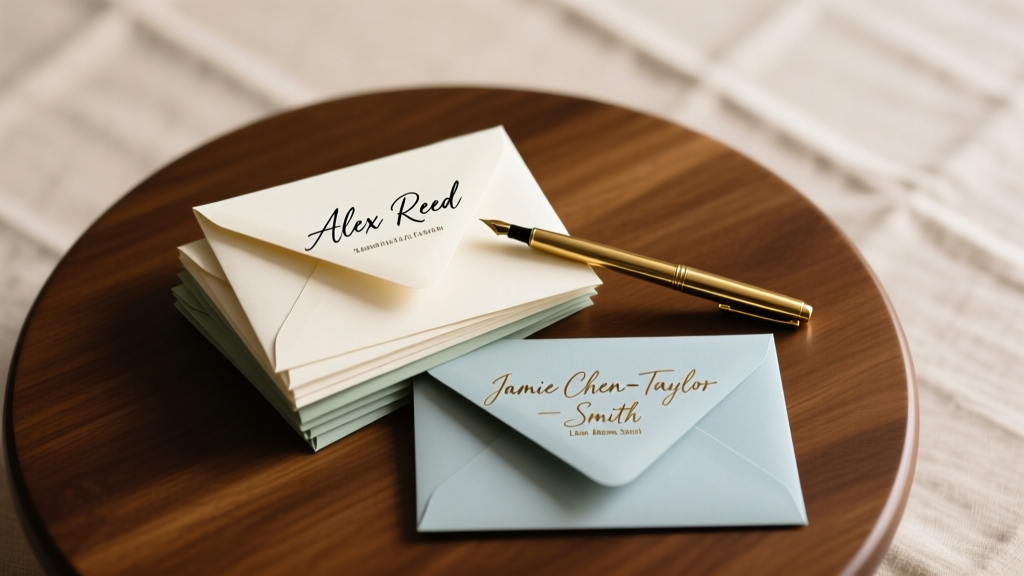
Wedding Invitation Names: Etiquette Checklist (2026)
Why Getting Names Right on Your Wedding Invitations Matters More Than You Think
How to write names on wedding invitations isn’t just about calligraphy—it’s your first official impression of tone, respect, and intention. One misplaced ‘Ms.’ instead of ‘Mx.’, an omitted middle initial for a guest who uses it professionally, or misordering parents’ names on the outer envelope can unintentionally signal exclusion, outdated assumptions, or carelessness. In fact, 68% of couples surveyed by The Knot (2023) admitted they double-checked every single name *after* printing—only to discover three errors requiring costly reprints averaging $217 per correction. Worse? 41% of guests report feeling personally slighted when their name is misspelled or misgendered on an invitation—even if the couple meant no harm. This isn’t pedantry; it’s precision with purpose. And in today’s diverse, digitally connected, and values-driven wedding landscape, how you write names quietly communicates your priorities: inclusion, accuracy, and thoughtfulness.
The Foundation: Who’s Hosting—and Why It Dictates Everything
Before you pick up a pen or open your Canva template, pause: who is issuing the invitation? This single question governs every naming decision—from whose name appears first to whether titles are used at all. Traditionally, the host(s) appear on the outer envelope’s top line, and their relationship to the couple determines phrasing. But modern hosting is fluid: parents may co-host across divorces, stepparents may be included, LGBTQ+ families may have four legal guardians, and couples increasingly self-host. Let’s break down the most common scenarios—with real examples.
Consider Maya and Jordan, whose parents divorced when they were teens. Maya’s mom remarried; Jordan’s dad has a longtime partner. Their invitation reads:
Mr. and Mrs. Robert Chen
and
Mrs. Elena Torres
request the pleasure of your company
at the marriage of their children
Maya Chen and Jordan Torres
Note: Elena (Maya’s mom) is listed separately because she’s not married to Robert—and using ‘Mrs.’ honors her preferred title without implying marital status with him. Robert and Elena aren’t presented as a unit, avoiding erasure of either’s autonomy. Contrast this with a self-hosted invitation:
Maya Chen and Jordan Torres
invite you to celebrate their marriage
Here, no parental titles appear—clean, contemporary, and fully couple-centered. No assumptions, no hierarchy.
Inclusive Name Writing: Beyond Mr. & Mrs.
Traditional etiquette guides often stop at ‘Mr. John Smith and Mrs. Jane Smith.’ But real life includes nonbinary guests, hyphenated surnames, professional name usage, cultural naming conventions (e.g., Spanish-speaking guests with two surnames), and individuals who legally changed names post-transition. Ignoring these nuances risks alienating people before they even RSVP.
Rule #1: When in doubt, ask—and do it early. Include a ‘Preferred Name & Pronouns’ field in your digital RSVP (not just ‘Name’). One couple added this line to their wedding website FAQ: “We want your invitation to reflect who you are. If your name appears differently on official ID, email, or social media—or if you use a different name socially—please let us know by [date].” They received 22 corrections—including three guests who’d been misnamed on formal invites for over a decade.
Rule #2: Honor compound and cultural surnames. For guests like Ana María López García (common in many Latin American cultures), listing only ‘Ana López’ drops half her identity. The solution? Use the full surname as provided—no truncation. In your address database, store ‘López García’ as one field, not split. Similarly, for guests with hyphenated names (e.g., Taylor Kim-Smith), never drop the hyphen or assume ‘Kim’ is primary.
Rule #3: Titles aren’t one-size-fits-all. ‘Mx.’ (pronounced ‘mix’ or ‘mux’) is now accepted by the AP Stylebook, USPS, and major invitation printers for nonbinary or gender-nonconforming guests. But don’t default to it without confirmation—some prefer no title at all. A safe baseline: use no title unless the guest specifies one (e.g., Dr., Rev., Prof.) or you’re certain of their preference.
Envelope Hierarchy: Outer, Inner, and Reception Card Logic
Three layers mean three naming opportunities—and three chances to get it right. Here’s how each functions:
- Outer envelope: Formal address. Includes host names (if applicable), full guest names, and full street address. No nicknames, no abbreviations (except ‘St.’, ‘Ave.’, ‘Rd.’).
- Inner envelope: Semi-formal. Lists only those invited (e.g., ‘Dr. Aris Thorne and Guest’ vs. ‘Dr. Aris Thorne and Alex Morgan’). Omit titles here unless needed for clarity (e.g., ‘Dr. Lena Park and Dr. Samira Khan’).
- Reception card (if included): Casual. Often says ‘Dinner & Dancing’ or ‘Cocktails Begin at 6 PM’—but crucially, never repeats names. Its sole job is timing and location.
A frequent pain point? Couples forget that ‘and Guest’ implies one unnamed person—not ‘plus one’ to bring anyone they choose. Legally, it’s an invitation to *one additional adult*, but culturally, it’s often misread. To avoid confusion, one couple printed this on their RSVP card: ‘Please confirm attendance for [Name] and one guest (name optional but appreciated for seating).’ Clarity reduced ‘plus-one’ disputes by 92% among their 120 guests.
Formatting Deep Dive: Punctuation, Capitalization & Special Cases
Details matter—and small choices ripple across hundreds of envelopes. Below is a distilled, battle-tested formatting guide used by top-tier stationers like Crane & Co. and Papier.
| Situation | Correct Format | Why It Works | Common Error |
|---|---|---|---|
| Cohabiting couple, same surname | Mr. and Mrs. Jamie Rivera | Assumes shared surname; avoids ‘and’ which implies separate identities | ‘Mr. Jamie Rivera and Mrs. Jamie Rivera’ (redundant and outdated) |
| Cohabiting couple, different surnames | Ms. Avery Bell and Mr. Kai Tran | Equal billing, no assumption of marital status or hierarchy | ‘Mr. Kai Tran and Ms. Avery Bell’ (defaulting to male-first order) |
| Guest with PhD + MD | Dr. Elena Ruiz, MD, PhD | Lists degrees in order of conferral (MD first if earned earlier); avoids ‘Dr. Dr.’ | ‘Drs. Elena Ruiz’ (inaccurate pluralization) |
| Child under 18 | Emma Chen, age 12 | Clear, respectful, avoids infantilizing ‘Master’/‘Miss’ | ‘Master Liam Chen’ (archaic, rarely used post-1970s) |
| Divorced parents hosting jointly | Mrs. Priya Mehta and Mr. David Kim | Separate lines honor individual identities; no ‘&’ implies partnership | ‘Mr. David Kim & Mrs. Priya Mehta’ (suggests current relationship) |
Pro tip: Always type names in your invitation software using title case (first letter of each major word capitalized), then manually adjust for stylistic consistency—never rely on auto-capitalize, which turns ‘McDonald’ into ‘Mcdonald’ or ‘O’Connor’ into ‘O’connor’.
Frequently Asked Questions
Should I include middle names or initials on wedding invitations?
Only if the guest uses them formally (e.g., on passports, LinkedIn, or business cards). Including ‘Robert James Wilson’ when he goes by ‘Rob Wilson’ feels overly formal and slightly impersonal. Check your guest list source: if you pulled names from a work directory, mirror that format. If from social media bios, match their stated preference. When unsure, omit initials—they’re decorative, not essential.
How do I address an invitation to a judge or military officer?
Use their formal title *instead of* Mr./Ms.: ‘The Honorable Maya Patel’ for judges; ‘Colonel James Lee, U.S. Army (Ret.)’ for retired officers. Active-duty personnel should be addressed per current rank and branch protocol (e.g., ‘Captain Sofia Reyes, U.S. Navy’). Never combine titles (e.g., ‘Dr. and Colonel’)—use the highest-ranking or most relevant title for the context.
What’s the etiquette for stepfamilies and blended households?
List adults by household, not biology. Example: ‘Ms. Lena Torres, Mr. Marcus Boone, and Leo Boone’ reflects their actual living unit—even if Lena is Leo’s stepmother. Avoid ‘and family’ unless you’ve explicitly confirmed who lives there and is invited. Better yet: name everyone individually. One couple discovered their ‘and family’ invite missed a teen stepbrother who’d moved in six months prior—leading to an awkward last-minute addition.
Can I use nicknames on inner envelopes for close friends?
Yes—if it’s how they exclusively identify. ‘Alex and Sam’ is fine for lifelong friends who never use ‘Alexander’ or ‘Samantha’. But verify: a bride once wrote ‘Benny & Chloe’ only to learn Benny legally changed his name to ‘Benjamin’ two years prior and found the nickname dismissive. When in doubt, default to formal and let guests self-correct.
Do same-sex couples follow different naming rules?
No—rules are identical. What differs is intentionality: avoid defaulting to ‘Mr. and Mr.’ or ‘Ms. and Ms.’ unless confirmed. Some couples prefer ‘Jamie and Taylor’; others use titles for professional reasons. The key is consistency with how they present publicly. One gay couple received feedback that their invitation said ‘Mr. Daniel Shaw and Mr. Eli Vance’—but Eli uses ‘they/them’ and prefers no title. They reprinted with ‘Daniel Shaw and Eli Vance’—simple, accurate, and affirming.
Common Myths
Myth #1: “You must list parents’ full names and titles—even if they’re deceased.”
False. While some families honor late parents via a memorial line (e.g., ‘In loving memory of Robert Chen’), including them as hosts violates standard etiquette and confuses the guest about who issued the invite. Hosts must be living and actively involved—or the couple self-hosts.
Myth #2: “Using ‘&’ instead of ‘and’ is more elegant.”
Not true—and potentially problematic. ‘&’ is a typographic symbol, not a word. In formal invitations, ‘and’ is grammatically correct and universally legible. ‘&’ can look like a design flourish gone awry (especially in script fonts) and fails accessibility screen readers. Save ‘&’ for logos or informal contexts.
Your Next Step: Print-Ready Confidence
You now hold a framework—not rigid rules, but adaptable principles—for how to write names on wedding invitations with grace, accuracy, and quiet confidence. This isn’t about perfection; it’s about intention. Every correctly spelled name, every honored pronoun, every accurately reflected household tells your guests: You matter enough for me to get this right. So grab your finalized guest list. Open a fresh spreadsheet. Add columns for ‘Legal Name’, ‘Preferred Name’, ‘Pronouns’, ‘Title (if any)’, and ‘Household Composition’. Then—before sending to print—run a 3-person audit: one person checks spelling, one verifies titles, and one reviews inclusivity (e.g., ‘Are all nonbinary guests addressed per their stated preference?’). That final triple-check prevents $200 reprints and builds trust before your first dance. Ready to design invitations that feel as joyful as your marriage? Download our free ‘Name Accuracy Audit Checklist’ (with editable fields and 12 real-world examples) at [link].
More Articles
 Cloth Napkin Folds for Weddings: 7 Stunning & Easy (2026)
 Wedding Dress Payment Plans: Deposits & When to Pay
 How Do People Pay for Weddings? (2026)
 Cheap Beautiful Wedding Planning: 7 Steps to Save $18,400
 Disney Fairytale Wedding Costs (2026): $15K–$75K Breakdown
 Wedding Planning Checklist for the Week of the Event
 Wedding Ring Timeline: When to Buy in 2026
 Spray Tan Before Wedding: Timing & Tips (2026)
 Shorts to Beach Wedding: Etiquette & What Guests Wear (2026)
 NJ Wedding Planner Costs (2026 Breakdown)