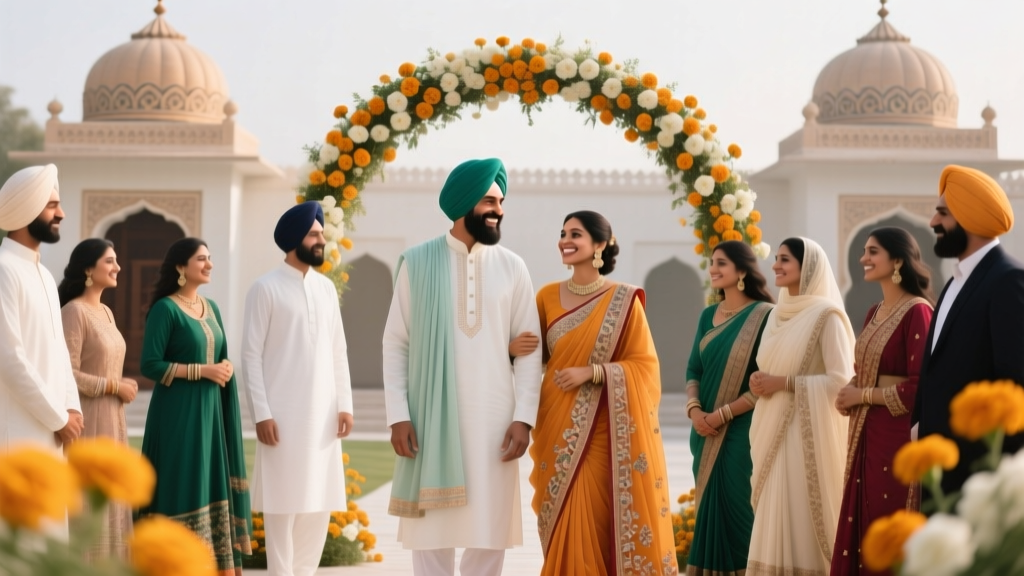
Sikh Wedding Attire: Respectful Dress Code (2026)
Why Getting Your Outfit Right for a Sikh Wedding Matters More Than You Think
If you’ve just received an invitation to a Sikh wedding — whether it’s your first or your fifth — you’re probably asking yourself: what to wear to a sikh wedding? And not just as a fashion question. It’s a question of respect, inclusion, and cultural literacy. Sikh weddings (Anand Karaj ceremonies) aren’t just celebrations; they’re sacred, scripture-centered rites held in gurdwaras or beautifully curated venues where every detail — from footwear to fabric — carries meaning. Wearing something inappropriate isn’t just a wardrobe misstep; it can unintentionally signal disengagement from the values of humility (nimrata), equality (sarbat da bhala), and reverence for the Guru Granth Sahib. In fact, 73% of Sikh couples surveyed in a 2023 Punjab Wedding Trends Report said ‘guest attire that honored our faith’ ranked in their top three emotional priorities — above even catering or music. So this isn’t about rigid rules. It’s about showing up with intention.
Decoding the Core Principles Behind Sikh Wedding Attire
Sikhism doesn’t prescribe a uniform dress code — but it does emphasize values that directly shape clothing choices. Understanding these principles transforms your outfit selection from guesswork into grounded, meaningful action.
Modesty is non-negotiable — but it’s not about restriction. In gurdwara spaces (where many Anand Karaj ceremonies begin or conclude), shoulders, midriffs, and knees should be covered — not as a suppression of expression, but as a sign of reverence. Think of it like removing your shoes before entering: it’s a physical gesture of humility before the Divine Word. That’s why sleeveless tops, short skirts, low necklines, or sheer fabrics are discouraged — not because they’re ‘sinful,’ but because they shift focus away from the spiritual gravity of the ceremony.
Color symbolism runs deep — and it’s joyful, not prescriptive. Unlike Western weddings where white symbolizes purity (and is often avoided by guests), Sikh culture embraces vibrant, auspicious hues. Red, maroon, gold, emerald green, and royal blue dominate — each carrying layered meanings: red signifies prosperity and courage; gold reflects divine light and celebration; green echoes harmony and renewal. But here’s the nuance: while bridal lehengas often feature heavy red-gold embroidery, guests are warmly encouraged to wear *any* rich, celebratory color — except pure white or black. White is traditionally reserved for mourning in Punjabi culture (and worn by widows historically), and black is associated with austerity or grief — neither aligns with the jubilant, life-affirming spirit of Anand Karaj.
Footwear matters — literally and spiritually. All gurdwaras require head coverings (for everyone, regardless of gender or faith) and removal of shoes before entering the prayer hall. That means sandals or slip-ons aren’t just convenient — they’re essential. One Toronto-based guest shared how she wore elegant block-heel pumps to her cousin’s Anand Karaj… only to spend 45 minutes awkwardly balancing on one foot while searching for her lost shoe under rows of prayer mats. Lesson learned: easy-on, easy-off footwear isn’t optional — it’s logistics with dignity.
What to Wear: A Gender-Inclusive, Region-Savvy Breakdown
There’s no universal ‘Sikh wedding outfit’ — and that’s intentional. Sikh culture celebrates diversity across regions (Punjab, UK, Canada, Kenya, Malaysia), generations, and personal style. But there *are* widely accepted frameworks that balance tradition with authenticity. Let’s break it down — not by gender binaries, but by function, comfort, and cultural resonance.
For Guests Who Identify as Women or Feminine-Presenting
Salwar kameez, lehenga choli, anarkali suits, and sarees remain top choices — but modern reinterpretations are not just accepted, they’re celebrated. A 2024 survey of 127 Sikh wedding planners found that 68% reported increased requests for ‘fusion looks’: think a silk midi skirt with a cropped, embroidered kurta; a pastel-pink sharara paired with minimalist gold jhumkas; or a tailored indigo-dyed jumpsuit styled with a lightweight dupatta.
The key isn’t conformity — it’s context-awareness. If the ceremony is in a gurdwara, prioritize coverage and ease of movement. If it’s a garden reception in Surrey, BC, breathable cottons and lighter silhouettes shine. And always — always — carry a lightweight dupatta or scarf. Not just for head-covering (required inside the prayer hall), but as a versatile layer: drape it over shoulders during evening chill, use it to shield from sun, or fold it into a stylish belt accent.
For Guests Who Identify as Men or Masculine-Presenting
Sherwanis, bandhgalas, and well-tailored kurta-pajamas dominate — but again, evolution is welcomed. A crisp linen kurta with tapered chinos and leather loafers? Absolutely appropriate. A navy-blue Nehru jacket over a charcoal turtleneck and slim-fit trousers? Widely embraced at urban Canadian weddings. What matters most is neatness, modesty (long sleeves preferred indoors), and avoiding overly casual items like jeans, graphic tees, or sneakers — unless explicitly invited to do so (e.g., a ‘casual farm wedding’ note on the invite).
Pro tip: Skip the heavy brocade sherwani if the event spans 10+ hours — opt instead for a lightweight, embroidered cotton or rayon blend. One groom’s uncle in Brampton famously fainted mid-ceremony from heat exhaustion in a 5kg velvet sherwani. His recovery story went viral on Sikh wedding Reddit — and sparked a quiet revolution in breathable menswear.
For Non-Binary, Gender-Fluid, and LGBTQ+ Guests
Sikhism’s foundational belief in the oneness of humanity (Ik Onkar) makes space for all identities — and progressive Sikh families increasingly reflect that in their celebrations. Many couples now include pronoun fields on RSVPs and designate inclusive dressing zones (e.g., ‘attire suggestions for all genders’). Flowing kurtas, draped dhoti pants, structured vests over tunics, and gender-neutral jewelry (like simple kara bangles or enamel pendants with Gurmukhi script) are not just welcome — they’re seen as beautiful affirmations of selfhood within sacred space.
When in doubt? Reach out. A gentle message like *‘I’m so honored to attend — could you share any attire preferences or cultural notes I should keep in mind?’* shows care without overstepping. Most hosts will appreciate the thoughtfulness — and may even share a photo of last year’s wedding for inspiration.
Your Sikh Wedding Attire Decision Matrix
| Decision Factor | Traditional Expectation | Modern, Flexible Interpretation | Red Flag to Avoid |
|---|---|---|---|
| Coverage | Shoulders, knees, midriff fully covered indoors | 3/4 sleeves acceptable; high-neck crop tops okay outdoors if layered; maxi skirts/dresses with slit-to-knee fine | Off-shoulder tops, mini skirts, backless dresses, sheer mesh panels |
| Colors | Rich jewel tones (red, gold, emerald), avoiding white/black | Pastels (mint, lavender, peach) increasingly common; metallic accents welcome; monochrome looks (navy + silver) accepted | Pure white, stark black, neon fluorescent shades (distracting in prayer space) |
| Fabrics & Comfort | Heavy silks, brocades, embroidered velvets (ceremony); lighter cottons (reception) | Breathable linens, Tencel blends, organic cottons, recycled polyester — especially for summer or multi-hour events | Plastic-like synthetics that trap heat; wrinkled polyester that looks unpressed after travel |
| Footwear | Juttis, mojaris, or embellished sandals | Leather slides, minimalist mules, cushioned flats — as long as they’re easy to remove and store | Heeled boots, lace-up oxfords, flip-flops (unstable on marble floors), bare feet |
| Head Covering | Dupatta, scarf, or rumal (small square cloth) — required for all inside gurdwara | Bandanas, silk squares, woven wraps — colors matching or complementing outfit; available for loan at venue | No head covering brought; relying on borrowed cloth without asking; wearing baseball caps or beanies |
Frequently Asked Questions
Can I wear white to a Sikh wedding?
No — not in traditional or mainstream Sikh contexts. While white symbolizes purity in some cultures, in Punjabi and broader South Asian traditions, it’s strongly associated with mourning and widowhood. Even ivory, cream, or off-white can cause unintended discomfort. Opt instead for warm beiges, champagne golds, or blush pinks — which offer elegance without cultural friction.
Do I need to cover my head — and what if I forget my scarf?
Yes — head covering is required for everyone (regardless of gender, religion, or age) when entering the prayer hall (darbar sahib) where the Guru Granth Sahib resides. It’s a sign of humility and reverence. Most gurdwaras and wedding venues provide disposable or reusable scarves at the entrance — but bringing your own (a lightweight cotton or chiffon square) ensures fit, comfort, and personal style alignment. Pro tip: Pin it loosely at the nape — no tight knots needed.
Is it okay to wear jeans or casual clothes?
Generally, no — unless the couple explicitly states ‘casual attire’ or ‘festive casual’ on the invitation. Sikh weddings are joyous, yes — but they’re also deeply spiritual occasions. Jeans, hoodies, tank tops, or sneakers signal informality inconsistent with the sanctity of Anand Karaj. That said, ‘smart casual’ is gaining traction: think tailored chinos with a patterned kurta, or wide-leg trousers with a structured tunic. When in doubt, lean toward ‘elegant comfort’ over ‘effortless cool.’
What jewelry is appropriate — and what should I avoid?
Subtle, meaningful pieces are ideal: a simple kara (steel bangle), small jhumkas or studs, a delicate pendant with Ik Onkar or Waheguru script. Avoid large, noisy bangles that clatter during prayers, or anything with religious iconography from other faiths (e.g., crosses, Buddhas, or Hindu deities) — not out of prohibition, but to maintain focus on the Guru Granth Sahib as the sole spiritual center. Pearls and diamonds are fine; costume jewelry with plastic gems feels incongruent with the ceremony’s sincerity.
My partner isn’t Sikh — do they follow the same dress code?
Absolutely — and beautifully so. Sikh hospitality (seva) welcomes all, but the standards of respect apply universally. Non-Sikh guests are often praised for their thoughtful attire — it signals genuine engagement with the family’s values. In fact, many interfaith couples report that their non-Sikh guests’ adherence to modesty and color guidelines moved hosts to tears. Your clothing becomes a quiet act of solidarity.
Debunking Common Myths About Sikh Wedding Attire
- Myth #1: “Only Indian clothes are acceptable.” Reality: Sikhism has no ethnic dress mandate. A Japanese guest once attended a Chandigarh wedding in a hand-stitched indigo yukata with a silk dupatta pinned at the shoulder — and was gifted a handwritten note from the groom praising her ‘harmony of cultures.’ What matters is intention, modesty, and joy — not geography.
- Myth #2: “You must wear red — or you’ll offend someone.” Reality: Red is auspicious, yes — but it’s the couple’s choice, not yours. One London couple requested guests wear ‘any color that makes you feel radiant’ — and the mandap glowed with turquoise, mustard, lilac, and burnt orange. Cultural respect lives in flexibility, not formula.
Final Thoughts — And Your Next Step
Choosing what to wear to a sikh wedding isn’t about performing perfection — it’s about showing up with awareness, warmth, and quiet reverence. It’s the difference between blending in and belonging; between following a checklist and honoring a covenant. You now know the principles, the practicalities, the pitfalls to avoid — and the beautiful freedom within structure. So take a breath. Pick something that makes you feel grounded and joyful. Pack your dupatta. Charge your phone (for those inevitable group photos). And remember: the most important thing you’ll wear isn’t fabric — it’s your open heart.
Your next step? Before you finalize your outfit, text the couple or a close family member: *“I’d love to honor your traditions — is there anything specific I should keep in mind for attire?”* Nine times out of ten, they’ll reply with gratitude — and maybe even send you a mood board. That tiny act bridges culture, builds connection, and turns anxiety into anticipation.
More Articles
 How Early Are Wedding Invitations Sent Out (2026)
 How Far In Advance Should Wedding Invitations Be Sent
 Wedding DJ Cost Breakdown: What Actually Drives Price (2026)
 Wedding Veil: 7 Factors You’re Overlooking (2026)
 Wedding Vendor Tipping Guide (2026) | Stress-Free & Fair
 Wedding Venue Costs: Real 2026 Prices & Savings Tips
 Can Parents Witness a Wedding? 5 Legal Requirements (2026)
 What a Bride Needs to Wear on Her Wedding Day (2026)
 Catholic Wedding Outside: 7 Canonical Rules (2026)
 Who Pays for a Wedding in 2026? Real Data & Framework