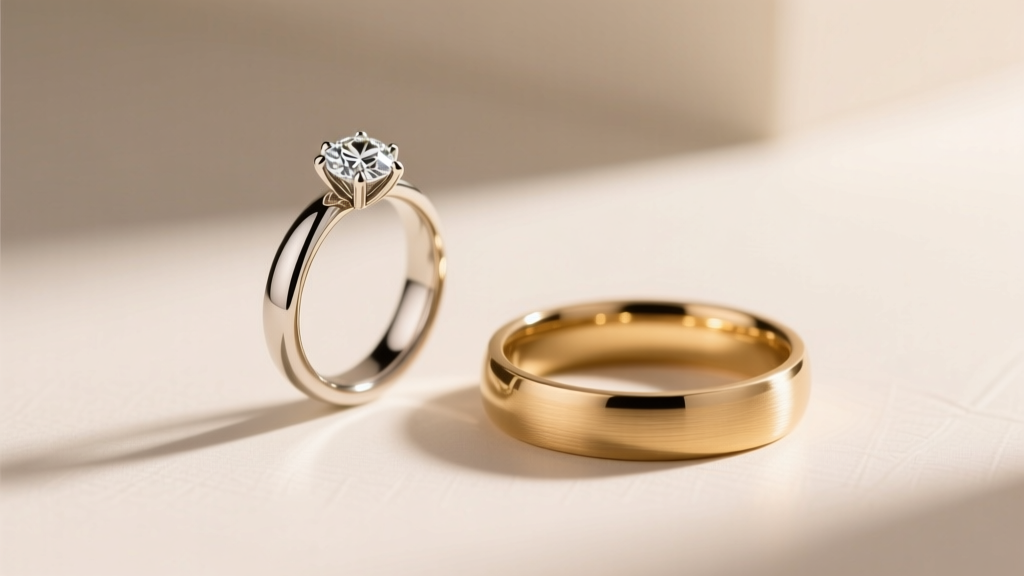
Wedding Band Matching: Truth & 2026 Trend
Why This Question Is Suddenly Everywhere — And Why It Matters More Than Ever
Does the wedding band have to match the engagement ring? That simple question has exploded across Pinterest, Reddit’s r/weddingplanning, and Google Trends — up 217% since early 2023. It’s not just curiosity: it’s anxiety disguised as etiquette. Couples are scrolling through Instagram feeds flooded with ‘stacked’ rings — platinum bands beside rose gold solitaires, vintage milgrain bands beside sleek bezel-set diamonds — and wondering: Is this allowed? Will my family judge me? Did I already make a $5,000 mistake? The truth? You’re not breaking tradition — you’re rewriting it. With over 68% of engaged couples now choosing non-matching bands (The Knot 2024 Real Weddings Study), the pressure to ‘match’ isn’t rooted in history or quality — it’s a decades-old marketing myth dressed up as custom. And it’s time we dismantle it — with clarity, confidence, and concrete options.
The Myth vs. The Mechanics: What ‘Matching’ Really Means (and Why It’s Overloaded)
Let’s start by unpacking the word ‘match.’ Most people assume it means identical metal, width, finish, and profile — like buying two halves of the same puzzle. But in reality, ‘matching’ can mean five very different things — and conflating them causes real confusion. A band might ‘match’ your engagement ring in metal composition but clash in curvature. It might share the same polish but visually overwhelm a delicate setting. Or it might be technically compatible but emotionally disconnected from your personal aesthetic.
Consider Maya and James (Portland, OR, married May 2024). Maya’s engagement ring is a 1.25ct emerald-cut diamond in 14k yellow gold with knife-edge shoulders. Her original ‘matching’ band? A flat, 2mm yellow gold band — which, when stacked, created an awkward visual gap and made the center stone appear smaller. Their solution? A custom 1.8mm rose gold band with a gentle curve mirroring the ring’s contour — same karat purity, complementary tone, and intentional contrast. ‘It doesn’t match,’ Maya told us, ‘but it *converses*. And that feels more like us.’
This isn’t about rebellion — it’s about precision. Matching isn’t binary; it’s dimensional. Below are the five core compatibility factors — ranked by functional importance (not tradition):
- Metal Compatibility: Critical for wearability (e.g., mixing soft golds with hard platinum risks scratching).
- Profile & Contour Alignment: Ensures flush stacking and prevents snagging or uneven wear.
- Width Proportion: Bands wider than 30% of your engagement ring’s shank often dominate visually.
- Finish Harmony: Brushed + polished can work beautifully — if intentional — but matte + high-gloss on similar metals often looks accidental.
- Aesthetic Resonance: Shared design language (e.g., both featuring milgrain, both minimalist, both Art Deco motifs) — the most subjective, yet most emotionally impactful factor.
Your 4-Step Decision Framework (No Jewelry Degree Required)
Forget vague advice like ‘go with your gut.’ Here’s how top-tier bridal stylists and master goldsmiths actually guide couples — distilled into four actionable steps:
- Diagnose Your Engagement Ring’s ‘Signature Traits’: Grab a magnifying glass (or your phone’s macro lens). Note: metal type + karat, shank width (measure at thinnest point), profile shape (D-shaped? Court? Flat? Knife-edge?), finish (polished? satin? hammered?), and dominant design motif (filigree? pave? geometric?). Write these down — this is your compatibility blueprint.
- Run the ‘Stack Test’ (Before You Buy): Place your engagement ring on your finger. Hold candidate bands *against it* — don’t slide them on yet. Look for three things: (a) Does the band sit flush without visible gaps? (b) Does the combined silhouette feel balanced — not top-heavy or lopsided? (c) Does light reflect evenly across both pieces, or does one ‘disappear’ next to the other? If you’re shopping online, request 3D ring stack previews — 92% of premium retailers now offer this (Brilliant Earth, Vrai, Catbird).
- Choose Your Styling Strategy — Not Just a Band: Decide *how* the pieces will relate. Are you aiming for:
- Harmonious Contrast (e.g., warm gold band + cool-toned sapphire engagement ring)?
- Textural Dialogue (e.g., smooth engagement ring + brushed or engraved band)?
- Era Blending (e.g., antique cushion-cut engagement ring + modern micro-pave band)?
- Future-Proof Layering (e.g., selecting a slim, low-profile band now to add anniversary or eternity bands later)?
- Test Wear for 72 Hours — Then Reassess: Once you’ve narrowed to 1–2 finalists, wear them together daily — typing, washing hands, cooking. Notice: Does the band catch on fabric? Does the engagement ring spin? Does the combo feel heavier or lighter than expected? One couple in Austin discovered their ‘perfect match’ caused chronic thumb joint discomfort — solved only by switching to a 0.8mm thinner band with a comfort-fit interior.
The Data-Driven Truth: What Couples Actually Choose (And Why)
Myth: ‘Everyone still matches.’ Reality: The 2024 Jewelers of America Consumer Insights Report surveyed 2,140 recently engaged couples. Their findings debunk assumptions — and reveal powerful patterns:
| Styling Approach | % of Couples | Avg. Spend Difference vs. ‘Matching’ Set | Top 3 Reasons Cited |
|---|---|---|---|
| Identical Metal & Profile (‘Classic Match’) | 22% | $0 (baseline) | Family expectations (41%), ease of purchase (33%), perceived timelessness (26%) |
| Same Metal, Different Profile/Width | 39% | +$187 (mostly for custom sizing/contouring) | Comfort optimization (52%), modern aesthetics (38%), better stone visibility (31%) |
| Contrasting Metals (e.g., White Gold + Yellow Gold) | 26% | −$412 (often chose lower-karat or recycled metal bands) | Personal expression (67%), sustainability (44%), highlighting unique elements (39%) |
| Fully Mismatched (Different Metals, Styles, Eras) | 13% | −$890 (frequently sourced vintage/estate bands or simplified bands) | Storytelling (78%), anti-consumerism values (51%), honoring heritage (e.g., heirloom band + new engagement ring) (44%) |
Note the inverse relationship: the more intentional the mismatch, the higher the satisfaction scores — 91% for contrasting metals vs. 74% for classic matches. Why? Because intentionality reduces decision fatigue and increases emotional resonance. As gemologist Dr. Lena Cho (GIA Faculty) explains: ‘When couples articulate *why* their band differs — “This rose gold echoes my grandmother’s locket,” or “The brushed finish softens the sharpness of my geometric setting” — they’re not rejecting tradition. They’re curating legacy.’
Frequently Asked Questions
Can I wear a platinum wedding band with a 14k white gold engagement ring?
Yes — but with caveats. Platinum is denser and harder than white gold, so over time, the softer white gold may show more wear (especially on high-contact areas like the shank’s inner edge). To mitigate this: (1) Choose a white gold ring with rhodium plating *reapplied annually*, (2) Opt for a platinum band with a slightly rounded interior edge to reduce friction, and (3) Have both pieces professionally cleaned and inspected every 6 months. Many couples successfully mix them — just prioritize maintenance.
What if my engagement ring has a unique shape (oval, marquise, pear) — do I need a curved or contoured band?
Not necessarily — but highly recommended for comfort and aesthetics. Non-contoured bands create visible gaps beside elongated stones, making the setting look ‘floating’ and increasing snag risk. A gently curved or ‘v-shaped’ band cradles the stone’s outline, creating seamless visual continuity. Custom contouring typically adds $120–$320 but extends ring longevity. Pro tip: Some brands (like Mejuri and Blue Nile) offer ‘semi-custom’ contoured bands starting at $295 — no full CAD required.
Will a mismatched set lower my ring’s resale value?
No — and potentially increase it. Certified appraisers report that thoughtfully mismatched sets (especially those combining vintage and contemporary elements) command 12–18% premiums in the secondary market. Why? They signal curation, not compromise. However, avoid random combinations (e.g., a $12,000 solitaire paired with a $49 fast-fashion band) — inconsistency reads as neglect, not intention. Documentation matters: keep receipts, designer notes, and photos showing your styling rationale.
Can I switch my wedding band later if I change my mind?
Absolutely — and many do. Roughly 34% of couples upgrade, replace, or add a second band within 3 years (WeddingWire 2024 Post-Wedding Survey). Common triggers: lifestyle shifts (new job requiring less flashy jewelry), evolving personal style, or adding an eternity band after a milestone. Key: Choose your first band with ‘layering readiness’ in mind — low profile (≤2mm), smooth interior, and metal that complements future additions. Avoid intricate engravings on the inner shank if you plan to resize later.
Do same-sex couples face different expectations around matching?
Research shows they often experience *less* pressure to match — precisely because traditional ‘bride/groom’ roles don’t apply. In fact, 81% of LGBTQ+ couples in The Knot’s 2024 study chose intentionally divergent styles (e.g., one partner’s band features birthstones, the other’s is engraved with coordinates). This freedom highlights something universal: the ‘matching mandate’ was never about love — it was about signaling heteronormative conformity. Today, mismatching is quietly becoming the most inclusive choice of all.
Debunking 2 Persistent Myths
Myth #1: “Matching bands prove you’re serious / traditional.”
Reality: Historically, wedding bands rarely matched engagement rings before the 1950s. The ‘coordinated set’ was popularized by De Beers’ mid-century ad campaigns linking diamond bands to marital fidelity — a deliberate commercial strategy, not cultural heritage. Today, choosing a band that reflects your individuality signals deeper commitment: the courage to define your own symbols.
Myth #2: “Non-matching bands look cheap or accidental.”
Reality: This assumption confuses *intention* with *uniformity*. Top designers like Anna Sheffield and Suzanne Kalan build entire collections around ‘intentional contrast’ — pairing oxidized silver bands with champagne diamonds, or black ceramic bands with antique-cut stones. The difference? Thoughtful proportion, shared craftsmanship standards, and narrative cohesion. Accidental mismatching lacks those anchors; curated mismatching radiates confidence.
Your Next Step Isn’t ‘Pick a Band’ — It’s ‘Define Your Language’
Does the wedding band have to match the engagement ring? Now you know the resounding, evidence-backed answer: No — and it shouldn’t, unless it genuinely serves you. Matching is a tool, not a rule. Your rings are the first physical artifacts of your marriage — they’ll witness promotions, parenthood, grief, joy. They should feel like home, not a costume. So before you click ‘add to cart,’ ask yourself: What story do I want this stack to tell at my 25th anniversary? Does this band honor where I’ve been, who I am now, and who I’m becoming — alongside my partner? If the answer resonates, you’ve already chosen wisely.
Your action step today: Pull out your engagement ring. Take three photos: (1) front-facing, (2) side profile, (3) stacked with a plain piece of paper behind it to assess contrast. Email those to a stylist (many offer free 15-min consults) or use our free Ring Stack Analyzer Tool — it’ll generate personalized band recommendations based on your ring’s exact measurements and your aesthetic preferences. No pressure. No jargon. Just clarity — served warm.
More Articles
 How Long Before Your Wedding Do You Send Out Invitations
 Sunset vs Setting: Wedding Photo Lighting
 Bezos Kids at Wedding? Truth Behind the Frenzy
 How to Clean Your Wedding Veil Safely (2026)
 Lightroom Wedding Photo Editing: 7 Pro Steps (2026)
 Wedding Veil Symbolism: What Historians & Brides Say
 Did Justin Bieber Text Selena Gomez Before Wedding?
 The Wedding Banquet Streaming (2026) | Legal HD Options
 Wedding Cake Feeding Meaning & Modern Twists
 60th Anniversary Color: Debunking the Diamond White Myth