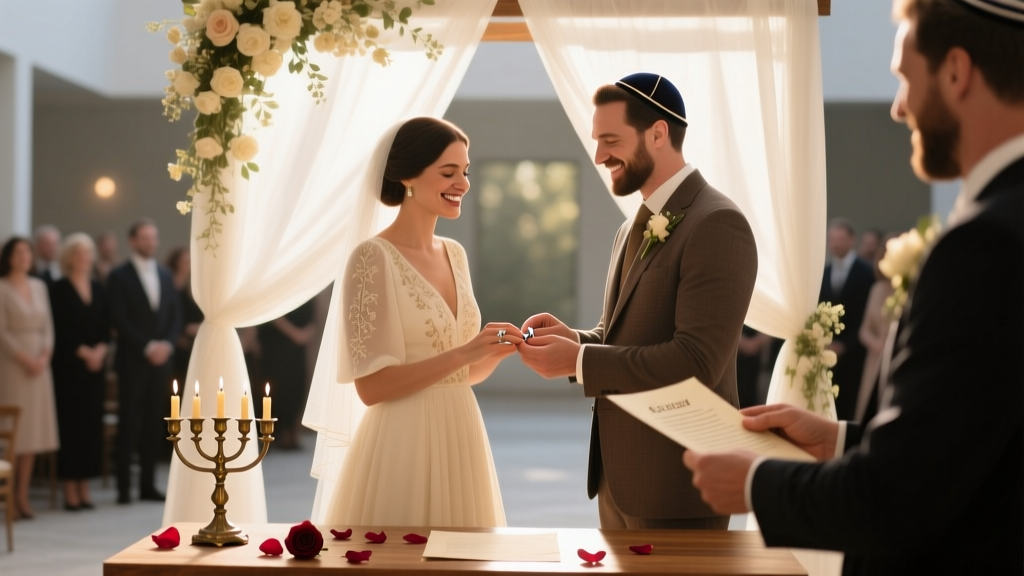
What Are Jewish Weddings Like? A Real Guest’s Guide
Why This Question Matters More Than Ever
If you’ve been invited to your first Jewish wedding—or you’re marrying someone Jewish, converting, or simply trying to understand interfaith traditions—you’re not alone in wondering: what are Jewish weddings like? Unlike many Western ceremonies that prioritize aesthetics over meaning, Jewish weddings are deeply rooted in covenant, community, and continuity. And yet, misconceptions abound: some assume it’s all solemn prayer; others think it’s just ‘a party with bagels.’ The truth is richer, more layered, and surprisingly accessible—even if you’ve never lit a Shabbat candle. With intermarriage rates at 58% among non-Orthodox U.S. Jews (Pew Research, 2023), understanding these rituals isn’t just about etiquette—it’s about showing up with respect, curiosity, and heart.
The Structure: It’s Not One Ceremony—It’s Two Acts in One Day
Jewish weddings unfold in two distinct phases: the ceremony (chuppat) and the reception (seudat mitzvah). But unlike secular events where the ‘main event’ ends at vows, here the ritual continues—and deepens—after the glass breaks. Think of it as Act I (sacred covenant) and Act II (joyful celebration with theological weight).
At its core, a traditional Jewish wedding is built around seven blessings (sheva brachot), signed ketubah (marriage contract), and the chuppah—a canopy symbolizing the couple’s new home. But how those elements manifest varies widely: Reform couples may write their own ketubah in English; Sephardic families often include henna nights; Modern Orthodox weddings might feature separate seating but full musical celebration. What unites them is intentionality—not uniformity.
Take Maya and David, a Brooklyn-based couple who married in 2022. Both raised secular but culturally Jewish, they spent months consulting with a rabbi *and* a wedding educator to craft a ceremony that honored halacha (Jewish law) without feeling alienating to their Christian and Hindu guests. Their solution? Bilingual blessings, footnotes on printed programs explaining each ritual, and a 90-second ‘ritual primer’ delivered by their officiant before the chuppah. Guest feedback? ‘I finally understood why the glass broke—and cried when it did.’ That’s the power of context.
Rituals Decoded: What Happens (and Why It Matters)
Let’s walk through the key moments—not as abstract customs, but as lived experiences with emotional resonance and theological logic.
- The Bedeken (Veiling): Often overlooked in pop culture, this pre-ceremony moment occurs when the groom—accompanied by friends—approaches the bride and lowers her veil. Rooted in Genesis (where Jacob mistakenly marries Leah instead of Rachel), it affirms: ‘I choose you, not your appearance.’ In practice? It’s tender, quiet, sometimes tearful—and always private. No photos. No fanfare. Just presence.
- The Chuppah: More than ‘just a canopy,’ it’s an open-sided structure representing hospitality (Abraham’s tent had four sides open to travelers) and divine presence. Materials vary: family heirloom tallit (prayer shawl), wooden beams from grandparents’ home, even reclaimed barn wood. Crucially, it must be held up by people—not poles—symbolizing communal support. At Rachel and Eli’s wedding in Portland, eight friends held the corners while two rabbis stood beneath. One guest whispered, ‘I’ve never felt so surrounded by love—and responsibility.’
- Ketubah Signing: This isn’t a legal formality. It’s a binding ethical document outlining mutual responsibilities—financial, emotional, spiritual. Traditionally written in Aramaic, today’s versions range from feminist rewrites (‘We commit to shared labor and equal voice’) to illustrated art pieces displayed at receptions. A 2021 survey by Ketubah.com found 73% of couples now co-author their texts—and 41% display them prominently during dinner.
- Circling & Wine: The couple shares a cup of wine *twice*: once before blessings (symbolizing joy), once after (symbolizing sanctification). And yes—the bride often circles the groom seven times (or vice versa, or together). Contrary to myth, this isn’t about subservience. In Kabbalistic thought, seven represents completion (seven days of creation); circling creates a sacred boundary—like building a home together, one layer at a time.
- The Glass Breaking: That sharp, startling crunch? It’s the most misunderstood moment. It’s not about remembering destruction (though that’s part of it), but about grounding joy in moral awareness. As Rabbi Danya Ruttenberg writes: ‘Even at our highest moment, we hold space for brokenness—in the world, in ourselves, in history.’ Guests don’t shout ‘Mazel tov!’ until *after* the break—creating collective breath-hold, then release. Try it: next time you hear that sound, notice your own exhale.
The Reception: Where Halacha Meets Havoc (in the Best Way)
If the ceremony is theology in motion, the reception is Torah in translation—joy made tangible. But it’s not ‘just dancing.’ Every element serves a purpose:
- Yichud (Seclusion): Immediately after the ceremony, the couple retreats alone for 10–20 minutes. No phones. No guests. Just silence, a snack (often honey cake and wine), and the first private moment as husband and wife. This isn’t romantic privacy—it’s a halachic requirement ensuring the marriage is consummated *with intention*, not performance. At a Tel Aviv wedding, the yichud room was a rooftop garden with jasmine vines; the couple emerged holding hands, both visibly calmer.
- Dancing Styles: From the slow, swaying mitzvah tantz (where family members dance with the bride/groom separately, often holding a handkerchief) to the frenetic hora (chair-lifting circle), movement expresses communal belonging. In Hasidic communities, men and women dance separately; in Reconstructionist settings, everyone joins one giant, sweaty, singing circle. Key insight: Dancing isn’t optional—it’s a mitzvah. As one guest told us, ‘When my 82-year-old grandmother was lifted in the hora, she wasn’t performing. She was testifying.’
- Sheva Brachot Meals: The week following the wedding, friends host festive dinners featuring the seven blessings. This extends celebration—and accountability. It’s not ‘after-partying’; it’s relational infrastructure. Couples report deeper post-wedding connection when they experience this, citing ‘feeling held, not hurried.’
Food tells its own story: Ashkenazi menus lean toward brisket and kugel; Sephardic tables overflow with borekas and kebabs; Ethiopian Beta Israel weddings serve doro wat with injera. Dietary laws (kashrut) shape everything—but flexibility exists: many caterers now offer ‘kosher-style’ (no pork/shellfish, but no rabbinic supervision) or fully supervised options. Cost difference? $3–$8 per plate, but 68% of surveyed couples said ‘worth every penny’ for guest comfort and tradition integrity (Jewish Wedding Institute, 2024).
What to Expect: A Practical Timeline & Cultural Navigation Guide
Here’s how a typical Saturday afternoon wedding unfolds—and what to watch for:
| Time | Event | What Guests Experience | Cultural Note |
|---|---|---|---|
| 3:00–3:45 PM | Pre-Ceremony Mingling / Bedeken | Soft music; light refreshments; quiet conversations near chuppah | Photographers avoid bedeken—it’s intimate, not performative |
| 4:00 PM | Ceremony Begins | Processional (often to instrumental klezmer); hushed awe; frequent Hebrew phrases with English translations in programs | Many couples provide ‘Ritual Glossaries’ in programs—smart move |
| 4:25 PM | Ketubah Signing & Reading | Guests stand; witness signatures; listen to poetic English reading | Signing happens *before* chuppah—legally, marriage begins at signing |
| 4:40 PM | Chuppah & Seven Blessings | Shared wine; circling; Hebrew blessings with melody; glass break | After glass breaks: spontaneous cheering, clapping, ululation (especially in Mizrachi communities) |
| 5:15 PM | Yichud | Reception begins without couple; guests enjoy cocktail hour | Don’t look for them—they’re intentionally absent. Trust the timing. |
| 6:00 PM | Grand Entrance & First Dance | Couple enters to upbeat music; immediate dancing; often includes choreographed moves | First dance is rarely slow—energy is communal, not couple-centric |
| 7:30 PM | Dinner & Sheva Brachot | Multi-course meal; blessings recited over wine by honored guests | Blessings require minyan (10 adults)—so latecomers may delay start |
| 9:00 PM+ | Open Dancing & Mitzvah Tantz | Nonstop music; chair lifts; intergenerational dancing; possible hora tunnel | ‘Dance floor’ is often the entire venue—tables pushed back, rugs rolled |
Frequently Asked Questions
Do I need to cover my head at a Jewish wedding?
Head-covering is customary but not mandatory for guests. Men are often offered kippot (skullcaps) at the entrance; wearing one shows respect, especially under the chuppah. Women may wear hats or scarves—particularly at Orthodox weddings—but it’s never required. If unsure, follow the lead of same-gender guests or ask the couple’s coordinator. Pro tip: Keep a foldable kippah in your bag—it’s a small gesture with big warmth.
Is it okay to take photos during the ceremony?
Photography policies vary widely. Most Conservative and Reform weddings allow discreet photo-taking (no flash, no blocking views), but Orthodox ceremonies typically prohibit *all* photography during the chuppah—considering it a sacred, non-performative space. Always check your invitation for notes (e.g., ‘No photos under chuppah’) or ask the couple directly. When in doubt: put the phone down. Your presence is the best documentation.
What should I wear?
Think ‘respectful elegance’—not black-tie unless specified. Modesty matters more than formality: covered shoulders, knee-length+ skirts/dresses, no low necklines. Men should avoid shorts or sandals. At ultra-Orthodox weddings, women wear sleeves past the elbow and skirts below the knee; men wear suits and white shirts. When invited, ask the couple or wedding planner for guidance—it’s not intrusive, it’s considerate.
Can non-Jews participate in rituals?
Absolutely—and often encouraged. Non-Jewish guests may be invited to sign the ketubah as witnesses (if not halachically required), hold chuppah poles, or even recite one of the Sheva Brachot in English. The key is intention: participation is about honoring covenant, not conversion. As Rabbi Sharon Brous says, ‘Judaism isn’t a club—it’s a conversation. Your presence *is* the point.’
What’s appropriate to give as a gift?
Cash in multiples of $18 (‘chai,’ meaning ‘life’ in Hebrew) remains popular—but not obligatory. Gift registries are increasingly common, especially for couples setting up homes. If giving cash, present it in a card with a personal note referencing the couple’s values (e.g., ‘Wishing you a life filled with laughter, learning, and latkes’). Avoid gifts with religious iconography unless you know their practice level—some Reform couples love mezuzahs; others prefer secular art.
Common Myths Debunked
Myth 1: “Jewish weddings are always solemn and somber.”
Reality: While reverence anchors the ceremony, joy is a religious imperative. The Talmud states, ‘A man who gladdens his bride is compared to one who rebuilds Jerusalem.’ Music, dancing, humor, and even playful choreography are not distractions—they’re mitzvot. At a Miami beach wedding last year, the couple entered to a salsa version of ‘Hava Nagila’—and the rabbi laughed so hard he snorted mid-blessing.
Myth 2: “Only Jews can get married under a chuppah.”
Reality: Interfaith couples increasingly create hybrid ceremonies *under* the chuppah—with dual officiants, bilingual readings, and inclusive blessings. While Orthodox Judaism requires two halachically Jewish partners, Reform, Reconstructionist, and Renewal movements welcome interfaith unions with thoughtful adaptation. The chuppah isn’t a gate—it’s an invitation to build something new, together.
Your Next Step: Show Up With Curiosity, Not Certainty
So—what are Jewish weddings like? They’re ancient and alive. Structured and spontaneous. Sacred and silly. They’re less about perfection and more about presence: presence of community, presence of memory, presence of hope. You don’t need to know every blessing to feel the weight of the chuppah or the lift of the hora. You just need to arrive with open hands and an open heart.
Your next step? If you’re attending one soon: read the program cover-to-cover—not just for logistics, but for the story it tells. If you’re planning one: schedule a 90-minute ‘ritual design session’ with your officiant—ask not ‘what do we have to do?’ but ‘what do we want this to mean?’ And if you’re still curious? Download our free 21-point Jewish Wedding Prep Checklist, vetted by rabbis, planners, and 127 real couples.
More Articles
 Was Adam Levine at Blake Shelton's Wedding? (2026)
 Wedding Without Marriage License: What’s Allowed (2026)
 Red Wedding Year: Season, Episode & Timeline (2026)
 Nicole Kidman at Daughter’s Wedding? Truth Revealed
 Wedding Rings: How to Wear Them Correctly
 BFGBW3 on Peacock? Where to Watch Legally (2026)
 Is Italian Wedding Soup Actually Served at Real Weddings?
 Mykelti and Tony’s Wedding Guest Count (2026)
 Is Trump Invited to Jeff Bezos Wedding? (2026)
 White Wedding Dress Origin: Queen Victoria’s 1840 Symbolism