What Does a Jewish Wedding Look Like? (2026)
Why This Question Matters More Than Ever Right Now
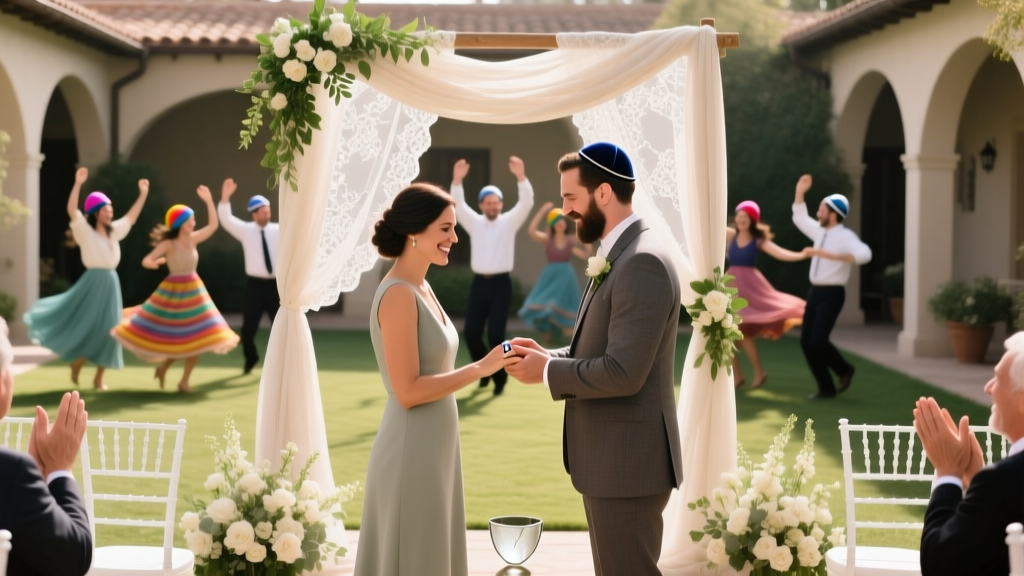
If you've ever scrolled through Instagram and paused on a photo of a couple under a chuppah with a glass held high—or watched a friend’s wedding video where guests stomped their feet during the hora—you’ve probably asked yourself: What does a Jewish wedding look like? It’s not just about aesthetics. In an era where interfaith relationships are at an all-time high (Pew Research reports 58% of U.S. Jews married outside the faith between 2000–2013), and cultural curiosity is surging across TikTok and Pinterest, this question reflects something deeper: a desire for respectful understanding, meaningful participation, and emotional resonance. Whether you’re attending your first Jewish wedding as a guest, planning one with your partner, or simply exploring traditions that feel spiritually grounded and deeply human—knowing what to expect isn’t about protocol. It’s about belonging.
The Ritual Blueprint: What Happens When the Ceremony Begins?
A Jewish wedding isn’t a single event—it’s a choreographed sequence of ancient symbols, embodied actions, and layered meanings. Unlike secular ceremonies that often prioritize speeches and vows, a traditional Jewish wedding centers on mitzvot (commandments) performed in real time. Let’s walk through the core sequence—not as dry liturgy, but as lived experience.
First: the bedekin. Often overlooked in summaries, this pre-ceremony moment occurs behind closed doors—usually 15–30 minutes before the chuppah begins. The groom, accompanied by male family and friends, approaches the bride (who sits veiled and surrounded by women). He lifts her veil—twice. Why twice? One lift fulfills the biblical story of Jacob, who mistakenly married Leah instead of Rachel because he couldn’t see her face. The second lift affirms intentionality: I choose you, knowingly, wholly, without illusion. Guests rarely witness this—but when they do, it’s hushed, tender, and emotionally charged.
Then comes the procession. In Ashkenazi tradition, the bride walks down the aisle with both parents—symbolizing dual lineage and communal support. Sephardic and Mizrahi weddings often feature the bride entering to live music, sometimes dancing with her mother or sisters. The groom stands under the chuppah, a canopy held aloft by four poles—often wrapped in a tallit (prayer shawl) or family heirloom fabric. It’s not just ‘a tent’; it represents the home the couple will build together: open on all sides, welcoming, impermanent yet sacred.
Once beneath it, the ceremony unfolds in two distinct legal phases: kiddushin (betrothal) and nissuin (marriage). Kiddushin begins with the groom placing a plain gold ring on the bride’s right index finger while declaring in Hebrew: Harei at mekudeshet li k’das Moshe v’Yisrael (“Behold, you are consecrated to me according to the law of Moses and Israel”). Note: no ‘I do’—no mutual vows. Instead, it’s a binding, unilateral act of sanctification rooted in halacha (Jewish law). Modern adaptations now include mutual ring exchange—but only if both rings are identical, unbroken, and made of solid metal (no stones or engravings, preserving the ring’s symbolic wholeness).
After the ring, the ketubah is read aloud—a beautifully illuminated marriage contract outlining the husband’s responsibilities (food, clothing, conjugal rights, emotional care) and signed by two kosher witnesses. Today’s ketubot often include egalitarian language, LGBTQ+ affirmations, or bilingual text—and many couples display theirs as art in their homes post-wedding.
Finally, the sheva brachot—seven blessings recited over wine. These aren’t generic ‘good luck’ lines. They span creation, joy, Zion, love, companionship, fertility, and communal celebration. Each blessing is chanted by a different guest—often elders, mentors, or newlyweds—making the community co-creators of the marriage. Then—the wine is shared. And then—the breaking of the glass. Not a finale, but a pivot: a sharp, startling sound that interrupts joy with remembrance—of Jerusalem’s destruction, of life’s fragility, of how holiness and sorrow coexist. Guests shout Mazel Tov!—not just ‘congratulations,’ but ‘good fortune flows!’—and the party erupts.
Sight, Sound & Sensation: The Unspoken Atmosphere
What does a Jewish wedding look like? It looks like light catching the silver rim of a kiddush cup as wine is poured. It looks like the groom’s hand trembling slightly as he places the ring—not out of nerves, but awe. It looks like a sea of guests rising as one during the hora, arms linked, circling the couple lifted on chairs, feet kicking midair to frenetic klezmer or modern Israeli pop. But more than visuals, it feels like texture: the crisp starch of a tallit draped over shoulders, the warmth of challah bread passed hand-to-hand at the meal, the sticky-sweet residue of honey cake on fingertips.
Sound design matters deeply. Traditional weddings use acoustic instruments only—no microphones for blessings (so voices must carry), no recorded music during the ceremony (to preserve the integrity of live, human expression). Post-chuppah, volume swells: accordions, violins, darbukas, even electric bass in progressive communities—but always with intention. One couple in Brooklyn hired a Yemenite vocalist to chant psalms during the cocktail hour; another in Tel Aviv streamed live Torah commentary via earpiece for guests curious about meaning behind each ritual.
Even scent tells a story. Many families bake keppelach (poppy seed cookies) or babka the night before—filling the venue with warm, spiced sweetness. At outdoor weddings in Israel, jasmine and lemon trees perfume the air; in Minnesota winters, cedar boughs and cinnamon sticks line the chuppah path.
Timeline & Logistics: From Sunrise to Sunrise
Forget ‘ceremony at 4 p.m., dinner at 6.’ A traditional Jewish wedding operates on its own temporal logic—shaped by Shabbat restrictions, seasonal customs, and halachic windows. Here’s how timing actually works:
| Phase | Typical Duration | Key Constraints & Notes |
|---|---|---|
| Pre-Wedding Fasting | From sunrise until after chuppah | Both bride and groom traditionally fast—even on non-Yom Kippur days—as spiritual preparation. Light snacks (e.g., fruit, water) may be permitted for health reasons; rabbi consultation required. |
| Bedekin & Final Prep | 30–45 minutes | Often scheduled precisely so the chuppah begins at a ‘lucky hour’—many choose the 3rd or 7th hour after sunrise (based on Talmudic auspiciousness). Photographers must coordinate access carefully—this is private, not performative. |
| Chuppah Ceremony | 25–40 minutes | Must conclude before sunset on Friday (for Shabbat weddings) or before nightfall on other days. No electronics allowed near the chuppah in Orthodox settings—so no phones, smartwatches, or Bluetooth mics. |
| Seudat Mitzvah (Festive Meal) | 3–5 hours | Halachically required—must include bread (challah), wine, and zemirot (table songs). Minimum of 10 adults present to recite sheva brachot again. In ultra-Orthodox circles, men and women sit separately; most modern weddings are mixed. |
| Sheva Brachot Dinners | 7 consecutive nights (optional but encouraged) | Each night features new guests, new blessings, and increasing intimacy. Couples report these dinners deepen community bonds more than the wedding itself—especially for interfaith or geographically dispersed families. |
Real Couples, Real Choices: How Tradition Adapts Without Losing Its Soul
Meet Maya and David—interfaith, Reform-identifying, married in Portland in 2023. Their chuppah was woven from reclaimed Oregon cedar and embroidered with Hebrew letters spelling ‘shalom’ and ‘love’ in English. They wrote their own ketubah, pledging mutual accountability for mental health care and climate action. During the bedekin, Maya’s Christian mother placed a sprig of rosemary (for remembrance) in her daughter’s hair—while David’s grandfather recited Psalm 121 in Yiddish. No one blinked. Why? Because authenticity isn’t deviation—it’s fidelity to meaning.
Contrast that with Sarah and Eli—Orthodox, Brooklyn-based, married in 2022. Their wedding followed every halachic detail: the ring was $28.75 (gold, no gemstones), the witnesses were male, Torah-observant, and unrelated to the couple; the chuppah stood exactly 12 feet from the synagogue entrance (per local minhag). Yet they also broke norms: Sarah gave a 90-second d’var Torah (teaching) after the sheva brachot, citing Rashi and bell hooks side-by-side. Their rabbi called it ‘the most halachically rigorous and intellectually daring wedding I’ve officiated in 27 years.’
What unites them? Neither treated tradition as museum exhibit. They treated it as living language—spoken with inherited grammar, but new vocabulary. A Jewish wedding doesn’t ‘look’ one way. It looks like intention made visible.
Frequently Asked Questions
Is a rabbi required to officiate a Jewish wedding?
No—halachically, the essential elements are the couple’s mutual consent, the presence of two kosher witnesses, the giving of an object of value (ring), and the recitation of the proper formula. A rabbi serves as guide, educator, and halachic advisor—not a sacramental necessity. That said, over 95% of Jewish weddings today involve a rabbi or cantor, both for legitimacy within the community and to ensure legal compliance (e.g., state marriage license requirements).
Can same-sex couples have a Jewish wedding?
Yes—across Reform, Reconstructionist, Conservative (since 2012), and many Open Orthodox communities. Ritual adaptations vary: mutual ring exchange, gender-inclusive ketubah language, reimagined sheva brachot (e.g., blessing ‘the love that joins two souls’), and chuppahs designed as inclusive spaces. The Rabbinical Assembly (Conservative) affirms that ‘marriage is the sacred union of two people committed to building a life of holiness and justice together.’
Do guests need to cover their heads at a Jewish wedding?
Head-covering is customary for men in Orthodox and many Conservative settings—kippot (yarmulkes) are provided at the entrance. Women may choose to cover their heads (with scarves or snoods) in ultra-Orthodox contexts, but it’s rarely expected of guests. In Reform, Reconstructionist, and secular celebrations, head-covering is entirely optional—and often skipped unless part of personal practice.
What should I wear to a Jewish wedding?
Dress codes vary widely—but modesty is consistently valued. For Orthodox weddings: avoid sleeveless tops, short skirts, low necklines, or sheer fabrics. For liberal weddings: business-casual or cocktail attire is standard. Pro tip: check the invitation for cues—‘black tie encouraged’ vs. ‘festive casual’ vs. ‘chuppah-ready attire’ (hinting at outdoor terrain or heat). And always bring a light wrap—ceremonies often begin outdoors, even in summer, and evenings cool fast.
Why is the glass broken—and can it be recycled?
The breaking fulfills the verse ‘If I forget you, O Jerusalem…’ (Psalm 137) and embodies the Jewish principle that joy must contain awareness of collective memory and loss. While some couples use a lightbulb (for safety) or a sugar cube (for symbolism), halacha requires a real glass—unreinforced, easily shattered. Recycling? Not traditionally—but many now donate proceeds from shattered-glass art projects to tzedakah (justice-oriented charities), turning rupture into repair.
Common Myths
Myth #1: “The bride circles the groom seven times to show submission.”
False. In Ashkenazi custom, the bride circles the groom—but interpretations vary widely: some say it creates a protective spiritual wall; others cite mystical texts where seven represents completion (like the seven days of creation); many modern couples reverse or share the circling. Crucially, no classical source links it to subservience—and numerous rabbis explicitly reject that reading as ahistorical and harmful.
Myth #2: “Kosher catering means only meat-free meals.”
No. Kosher catering follows strict separation of meat and dairy (no mixing, separate utensils, waiting 3–6 hours between courses), but most Jewish weddings serve meat (often beef or chicken). Vegetarian or vegan options are increasingly common—not for kashrut reasons, but for inclusivity and values. A truly kosher kitchen must be certified by a recognized rabbinic authority, not just ‘no pork.’
Your Next Step Starts With One Question
Now that you know what a Jewish wedding looks like—not as stereotype, but as spectrum—you’re equipped to engage with depth, ask better questions, and honor the nuance behind every gesture, song, and silence. If you’re planning your own: start small. Choose one ritual that resonates—bedekin, ketubah writing, or the hora—and research its roots. If you’re attending: arrive curious, not expert. Ask your hosts, ‘What does this moment mean to you?’—then listen more than you speak. Tradition isn’t preserved by perfection. It’s carried forward by presence. So whether you’re holding a glass, lifting a chair, or simply watching light fall across a chuppah—your attention is the first, most sacred act of all.
More Articles
 How to Call Off a Wedding in The Sims 4 (2026)
 Best Engagement Ring for Wear: Durability, Comfort, and Everyday Practicality Tested
 Wedding Rings After Separation: What to Know
 Family Wedding Guilt: Set Boundaries Without Shame (2026)
 Raining on Wedding Day: Good Luck? 12 Traditions & Stories
 7 Honest Signs Your Wedding Was a Success
 White Patterned Dress to Wedding: Etiquette Rules (2026)
 Should Christians Wear Wedding Rings? (2026)
 How to Get Every Wedding Item in ACNH Without Missing One
 7 Things You Must Know Before Planning an A.J. Colby Wedding