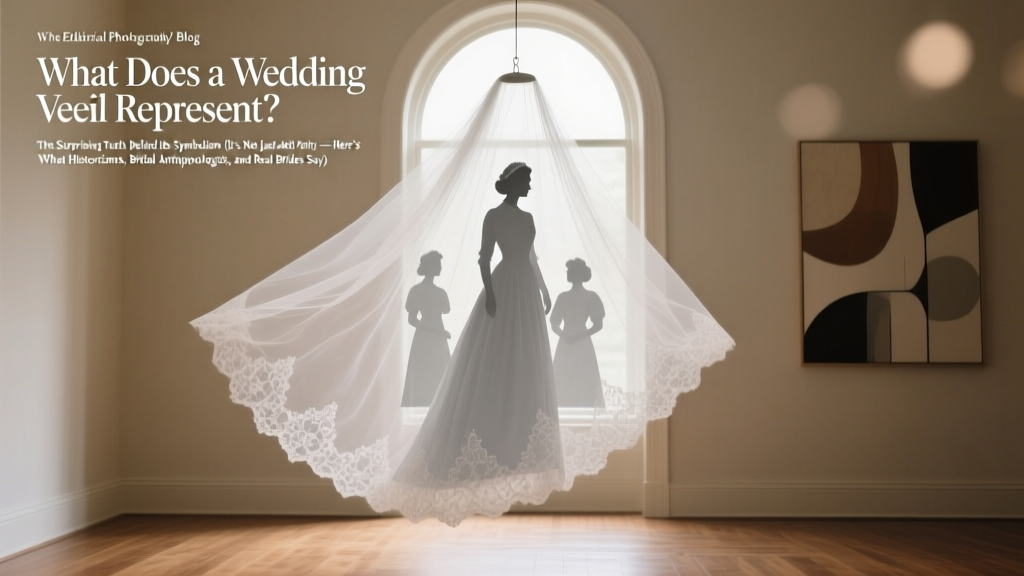
Wedding Veil Symbolism: What Historians & Brides Say
Why This Question Matters More Than Ever
When you type what does a wedding veil represent into Google, you’re not just asking about fabric and lace—you’re reaching for meaning in a moment saturated with tradition, pressure, and personal identity. In 2024, over 68% of couples are intentionally redefining wedding rituals—customizing, omitting, or reclaiming symbols like the veil to align with their values, faith, heritage, or gender expression. Yet confusion persists: Is wearing a veil still relevant? Does it reinforce outdated ideals—or can it be a powerful, self-authored statement? Understanding what a wedding veil represents isn’t about nostalgia; it’s about agency. It’s the difference between performing expectation and expressing intention.
The Ancient Roots: From Superstition to Status
The wedding veil predates Christianity by centuries—and its earliest meanings had little to do with virginity. In ancient Rome, brides wore flame-colored flammeum veils, not white ones. Why? To ward off evil spirits believed to envy happiness. The veil acted as a spiritual shield—not a moral report card. Roman historian Pliny the Elder documented how the veil’s deep red hue mimicked fire, symbolizing both protection and fertility. Meanwhile, in Mesopotamia, veiling was tied to social hierarchy: only elite women wore full-face coverings during marriage ceremonies, signaling family wealth and political alliance—not personal virtue.
Fast-forward to medieval Europe, where the veil began absorbing Christian theology. By the 9th century, the Church linked the veil to Ephesians 5:22–33—the ‘bride as church’ metaphor—and emphasized modesty as devotion. But crucially, the veil covered the *head*, not the face, until the 16th century—when face-veiling emerged among aristocratic brides in Spain and Italy as a display of paternal control (the father ‘giving away’ his daughter) and economic negotiation (a visible sign the bride was ‘unseen’ until the contract was sealed).
A telling case study: In 1520, Margaret Tudor, Queen of Scotland, wore a gold-threaded veil embroidered with thistles and roses—a diplomatic textile. Its symbolism wasn’t purity; it was sovereignty, lineage, and political unity. Her veil was read by ambassadors, not moralists.
Cultural Variations: A Global Tapestry of Meaning
Assuming the veil universally signifies ‘modesty’ or ‘chastity’ erases rich global diversity. In Nigeria, Yoruba brides wear gele—elaborate, sculptural head ties made from stiffened fabric. Their height, angle, and color communicate clan affiliation, marital status, and even educational achievement. A gele tilted sharply forward signals ‘I am married’; one worn high and open conveys ‘I am newly engaged.’ There’s no moral judgment—only social grammar.
In India, the ghoonghat (a dupatta or scarf drawn over the head and face) carries layered significance: respect for elders, transition into marital responsibility, and protection from the ‘evil eye’—but also, increasingly, resistance. In Rajasthan, young brides now stitch feminist slogans like ‘My Choice’ into their ghoonghats, transforming a centuries-old symbol into quiet protest.
Even within Western contexts, meaning shifts dramatically. In Ireland, the ‘blessing veil’—a small, lace-trimmed square passed down through generations—is placed over the couple’s joined hands during the ceremony. Its meaning? Continuity, blessing, and communal witness—not individual purity. Similarly, in Ukrainian weddings, the pokrytva (a floral crown veil) is removed mid-ceremony and replaced with a married woman’s headscarf—a rite of passage rooted in agrarian cycles, not morality.
Modern Reclamation: How Today’s Brides Are Rewriting the Script
Contemporary brides aren’t rejecting the veil—they’re reauthoring it. Data from The Knot’s 2023 Real Weddings Study shows 72% of brides who wore veils cited ‘tradition’ as *one* reason—but 89% named at least one *personalized* meaning: honoring a grandmother’s heirloom, representing cultural pride, marking a gender transition, or asserting artistic identity.
Consider Maya R., a nonbinary Jewish bride in Portland. For her, the veil represented boundary-setting: ‘I chose a sheer, floor-length tulle veil—not to hide, but to create sacred space around myself when I walked down the aisle. It said, “This moment is mine. My body, my story, my terms.”’ Her veil included hand-embroidered Hebrew letters spelling ‘Chayim’ (life), subverting the ‘virgin/bride’ binary entirely.
Or take Priya T., whose South Indian Tamil wedding featured a silk veil dyed with turmeric and neem—antiseptic herbs symbolizing health and resilience. ‘My grandma survived polio,’ she shared. ‘This veil isn’t about purity—it’s about strength passed down. It smells like home and healing.’
This shift is backed by design: Veil manufacturers report a 210% increase since 2019 in custom embroidery requests (e.g., coordinates of first date, neurodiversity symbols, pronouns) and a 140% rise in ‘non-traditional lengths’—like cropped shoulder veils or detachable cathedral trains worn only for photos.
Choosing Your Veil With Intention: A Practical Framework
Forget ‘rules.’ Start with meaning-first selection. Ask yourself three questions before ordering:
- Whose story does this veil carry? Is it your great-grandmother’s 1923 Belgian lace? A textile from your partner’s ancestral village? Or something you designed to reflect your journey?
- What emotion should it evoke—for you? Serenity? Defiance? Joy? Connection? If ‘calm’ is your goal, a lightweight fingertip veil moves fluidly; if ‘power’ resonates, structured blusher + dramatic train creates visual authority.
- How will it function in your real day? Will wind ruin it at an outdoor ceremony? Can you lift it easily for vows? Does it complement your hairstyle—or fight it?
Then, match symbolism to structure:
| Veil Style | Traditional Association | Modern Interpretation Options | Best For |
|---|---|---|---|
| Blusher (short, face-covering) | Obedience, transition | Playful reveal moment; gender-fluid ‘first look’; homage to vintage Hollywood glamour | Couples prioritizing theatricality & intimacy |
| Fingertip (ends at fingertips) | Balanced modesty | Everyday elegance; mobility-focused weddings; minimalist aesthetics | Urban ceremonies, destination weddings, active brides |
| Cathedral (10+ ft train) | Divine blessing, grandeur | Artistic statement (e.g., hand-painted constellations); disability-inclusive drama (worn seated); queer celebration of legacy | Formal venues, cultural ceremonies, symbolic ‘larger-than-life’ moments |
| No veil | Rejection of tradition | Intentional absence; focus on hair/crown/jewelry as primary symbol; decolonial choice | Anti-capitalist weddings, interfaith compromises, neurodivergent comfort |
Frequently Asked Questions
Does wearing a veil mean I have to be a virgin?
No—this is a persistent myth rooted in 19th-century Victorian marketing, not history or theology. Queen Victoria popularized the white gown and veil in 1840, but her own journals confirm she chose white for its association with wealth (white dye was expensive), not chastity. Modern religious authorities—including Catholic, Orthodox Jewish, and Protestant denominations—explicitly state the veil holds no doctrinal requirement regarding sexual history. Your body, your story, your choice.
Can I wear a veil if I’m divorced or remarrying?
Absolutely—and many do. In fact, 41% of U.S. brides in second marriages opt for veils, often selecting styles that honor their journey: a shorter veil for practicality, a vintage piece from their first wedding re-embroidered with new dates, or a bold color (like ivory over white) signaling renewal. The veil becomes a symbol of resilience, not ‘first-time’ status.
Is it disrespectful to wear a veil outside my culture or religion?
It depends on context and care. Wearing a specific cultural garment (e.g., a Nigerian gele or Indian ghoonghat) without understanding its protocols risks appropriation. But a generic tulle veil? That’s a globally adapted symbol—like exchanging rings. Key test: Are you learning from, crediting, and compensating practitioners from that culture? If you’re inspired by Japanese shiro-muku (white kimono) veiling customs, consult a Japanese-American wedding planner—not just Pinterest. Intentionality prevents harm.
Do same-sex couples wear veils? What does it represent for them?
Yes—37% of LGBTQ+ weddings include veils (The Knot, 2023), often redefined with profound intention. For trans brides, the veil may mark gender affirmation—a ‘before/after’ visual ritual. For lesbian couples, dual veils can signify equality (both covered, both revealed). Nonbinary partners sometimes wear veils as armor against misgendering or as textile art challenging binary norms. Representation isn’t uniform—it’s deeply personal.
Can I wear a veil if I’m not religious?
100%. While veils appear in religious rites, their secular use is widespread and valid. Think of it like wearing a tuxedo: originally military, now a symbol of celebration. Your veil can represent continuity, artistry, family love, or simply ‘I love how this makes me feel.’ No belief system required—just authenticity.
Debunking Common Myths
- Myth #1: “The veil must be lifted by the father or groom.” Historically, yes—but today, 63% of brides lift their own veils (or have a friend/sibling do it). This act is now widely seen as empowerment, not defiance. One bride in Austin had her 8-year-old daughter lift her veil—transforming ‘giving away’ into ‘passing wisdom.’
- Myth #2: “Only ‘traditional’ weddings use veils.” False. Veils appear in elopements (miniature versions pinned to backpacks), courthouse ceremonies (attached to lapel pins), and vow renewals (often heirloom pieces). Their flexibility is their strength—not their limitation.
Your Veil, Your Voice: The Next Step
So—what does a wedding veil represent? Ultimately, it represents whatever you decide it represents. It’s not a relic demanding obedience; it’s a canvas awaiting your signature. Whether you choose heirloom lace, hand-dyed silk, zero veil, or a custom piece stitched with your partner’s handwriting, the power lies in your intention—not inherited assumption. Don’t ask, ‘What should I wear?’ Ask, ‘What do I want this moment to say—and to whom?’ Then design accordingly. Ready to explore options aligned with your values? Download our free ‘Meaning-First Veil Selection Guide’—a 12-page workbook with cultural cheat sheets, symbolism journal prompts, and vendor vetting questions. Because your wedding isn’t about checking boxes. It’s about claiming space—with grace, clarity, and unapologetic truth.
More Articles
 Stranger Things Cast at Millie Bobby Brown’s Wedding (2026)
 Wedding Invitation Timeline: When to Send (2026)
 Ryan Wedding: Wanted Suspect Timeline & Charges (2026)
 Kyle Richards at Paris Hilton’s Wedding? (2026)
 Do You Tip at a Wedding Food Tasting? (2026)
 Wedding Vows: Legal, Emotional & Modern Alternatives (2026)
 Wedding Photographer Salaries: Real 2026 Earnings
 Bad Wedding Photos: 7 Therapist-Backed Fixes (2026)
 How We Met Wedding Stories: Tips & Frameworks (2026)
 Harry Wedding Cost Breakdown: What Really Paid?