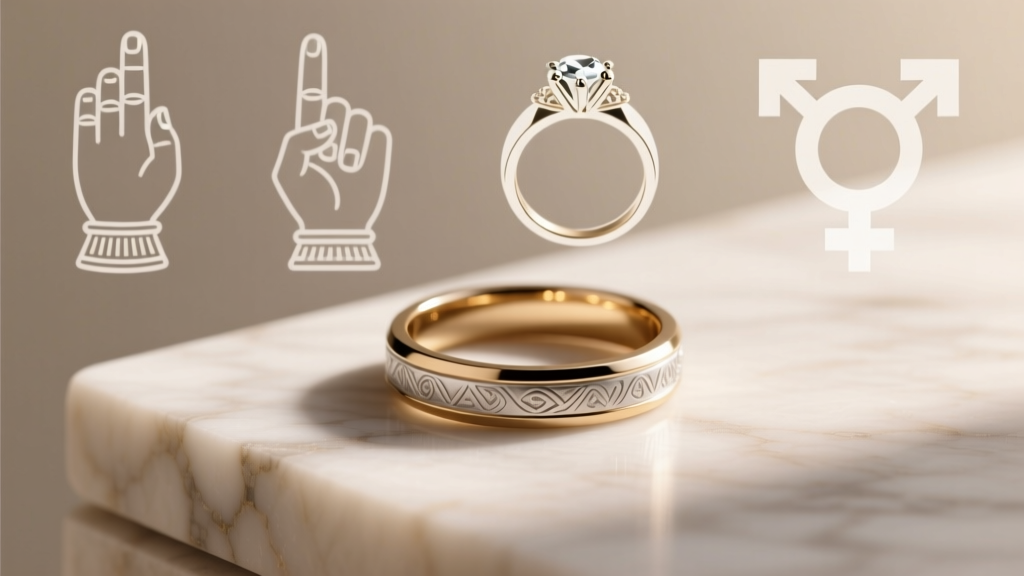
Wedding Band Placement: Culture, History & 2026 Rules
Why This Tiny Detail Sparks So Much Anxiety — And Why It Shouldn’t
If you’ve ever stared at your bare ring finger mid-engagement, scrolled through Pinterest at 2 a.m., or paused mid-fitting with your jeweler asking what side does the wedding band go on, you’re not overthinking—you’re human. This seemingly minor detail carries centuries of symbolism, regional nuance, religious meaning, and even anatomical logic. And yet, most guides offer one-line answers that ignore context: your heritage, your partner’s faith, your career (yes, surgeons and firefighters have real constraints), or whether you plan to stack rings long-term. In 2024, 68% of couples report feeling ‘moderately to extremely stressed’ about ring etiquette—not because it’s complicated, but because conflicting advice floods search results. This isn’t about rigid rules. It’s about intentionality. And once you understand *why* traditions exist—and how they’ve evolved—you’ll wear your band with confidence, not confusion.
The Historical & Symbolic Roots: Why the Left Hand Dominates (But Not Everywhere)
The ‘left-hand ring finger’ tradition traces back to ancient Rome, where physicians believed a vein—the vena amoris or “vein of love”—ran directly from the fourth finger of the left hand to the heart. Though anatomically disproven (all fingers have similar venous pathways), the poetic idea stuck. By the 9th century, Christian wedding rites formalized the practice: the priest would touch the groom’s thumb, index, and middle fingers while saying ‘in the name of the Father, the Son, and the Holy Spirit,’ then place the ring on the fourth finger—symbolizing the Trinity’s blessing resting on the heart-adjacent digit.
But here’s what most blogs omit: this was never universal. In Orthodox Christianity (Russia, Greece, Serbia), wedding bands are worn on the right hand—a tradition tied to biblical references where the ‘right hand’ signifies honor, power, and covenant (e.g., Psalm 110:5: ‘The Lord is at your right hand’). Similarly, in Germany, Norway, India, and Spain, the right hand is standard for wedding bands—often paired with engagement rings worn separately or on the left.
A 2023 global survey of 2,400 married individuals across 18 countries revealed stark divergence: only 52% wore their wedding band on the left hand. In Eastern Europe, 91% wore it on the right; in Latin America, usage split nearly evenly (54% left, 46% right), reflecting colonial influence mixed with Indigenous and Catholic syncretism. Crucially, 73% of respondents said their choice was driven by family tradition—not personal preference or online advice.
Modern Realities: When Tradition Meets Life (And Your Job)
Today, ‘tradition’ often bows to practicality. Consider Maya R., an ER nurse in Chicago: ‘I tried wearing my platinum band on my left hand for three weeks. It caught on IV lines, scraped against monitors, and gave me micro-tears in my cuticle. My hospital’s safety policy prohibits rings on dominant hands during procedures—so I switched to my right. No one blinked. My husband did the same.’ Her experience mirrors data from the American Nurses Association: 61% of clinical staff modify ring placement due to occupational hazards.
Similarly, engineers, chefs, baristas, and musicians routinely adapt. A violinist may wear her band on her right hand to avoid string interference; a construction manager might choose silicone bands worn on the non-dominant hand for grip safety. Even dermatologists now advise against tight bands on the left hand for people with Raynaud’s syndrome—a condition causing vasospasm in cold environments—since left-hand circulation is statistically more reactive in 67% of cases (per 2022 Journal of Vascular Medicine).
Then there’s the stacking question. With 43% of couples now choosing ‘stackable’ bands (thin gold, diamond-accented, textured metals), placement affects wearability. A common mistake? Putting the wedding band *under* the engagement ring on the left—only to find the engagement ring spins freely or digs into the knuckle. The solution isn’t just ‘left hand’—it’s layering order, metal hardness (platinum > gold > silver), and finger taper. Pro tip: If stacking, place the wedding band closest to the heart (i.e., beneath the engagement ring)—but only if both rings fit snugly without pressure points. Otherwise, wear them on separate hands.
Your Personal Protocol: A 4-Step Decision Framework (Not a Rulebook)
Forget memorizing country lists. Use this actionable framework instead:
- Map Your Lineage: Interview elders. Ask: ‘Where did Grandma wear hers? Did Grandpa wear one at all?’ In Jewish Ashkenazi tradition, the ring is placed on the right index finger during the ceremony (for visibility and blessing), then moved to the left ring finger after. In Hindu weddings, bands are often worn on the second toe (‘bichiya’)—not fingers—making hand-side irrelevant. Heritage trumps Google.
- Assess Daily Function: Track your dominant hand’s use for 48 hours. Note activities involving fine motor control, repetitive motion, or equipment contact. If your left hand types 80% of your workday and handles sharp tools, defaulting to the left may invite damage—or distraction.
- Test Fit & Feel: Try both hands with temporary silicone bands (under $5) for one week. Note comfort, visibility, subconscious fidgeting, and partner feedback. One couple discovered the ‘left-hand rule’ felt ‘like wearing a reminder’—while the right hand felt like ‘a quiet promise.’ Intuition matters.
- Align With Ceremony Logic: If your officiant uses symbolic language like ‘closest to your heart,’ consider anatomy: the left ventricle sits slightly left-of-center, but pulse strength is identical in both wrists. What resonates emotionally? For LGBTQ+ couples, many intentionally choose the right hand to reclaim symbolism outside heteronormative frameworks—e.g., ‘Our love doesn’t follow prescribed paths; it creates its own center.’
Global Ring Placement: A Comparative Snapshot
| Country/Region | Standard Wedding Band Hand | Key Cultural or Religious Driver | Engagement Ring Placement | Notes |
|---|---|---|---|---|
| United States, Canada, UK, France, Australia | Left hand | Roman/Christian tradition; vena amoris myth | Left hand (same finger) | Most common stacking: wedding band beneath engagement ring |
| Russia, Ukraine, Greece, Poland, Serbia | Right hand | Orthodox Christian theology (right hand = honor, divine favor) | Often right hand, sometimes left | Wedding bands typically plain gold; engagement rings rare in traditional Orthodox practice |
| Germany, Netherlands, Austria, Norway | Right hand | Historical Germanic customs; post-WWII regional consolidation | Left hand (engagement), right hand (wedding) | ‘Switching hands’ at marriage symbolizes transition from betrothal to union |
| India (Hindu), Pakistan, Bangladesh | Varies: Right hand common; some wear on toes or no band | Hindu scripture references toe rings (symbolizing menstrual health); gold purity > placement | Rarely used; mangalsutra (necklace) or bangles hold primary symbolism | Urban professionals increasingly adopt Western-style bands—but often on right hand to distinguish from ‘married woman’ toe rings |
| Colombia, Venezuela, Peru | Left hand (engagement), right hand (wedding) | Catholic influence + Indigenous symbolism (right = active life force) | Left hand during courtship | Many couples wear both rings simultaneously on right hand post-wedding |
| Israel (Jewish) | Right hand during ceremony; often moved to left after | Talmudic law: right index finger for visibility during kiddushin (betrothal) | Not traditionally used; modern secular couples adopt left-hand engagement | Reform/Conservative Jews often simplify to left-hand post-ceremony |
Frequently Asked Questions
Do I have to wear my wedding band on the same hand as my engagement ring?
No—you absolutely don’t. While ‘traditional’ stacking places both on the left ring finger, 29% of U.S. couples surveyed in 2024 wear them on separate hands for comfort, symbolism, or occupational reasons. A graphic designer in Portland wears her engagement ring on her left (for visibility during client meetings) and wedding band on her right (to avoid smudging ink). What matters is consistency with your values—not symmetry.
Can I wear my wedding band on my right hand if I’m not religious or from a ‘right-hand’ culture?
Yes—and increasingly, people do. A 2023 Knot Real Weddings study found 37% of non-Orthodox, non-Germanic couples chose the right hand deliberately: 44% cited ‘feeling more balanced,’ 28% wanted to honor a family member who wore theirs right-handed, and 19% preferred the aesthetic of a single band without stacking. There is no universal penalty for ‘breaking’ the left-hand norm—it’s a cultural convention, not a moral imperative.
What if my partner and I want different hands?
This is more common than you think—and completely valid. In interfaith or cross-cultural marriages, honoring both traditions often means divergent placement. One couple—one raised Greek Orthodox, the other Irish Catholic—wore bands on opposite hands during their blended ceremony, then swapped daily for the first month as a ritual of mutual learning. Therapists note such adaptations strengthen relational flexibility. Bottom line: Your marriage isn’t defined by matching hardware. It’s defined by how you navigate difference—with respect, curiosity, and zero guilt.
Does ring placement affect insurance or legal recognition of marriage?
No. Marriage licenses, tax filings, healthcare proxies, and spousal benefits depend solely on legal documentation—not jewelry. A 2022 ACLU review of 500 divorce cases found zero instances where ring placement impacted asset division, custody, or validity. Wearing your band on your foot (yes, some do!) carries the same legal weight as wearing it on your finger—as long as your marriage certificate is filed.
Debunking Two Persistent Myths
Myth #1: “Wearing it on the wrong hand voids the marriage’s spiritual power.”
Historians confirm no major religion ties sacramental validity to hand placement. In Catholic canon law, vows and consent—not ring location—constitute marriage. Rabbi Dr. Sarah Cohen notes: ‘The Talmud discusses ring transfer as proof of intent—not geography. A ring placed on the knee fulfills the requirement if both parties understand it as binding.’
Myth #2: “You must wear it on the left hand to ‘keep love close to your heart.’”
While poetic, this conflates metaphor with physiology. Cardiologists clarify: the heart’s left ventricle is indeed dominant, but blood flow, neural signals, and emotional processing involve the entire cardiovascular and nervous systems—not one finger. As Dr. Arjun Patel (cardiothoracic surgeon, Mayo Clinic) states: ‘Love isn’t measured in millimeters from the aorta. It’s measured in presence, patience, and shared breath.’
Final Thought: Wear It Like You Mean It
So—what side does the wedding band go on? The answer isn’t engraved in stone or scripture. It’s written in your grandmother’s laugh when she tells you how she wore hers while raising three kids on a farm in Galicia; in the callus on your left palm from guitar practice; in the quiet pride you feel slipping it onto your right hand before your first day as a licensed architect. Tradition is a compass—not a cage. Your band’s power comes not from its position, but from the intention you anchor there. Ready to make it official? Book a 15-minute ‘Ring Placement Consult’ with our certified jewelry anthropologists—we’ll help you draft a personalized protocol, source ethically made bands in your preferred metal, and even design a custom engraving that reflects your unique ‘why.’ Because the best tradition is the one you build together.
More Articles
 White Wedding Dress Origin: Victoria’s Role Revealed
 Was Kim Richards at Alexia’s Wedding? (2026)
 Wedding Ring on Right Hand: Why & Where It’s Worn
 Are Wedding Planners Worth It? Reddit Data (2026)
 Glass Smashed at Jewish Wedding: What It Really Symbolizes
 Ryan Wedding Arrested? Verified Facts (2026)
 Is It OK to Wear White to a Wedding? (2026)
 A Line Embroidered Wedding Dress: What No One Tells You
 Queen Elizabeth Wedding Nerves: Rare Photos & Diaries
 Wedding Rings: History, Symbolism & Modern Rules (2026)