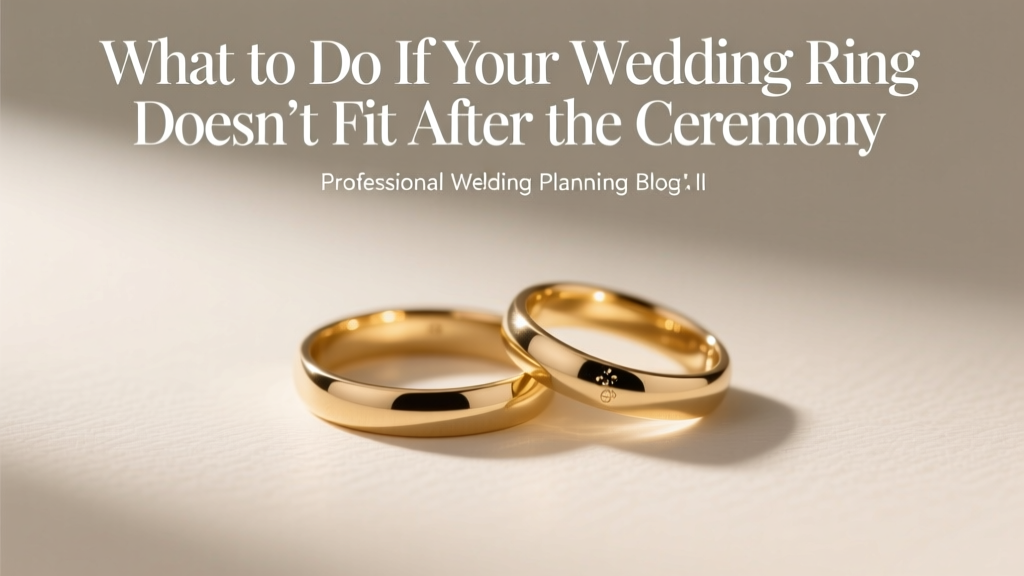
What to Do If Your Wedding Ring Doesn’t Fit
What to Do If Your Wedding Ring Does Not Fit After the Ceremony
You did the planning, you said the vows, you hugged everyone you love—and then you glance down and realize your wedding ring doesn’t fit the way you expected. Maybe it’s suddenly too tight, maybe it’s spinning like a hula hoop, or maybe it won’t go on at all. It’s surprisingly common, and it can feel emotional because your ring is one of the few physical symbols you’ll wear every day.
If you’re wondering what to do if your wedding ring does not fit after the ceremony, you’re not alone. Fingers change size for all sorts of normal reasons (travel, weather, nerves, hydration, and even the time of day). The good news: there are easy, etiquette-friendly fixes—and you don’t have to panic or “make it work” uncomfortably.
Quick Answer: What should you do right now?
If your wedding ring doesn’t fit after the ceremony, take it off (or don’t force it on), keep it safely stored, and contact a reputable jeweler as soon as possible for a professional sizing solution. In the meantime, use a temporary ring adjuster (for a ring that’s too loose) or wear the ring on a chain/necklace (if it’s too tight or you’re worried about swelling). Avoid DIY bending, forcing, or “squeezing” tricks that can damage the ring or your finger.
Why rings stop fitting (even if you were sized correctly)
Couples are often shocked because they were sized months ago and the ring fit perfectly at the appointment. Then the wedding happens—possibly during a hot outdoor ceremony, after a long flight, or after a salty rehearsal dinner—and your fingers behave differently.
Common, real-world reasons your ring fit changed overnight:
- Swelling from heat or travel: Summer weddings and destination weddings are a prime recipe for puffier fingers.
- Stress and adrenaline: Even happy stress can change circulation and fluid retention.
- Time of day: Many people are slightly more swollen later in the day.
- Diet and hydration: Alcohol, sodium, and dehydration can all affect finger size.
- Pregnancy or postpartum changes: Common for newlyweds and couples planning soon after.
- Temperature swings: Cold makes fingers shrink; warmth makes them expand.
“I tell couples to think of ring size as a range, not a single number,” says Marisa Kline, a fictional but realistic bench jeweler in Chicago. “A ring that fits perfectly in an air-conditioned showroom can feel tight at a July garden wedding. That doesn’t mean the ring is wrong—it means bodies are normal.”
Scenario 1: Your ring is too tight
What to do immediately
- Don’t force it. If it’s stuck or painful, stop. Forcing can cause swelling that makes it worse.
- Try cool water and elevation. Run your hand under cool (not icy) water and hold it above heart level for a few minutes.
- Lubricate gently. A small amount of hand lotion or dish soap can help a snug ring slide off. Go slowly and don’t twist aggressively.
- If it’s stuck and your finger is turning colors: Seek urgent help. An urgent care clinic or ER can remove a ring safely if circulation is compromised.
Short-term solutions
- Wear it on a chain necklace. This is a modern, very accepted option—especially on honeymoon hikes, at the gym, or during swelling.
- Switch to a temporary band. Some couples use a simple silicone band until the finger settles. Silicone wedding bands are a major trend for active lifestyles and travel.
Long-term solutions
Once swelling is down (often a few days to a couple of weeks), visit a jeweler for resizing or adjustments. Many rings can be resized up, but the process depends on the design:
- Plain metal bands are typically easiest to resize.
- Eternity bands (stones all the way around) are harder and sometimes not resizable.
- Alternative metals like tungsten and some titanium styles often can’t be resized and may require replacement.
- Engraved or intricate designs may be resizable but need a skilled bench jeweler to preserve details.
Real-couple moment: “My ring fit perfectly at our winter fitting, then our tropical honeymoon happened and I couldn’t get it over my knuckle,” says Ashley R., newlywed. “I wore it on a chain for two weeks, then we sized it up a quarter size. No drama—just normal life.”
Scenario 2: Your ring is too loose (spinning or slipping)
A loose ring can feel less urgent—until it disappears. Rings are often lost during handwashing, lotion application, ocean swims, or even a happy post-ceremony hand-wave.
What to do immediately
- Stop wearing it in risky situations (showering, swimming, gym, cooking with messy hands).
- Use a temporary ring size adjuster. Clear spiral ring sizers or sizing beads can help right away without changing the ring permanently.
- Consider insurance and documentation. If you haven’t already, photograph the ring and store receipts/appraisals. Ring insurance is increasingly common, especially for destination weddings.
Long-term solutions
- Professional resizing down is typically straightforward for most gold and platinum rings.
- Sizing beads or a spring insert can be ideal if your knuckle is larger than the base of your finger (a very common fit challenge).
“If a ring spins constantly, it’s not just annoying—it’s a safety issue for stones and prongs,” says fictional wedding jewelry consultant Devon Morales. “A simple adjustment can prevent long-term damage and the heartbreak of a lost ring.”
Modern etiquette: Is it “bad luck” if the ring doesn’t fit?
You may hear old sayings about rings not fitting or slipping off being bad luck. Modern wedding etiquette is much kinder and more practical: a ring that doesn’t fit is a sizing and timing issue, not a relationship omen.
Traditional couples sometimes feel pressure to wear the ring immediately and constantly. Modern couples are more flexible: they’ll wear a silicone band for travel, wear the ring on a necklace, or wait to resize until after the honeymoon. None of this is considered rude or “less married.”
If family comments make you anxious, a simple line works: “We’re having it professionally adjusted so it fits safely.” Most people drop it immediately.
Actionable tips to prevent this (or handle it smoothly next time)
- Schedule sizing at the right time of day. Late afternoon often reflects a more “average” finger size than early morning.
- Avoid sizing right after flights, workouts, or salty meals. You want your typical baseline.
- Consider a quarter-size adjustment. Tiny changes make a big difference in comfort.
- Plan for seasonal shifts. If you’re getting married in summer but sized in winter, mention that to your jeweler.
- Ask about resizing policies before you buy. Many jewelers include one resize within a certain time window.
- Bring a backup option to the wedding weekend. A clear ring sizer, a simple temporary band, or a chain necklace can save the day.
Related questions couples ask (and edge cases)
Should I resize immediately after the wedding?
If the ring is painfully tight or dangerously loose, yes—book a jeweler appointment soon. If it’s only slightly off and you’ve been traveling or it’s unusually hot/cold, wait a week or two for your body to settle before resizing.
Can my ring be resized if it has diamonds or an eternity band?
Sometimes, but not always. Full eternity bands are often not resizable. A jeweler may suggest sizing beads, a replacement band, or a redesign (such as a half-eternity). If your ring has pavé stones, resizing is possible but should be done by a skilled bench jeweler to protect settings.
What if I lose weight or gain weight after the wedding?
It happens. Many couples resize within the first year. Some wait until their weight stabilizes, using a temporary ring adjuster in the meantime.
What if my partner’s ring fits and mine doesn’t—did we do something wrong?
No. Different hands swell differently, and ring styles fit differently too. A wide band often feels tighter than a thin band at the same size, so the “number” isn’t the whole story.
Can I resize it myself with online tools?
Avoid at-home stretching or bending. It can warp the ring, weaken prongs, crack certain metals, and void warranties. Temporary ring sizing tools (like plastic adjusters) are fine; permanent changes should be done professionally.
Conclusion: The reassuring takeaway
If your wedding ring does not fit after the ceremony, it’s a common hiccup—not a crisis, not a sign, and definitely not something you have to suffer through. Keep the ring safe, use a temporary solution that protects your finger and your jewelry, and get a professional adjustment when your body has settled. Your marriage is the forever part; the ring just needs a quick tweak to catch up.
More Articles
 Pagan Wedding: What Actually Happens (2026)
 Can You Edit Wedding Photos? A Complete Guide
 Diana and Charles Wedding: Was It Arranged?
 Chuck Drummond at Alex's Wedding? Evidence Revealed
 White Wedding Dress Origin: Victoria’s Role Revealed
 Wedding Cancellations on Day: Shocking 2026 Stats
 Who Decides the Wedding Menu the Couple or the Venue
 Church Wedding Guest Outfit Guide (2026)
 Where Does Man Wear Wedding Ring (2026)
 How Many Hymns at a Catholic Wedding: The Complete Guide