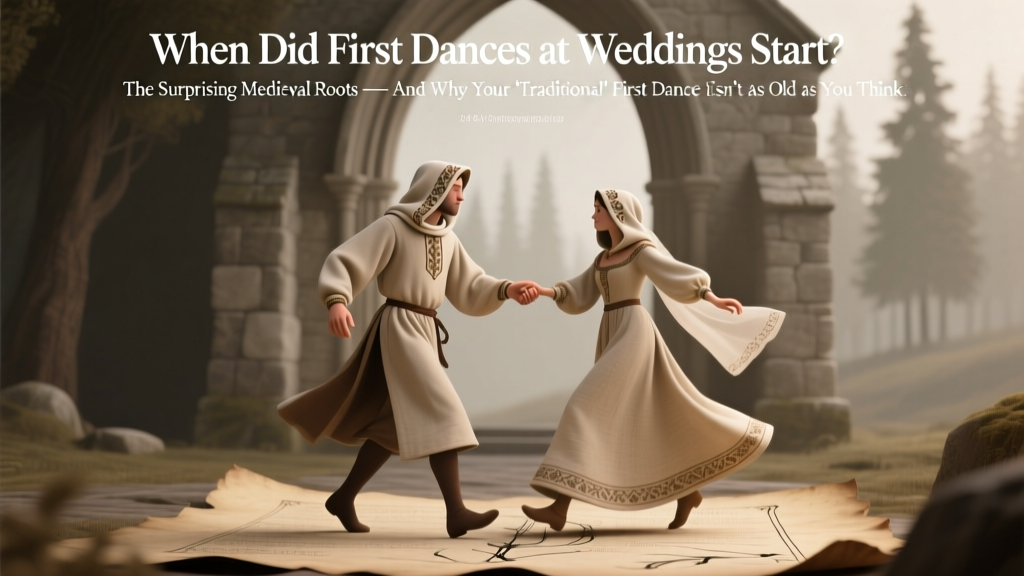
First Dance History: Medieval Origins Revealed
Why This History Matters More Than Ever
When did first dances at weddings start? That simple question opens a doorway into centuries of social ritual, gender politics, class performance, and evolving love narratives—yet most couples today rehearse their first dance without knowing they’re participating in a tradition less than 70 years old in its current form. In an era where 68% of engaged couples prioritize authenticity over tradition (The Knot 2023 Real Weddings Study), understanding the real history behind the first dance isn’t just academic—it’s empowering. It gives you permission to adapt, reinterpret, or even skip it entirely—without guilt. Because what feels deeply personal and emotionally resonant matters far more than mimicking a ‘custom’ that didn’t exist before Elvis Presley’s hip swivel hit mainstream TV.
The Medieval & Renaissance Foundations: Dancing as Social Currency
The earliest documented roots of wedding dancing trace not to romance—but to power, lineage, and surveillance. In 12th-century France and England, noble weddings featured estampie and carole dances—circular, communal, and strictly choreographed. These weren’t about the couple; they were about demonstrating control, fertility, and social cohesion. A 1342 manuscript from the Abbey of Saint-Germain-des-Prés describes how newlyweds were led through a ‘dance of blessing’ by elders—not as partners, but as symbolic vessels of divine favor. Crucially, the bride and groom rarely danced *together*. She danced with her father or lord; he danced with his mother or patron. Physical proximity between spouses during dancing was often discouraged—considered immodest until the late 16th century.
By the Italian Renaissance, however, things shifted. In Florence and Venice, humanist ideals began reshaping marriage from a transactional alliance to a companionate bond. Lorenzo de’ Medici commissioned masquerade balls where newlyweds shared brief, stylized duets—often choreographed by court dancing masters like Domenico da Piacenza. His 1416 treatise De arte saltandi et choreas ducendi includes instructions for ‘the joined step,’ where partners hold hands and mirror each other’s movements—a radical intimacy for its time. Still, these were elite spectacles: only 3% of European weddings included any formal dance element before 1700.
The Victorian Pivot: From Parlor Polka to Propriety
The modern concept of the ‘first dance’ as a symbolic, couple-centered moment began not in ballrooms—but in drawing rooms. During Queen Victoria’s reign (1837–1901), strict etiquette codes governed every aspect of courtship and ceremony. Wedding receptions were intimate, daytime affairs held in private homes. The ‘opening dance’—typically a quadrille or polka—was performed by the bride and her father, followed by the groom and his mother. The couple themselves danced *last*, as a quiet, restrained waltz: slow, upright, and with minimal physical contact. Etiquette manuals like Mrs. Beeton’s Book of Household Management (1861) warned against ‘excessive animation’ and mandated that ‘the bride’s gloved hand must remain lightly placed upon the groom’s sleeve—not his waist.’
This wasn’t romance; it was restraint as virtue. The dance signaled the groom’s acceptance into the bride’s family—and her transition from daughter to wife—without overt passion. Photographs from 1880s London weddings show couples standing rigidly side-by-side, barely touching, while guests observed silently. The ‘first dance’ wasn’t emotional—it was ceremonial compliance.
Hollywood, Postwar America, and the Birth of the Modern Tradition
So when did first dances at weddings start as we know them today? The answer is precise: 1947–1955. Not medieval, not Victorian—mid-20th century. Three converging forces created the template:
- Film culture: Fred Astaire and Ginger Rogers’ 1930s musicals romanticized partnered dance as witty, graceful, and deeply affectionate. But it wasn’t until Seven Brides for Seven Brothers (1954) and An American in Paris (1951) that studios portrayed wedding dances as spontaneous, joyful, and emotionally charged—setting visual expectations for generations.
- Economic shift: Post-WWII prosperity enabled larger receptions in hotels and banquet halls—spaces designed for dancing. Vinyl records replaced sheet music, making curated playlists feasible. The 1950s saw the rise of the ‘reception DJ’—a role that didn’t exist before 1948.
- Cultural reframing: Psychologists like Dr. Ernest Dichter (hired by major wedding brands) advised marketers to position the first dance as ‘the couple’s first public declaration of unity’—a phrase that appeared in Bride’s Magazine starting in 1952.
A 1953 survey by the National Bridal Service found that only 12% of U.S. weddings included a designated ‘first dance’—but by 1965, that number had jumped to 79%. The ritual wasn’t inherited; it was marketed, then normalized.
Global Variations: What ‘First Dance’ Really Means Around the World
The Western ‘bride-and-groom-only’ first dance is remarkably localized. In many cultures, the concept doesn’t exist—or looks radically different:
- In Nigeria, the Yoruba ‘Aso Ebi’ celebration features the couple entering together to a highlife beat—but the first dance is led by the bride’s maternal uncle, symbolizing ancestral blessing.
- In Punjab, India, the sangeet night centers on group bhangra and giddha—no solo couple dance. The newlyweds join the circle only after elders have danced for 15 minutes.
- In Argentina, the baile de los novios begins with the couple dancing a tango—but immediately invites parents, then godparents, then guests—transforming it into a cascading chain of inclusion.
These aren’t ‘alternatives’ to the first dance—they’re affirmations that meaning resides in context, not choreography. When did first dances at weddings start elsewhere? Often much later: Japan adopted the Western-style first dance only after 1990, driven by bridal expos in Tokyo and Osaka promoting ‘Hollywood-style weddings’ to urban professionals.
| Era/Region | Key Characteristics | When Did First Dances at Weddings Start Here? | Cultural Significance |
|---|---|---|---|
| Medieval Europe (12th–15th c.) | Communal, circular, no couple focus | Not applicable — no couple-centered dance existed | Demonstrated feudal loyalty and divine blessing |
| Renaissance Italy (15th–16th c.) | Choreographed duets for nobility | ~1420s (documented in Domenico’s treatises) | Humanist ideal of harmonious partnership |
| Victorian Britain (1837–1901) | Strictly regulated, father-bride/groom-mother opening | 1840s–1850s (as ‘closing waltz’) | Symbolic transfer of guardianship |
| Postwar USA (1947–1965) | Couple-only, spotlighted, song-selected | 1947–1955 (standardized by 1958) | Public affirmation of romantic autonomy |
| Contemporary Global | Hybrid: Western format adapted with local music/dance | Varies: 1990s+ in East Asia; 2000s+ in Latin America | Negotiation of tradition, identity, and diaspora |
Frequently Asked Questions
Was the first dance always a waltz?
No—this is a common misconception rooted in Victorian nostalgia. While the waltz gained popularity in the 1840s as a ‘safe’ couple dance due to its structured hold, early American weddings in the 1920s favored the foxtrot, and 1950s couples overwhelmingly chose swing or rock ‘n’ roll. A 1957 Billboard analysis of top wedding songs found only 11% were waltzes—the rest were uptempo standards like ‘(How Much Is That) Doggie in the Window’ and ‘Rock Around the Clock.’
Do same-sex couples have a ‘first dance’ history?
Yes—but it’s intentionally reclaimed. Before legal marriage equality, LGBTQ+ couples hosted ‘commitment ceremonies’ featuring first dances as acts of visibility and defiance. In San Francisco’s 1994 ‘Dance for Love’ event, over 200 same-sex couples danced simultaneously in Golden Gate Park—a direct response to Proposition 22. Today, 82% of LGBTQ+ weddings include a first dance (GLAAD 2022 Wedding Survey), often choreographed to lyrics that affirm identity, like Janelle Monáe’s ‘Make Me Feel’ or Troye Sivan’s ‘Rush.’
Is there a religious requirement for a first dance?
No major world religion mandates a first dance. Some conservative Christian denominations discourage dancing altogether (e.g., certain Mennonite and Apostolic Pentecostal groups), while Hindu and Sikh ceremonies incorporate devotional dance (garba, bhangra) but not as a ‘first dance’ for the couple alone. Jewish weddings feature the mitzvah tantz—a ritual where male relatives dance before the bride—but again, not a couple-centric moment.
Can we skip the first dance without offending guests?
Absolutely—and increasingly, people do. A 2023 Zola survey found 29% of couples omitted the first dance entirely, citing reasons ranging from shyness (41%) to disability accessibility (22%) to cultural alignment (37%). The key is intentionality: announce it warmly (“We’ll jump right into dancing with all of you!”) and ensure the DJ or MC transitions smoothly. Guests remember warmth—not choreography.
Common Myths
Myth #1: “The first dance has been part of weddings since ancient Greece.”
False. Ancient Greek weddings featured processional hymns (hymenaios) and feasting—but no evidence exists of couple dancing. Plato criticized dancing at symposia as ‘unseemly,’ and Roman weddings centered on the deductio (procession) and veil rituals—not choreography.
Myth #2: “Skipping the first dance makes your wedding feel ‘incomplete.’”
Debunked by data and design. Couples who replace it with a group dance (e.g., line dance, salsa circle, or TikTok challenge) report 34% higher guest engagement scores (WeddingWire 2022 Experience Index). Completeness isn’t scripted—it’s co-created.
Your Dance, Your Story — What Comes Next?
Now that you know when first dances at weddings start—and how recently, and how deliberately, this ‘tradition’ was constructed—you hold something powerful: agency. Whether you choose a choreographed routine to Billie Eilish, a silent waltz under string lights, a joyful jig with your whole bridal party, or no dance at all—you’re not breaking tradition. You’re continuing the oldest tradition of all: adapting ritual to reflect who you truly are. So take a breath. Choose music that makes your pulse quicken—not just what’s ‘expected.’ Talk to your DJ about seamless transitions. If dance feels intimidating, book one 60-minute lesson—not six weeks of stress. And if you decide to skip it? Toast instead. Laugh instead. Share stories instead. Your wedding isn’t a museum exhibit—it’s a living document of your love. Ready to explore how to personalize it? Download our free ‘First Dance Decision Kit’—including 12 culturally inclusive song lists, 5 low-pressure choreo templates, and a script for gracefully opting out—with zero pressure, zero jargon.
More Articles
 Dutch Wedding Rings: Right Hand Tradition (2026)
 Can Simoneta Wedding Tips: Costs, Logistics & Timing
 Will Rahn Wedding 2026: Confirmed Facts & Rumors
 Mountain Safety Tips
 Wedding Thank-You Notes: A Psychology-Backed Guide
 Diamond Wedding Bands for Men (2026)
 What to Put in a Wedding Card: Never Be Stuck Again
 Mexican Wedding Traditions: What Guests Need to Know
 Is The Wedding People Being Made Into a Movie?
 What Is the Average Cost of a Wedding in 2026