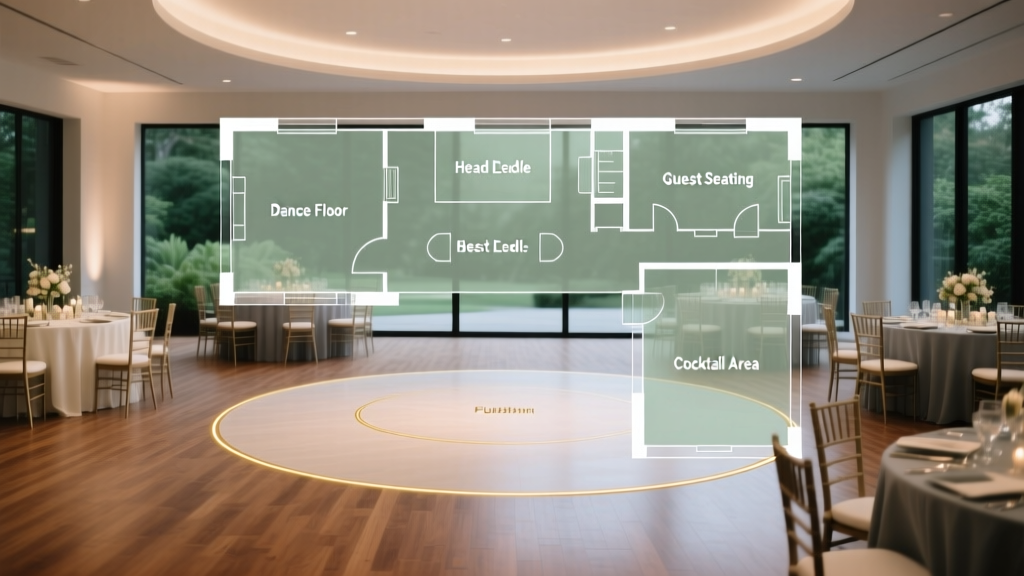
When to Finalize Your Wedding Reception Floor Plan
When to Finalize Your Wedding Reception Floor Plan
Q: When should we finalize our wedding reception floor plan?
If you’re staring at a blank room diagram and a growing guest list, you’re not alone. The reception floor plan is one of those behind-the-scenes details that quietly affects everything—how long dinner takes, whether guests mingle, how crowded the dance floor feels, and even how smoothly your photographer can move around the room.
Couples often worry they’ll finalize too early and regret it, or finalize too late and cause chaos for the venue. The good news: there’s a sweet spot that works for most weddings, plus a few flexible strategies if you’re dealing with last-minute changes.
A: Finalize your reception floor plan about 2–3 weeks before the wedding.
That timing usually lines up with your final RSVP count, seating assignments, and vendor needs (catering, DJ/band, rentals). Many venues ask for the final layout 10–14 days out; some planners prefer closer to 3 weeks so you have a buffer for tweaks.
Q: Why does the floor plan need to be finalized that “late”?
A: Because your floor plan depends on information you won’t truly have until the final stretch. You can draft it early (and you should), but locking it in too soon often leads to redo work and unnecessary stress.
Here’s what typically comes together right before the finish line:
- RSVP stragglers and final headcount. Even with firm RSVP deadlines, a few guests change plans.
- Meal selections and dietary notes. Caterers may want a layout that supports efficient service (especially with plated dinners).
- Vendor logistics. DJ/band footprint, photobooth space, bar placement, dessert displays, late-night snacks, and special stations.
- Rentals and linen counts. Final table sizes, chair totals, and whether you’re adding lounge furniture or extra cocktail tables.
As wedding planner “Marisol Grant” puts it: “A floor plan is like a living document until you have the final RSVP number. I aim to have a near-final version by three weeks out, then lock it once the venue and caterer confirm staffing and service flow.”
Q: What’s a realistic timeline for creating (and finalizing) the floor plan?
A: Think of it in phases—draft early, refine mid-way, finalize close to the wedding.
3–6 months before: Build your first draft
- Confirm your guest count estimate and your venue’s max capacity for seated dinner.
- Decide on your table types (rounds vs. long tables vs. a mix).
- Sketch the basics: dance floor, sweetheart/head table, DJ/band, bar, buffet or service path, cake/dessert area.
Real-world example: “We fell in love with long family-style tables,” says fictional bride “Tessa.” “Then we learned our venue columns would block servers if we forced that layout. Drafting early gave us time to pivot to rounds with one long head table.”
6–8 weeks before: Refine with vendor input
- Share your draft with your planner/coordinator, venue, and caterer.
- Confirm dance floor size based on your guest count and whether you’re doing a big party vibe or a more intimate dinner-forward reception.
- Adjust for trends you’re incorporating: a statement champagne wall, an audio guest book, a content creator corner, a cigar bar, or a selfie mirror.
“Modern receptions have more ‘moments’ than they used to,” notes fictional venue manager “David Chen.” “Couples want a photobooth, late-night snack station, and lounge seating. All of that can work beautifully—but it needs to be mapped so guests don’t bottleneck near the bar or restrooms.”
2–3 weeks before: Finalize and distribute
- Lock your final headcount (or as close as you can get).
- Complete seating assignments and table numbers.
- Send the floor plan to: venue, catering, rentals, florist, DJ/band, photographer (and planner/coordinator).
Pro tip: Finalize the floor plan at the same time you finalize your wedding seating chart. They’re best friends. One can’t truly be done without the other.
Q: Traditional vs. modern approaches—do the rules change?
A: The “2–3 weeks out” guideline holds, but your style affects how complex the plan is and how much flexibility you’ll want.
Traditional reception (more structured)
- Often includes a clear head table, assigned seating, and a standard timeline (grand entrance, dinner, toasts, dances).
- Floor plans are usually simpler, so finalizing at 2 weeks out is common.
Modern reception (experience-driven)
- May include mixed seating (some assigned, some open), lounge clusters, interactive food stations, or a room “flip” from ceremony to reception.
- Because there are more moving parts, couples often benefit from finalizing closer to 3 weeks out—and creating a backup version.
One modern etiquette shift: couples are prioritizing comfort and guest flow over rigid traditions. For example, it’s now common to place the dance floor near the bar to keep energy up, rather than centering everything around the head table.
Q: What should we double-check before we call it “final”?
A: Run through this quick floor plan checklist:
- Guest flow: Can guests move from entrance to seating, to bar, to restrooms without squeezing past tables?
- Accessibility: Are there clear paths for mobility devices? Are there seats reserved for elderly guests away from speakers and heavy traffic?
- Service efficiency: Does catering have room to serve plated meals or manage a buffet line without gridlock?
- Visibility: Can most guests see toasts and key moments? Avoid placing tall centerpieces where they block sightlines.
- Sound and lighting: Is the DJ/band placed to balance sound across the room? Is the sweetheart table in a flattering light?
- Vendor footprints: Photobooth, dessert table, gift table, guest book, card box, and any cultural elements (tea ceremony table, hora chair lifting space, etc.).
“The biggest mistake I see is underestimating space,” says fictional DJ “Renee Alvarez.” “A ‘small’ DJ setup can still need 8–12 feet of width once you add speakers, a facade, and lighting. When couples finalize early without confirming dimensions, they end up sacrificing guest seating or dance floor space later.”
Q: What if we have last-minute RSVP changes after the floor plan is finalized?
A: Plan for a little flexibility so a change doesn’t unravel everything.
- Build in a buffer table. If your budget allows, having one table that’s not completely full gives you wiggle room.
- Aim for “soft final” vs. “hard final.” Send the venue the final plan, but keep an internal version you can adjust if needed.
- Know your venue’s cutoff. Some venues can move place settings easily; others require a strict final diagram for staffing and rentals.
Real-couple style example: “Two guests canceled the day before,” says fictional groom “Eli.” “Our coordinator just redistributed them to fill gaps and removed one place setting at a table of ten. Because our layout wasn’t maxed out, it didn’t change the whole room.”
Q: How do current wedding trends affect floor plan timing?
A: Trends add extra vendors and spaces, which makes earlier drafting more valuable—even if you still finalize later.
Popular elements that impact reception layout:
- Lounge seating clusters (great for guest comfort; requires extra square footage)
- After-party vibes (bigger dance floor, late-night snacks, sometimes a second bar)
- Content creation (a designated “moment” wall or area with good lighting)
- Interactive food (espresso bar, oyster shucker, taco station—these need power and service lanes)
- Non-traditional seating (serpentine tables, mixed rounds and rectangles, kings tables)
If you’re incorporating any of these, get a draft to your venue earlier so they can flag spacing or power issues. Finalize at 2–3 weeks, but start collaborating sooner.
Related questions couples often ask
Q: Can we finalize the floor plan before we get all RSVPs back?
A: You can finalize a draft. If you must lock it early (destination weddings sometimes require this), create two versions: one for your expected count and one for a slightly higher count. That way you’re not rebuilding from scratch.
Q: What if we’re doing escort cards instead of assigned seats?
A: You still need a floor plan with table numbers and capacities. Escort cards reduce the pressure of perfect seat-by-seat placement, but the room layout must still support your headcount and service style.
Q: What if we’re having a buffet?
A: Buffets need more planning than people expect. You’ll want to finalize earlier with your caterer so you can avoid lines blocking the dance floor or restrooms. Consider dual-sided buffets or two stations for larger guest lists.
Q: Our ceremony and reception are in the same space—when should we finalize the flip plan?
A: Aim for 3 weeks out and confirm staffing. Room flips require precise timing, storage space for ceremony chairs, and a clear load-in/load-out plan for vendors.
Conclusion
Finalize your wedding reception floor plan about 2–3 weeks before the wedding, once RSVPs, rentals, and vendor logistics are clear. Draft it earlier, refine it with your venue and caterer, and leave yourself just enough flexibility for real life. A thoughtful layout isn’t about perfection—it’s about creating a reception that feels easy for your guests and calm for you.
More Articles
 How Soon to Buy a Wedding Dress: Avoid Costly Mistakes
 Lawfully Wedded Husband": Meaning & Modern Vow Alternatives
 Barney and Robin Wedding: What Really Happened (2026)
 What Strain Is Wedding Cake: Indica or Sativa? (2026)
 How to Say Congrats for a Wedding (2026)
 How Big Is Kim Kardashian's Wedding Ring? (2026)
 Does the Bride Do a Speech at the Wedding? The Truth
 Proposing at a Wedding: Truth, Risks & Timing (2026)
 Wedding Dress Consultants: Do They Get Commission? (2026)
 What Is the Etiquette for Wedding Gift Acknowledgment