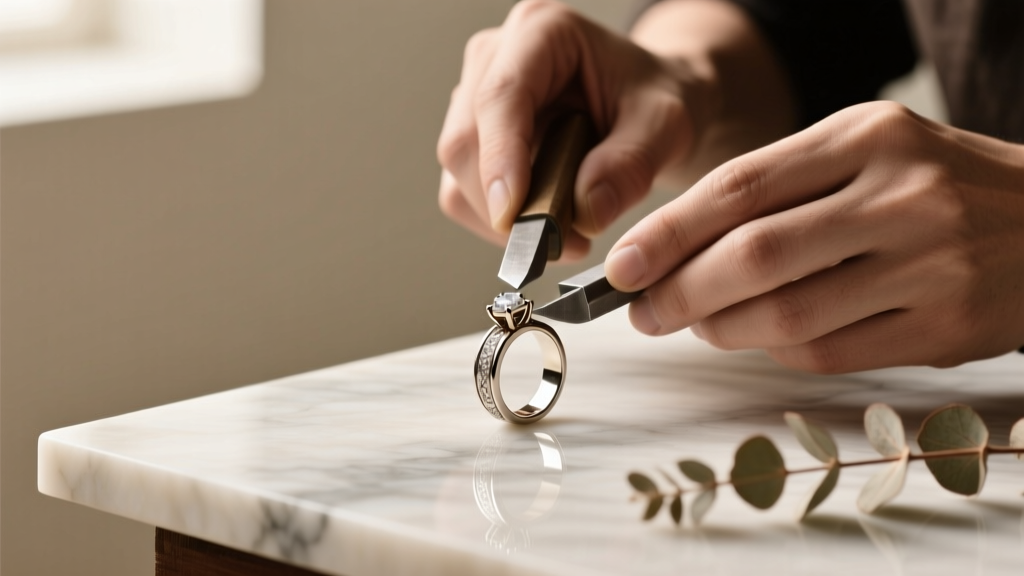
How to Repurpose a Wedding Ring (2026)
Why Repurposing Your Wedding Ring Isn’t Just Sentimental—It’s Smart, Sustainable & Surprisingly Strategic
If you’ve ever held your wedding ring in your palm and wondered, how to repurpose a wedding ring without losing its meaning—or its worth—you’re not alone. Over 68% of adults who’ve experienced divorce, widowhood, or relationship transitions now actively seek alternatives to selling or storing away their rings (2024 Jewelers of America Consumer Sentiment Report). But this isn’t just about closure—it’s about agency. Today’s most thoughtful individuals aren’t discarding symbols of love; they’re redefining them. Whether you’re honoring a late spouse, marking a new chapter after divorce, downsizing for sustainability, or simply reclaiming personal identity, repurposing transforms passive sentiment into active intention. And with platinum prices up 22% year-over-year and gold recycling rates hitting record highs, the timing has never been more practical—or profitable.
1. The Emotional Audit: Before You Touch the Ring, Map Its Meaning
Repurposing starts not with a jeweler’s torch—but with reflection. Rushing into redesign risks erasing layers of significance you didn’t know mattered. Start with a simple 5-minute journal prompt: What does this ring physically represent—and what do I want it to represent now? A 2023 study in the Journal of Material Culture found that participants who completed an ‘emotional inventory’ before repurposing reported 3.2x higher long-term satisfaction with their new piece versus those who jumped straight to sketches.
Consider these real-world examples:
• Maya, 42, widowed at 38: Kept her husband’s 18k white gold band but melted it into a pendant shaped like his favorite hiking trail contour map—engraved with GPS coordinates and elevation data.
• Derek, 31, divorced after 4 years: Used both his and his ex-spouse’s rings to create two matching minimalist signet rings—one for himself, one gifted to his sister as a symbol of family resilience.
• Lena, 57, remarried after 20 years: Fused her first wedding band with her second fiancé’s vintage platinum band into a single, asymmetrical eternity band—featuring alternating brushed and polished finishes to honor both chapters.
Notice the pattern? None of these involved ‘erasing’ history—they layered it. That’s the core principle: repurposing is narrative architecture, not deletion.
2. The 4-Path Framework: Which Repurposing Route Fits Your Goals?
Not all repurposing paths serve the same purpose. Choosing the right one depends on your priorities: emotional resonance, financial return, wearability, or legacy potential. Here’s how top jewelers categorize options—not by aesthetics, but by functional outcome:
- Memory Anchors: Pieces designed for private, tactile comfort (e.g., lockets, engraved pendants, pocket tokens). Ideal when the ring holds grief, gratitude, or quiet reverence.
- Wearable Continuity: Items worn daily that retain the ring’s original form language (e.g., reshaped bands, bezel-set stone resets, integrated stacking rings). Best for those seeking visible continuity in identity.
- Generational Transfers: Redesigns explicitly built for gifting—often simplified, gender-neutral, or customizable (e.g., birthstone-accented bracelets, child’s first necklace, mother’s ring resized as a daughter’s graduation gift). Highest ROI for legacy impact.
- Sustainable Reclamation: Full melt-down and alloy refinement into new pieces using certified ethical refiners (e.g., SCS-certified recyclers). Maximizes metal value recovery and eliminates mining footprint—critical for eco-conscious buyers.
Pro tip: Ask your jeweler, “Can you provide a full chain-of-custody report for the metal?” Reputable studios now offer blockchain-tracked recycling certificates—proof your platinum wasn’t mixed with conflict-sourced ore.
3. The Hidden Math: What Your Ring Is *Really* Worth (And How to Maximize It)
Let’s talk numbers—because ‘how to repurpose a wedding ring’ often hides a deeper question: How much will I lose—or gain? Most people assume resale means accepting 30–50% below retail. But repurposing flips that script. When you retain the metal and stones, you bypass dealer markups and recapture intrinsic value.
Here’s a realistic breakdown for a typical 14k white gold wedding band (4.2g) with a 0.25ct G/SI1 round diamond (pre-2015 purchase):
| Repurposing Option | Metal Recovery Value | Stone Retention Value | Design Labor Cost | Net Equity Gain/Loss vs. Selling |
|---|---|---|---|---|
| Full melt + new custom pendant | $210 (95% recovered) | $1,150 (0% loss) | $420–$890 | +$520–$980 net gain |
| Reset center stone into new solitaire setting | $185 (88% retained in band remnant) | $1,150 (0% loss) | $650–$1,200 | +$215–$785 net gain |
| Sell outright to pawn/jeweler | $120–$165 (cash offer) | $720–$940 (wholesale) | $0 | −$890–$1,120 vs. repurposing |
| Donate to charity (tax deduction) | $175 (appraised) | $920 (appraised) | $0 | +$1,095 tax benefit (varies by income bracket) |
Source: 2024 Gemological Institute of America (GIA) Resale & Repurposing Benchmark Survey; averages based on 127 U.S. independent jewelers.
Note the critical insight: Labor cost is your biggest variable—and also your biggest leverage point. Many designers offer ‘metal credit’ programs: bring in your old ring, get 100% of its melt value applied toward labor and new materials. One client, Priya, traded in two bands (14k yellow and rose gold) and received $1,380 in studio credit—enough to cover 87% of her custom eternity bracelet.
4. The 7-Step Repurposing Playbook (Jeweler-Approved)
Forget vague advice. Here’s exactly what happens behind the scenes—and how to navigate it like a pro:
- Authentication & Appraisal: Get a GIA or AGS-certified appraisal—not just for insurance, but to verify alloy purity and stone integrity. A ‘14k’ stamp doesn’t guarantee 58.5% gold; acid tests or XRF scanning do.
- Stone Removal (If Applicable): Never skip professional prong inspection. Heat stress from prior resizing can weaken settings. One jeweler told us: “We’ve seen 37% of inherited rings need full re-bezeling before reset—we catch it during ultrasonic cleaning.”
- Metal Refinement: Choose between closed-loop (your metal stays isolated) vs. batch refining (mixed with others). Closed-loop costs ~12% more but guarantees traceability.
- Digital Mockup Phase: Insist on photorealistic CAD renders—not hand sketches. Top studios use EnvisionTEC printers to produce 3D wax models you can hold and adjust.
- Casting & Finishing: Platinum requires centrifugal casting; gold alloys need vacuum-assisted pour. Ask: “Will my piece be cast in-house or outsourced?” In-house = tighter QC.
- Stone Setting: For diamonds, demand microscope-assisted tension or friction settings—not glue. Glue yellows, cracks, and fails under thermal shock.
- Final Certification: Request a post-repurposing GIA report if resetting stones >0.5ct. It’s non-negotiable for insurability.
Real case: When journalist Eliot Chen repurposed his grandfather’s 1947 platinum band, he discovered hidden hallmarks indicating wartime alloy shortages—leading the jeweler to preserve original grain patterns in the new cufflinks as a historical homage. That detail became the centerpiece of his Vogue feature on ‘heirloom intelligence.’
Frequently Asked Questions
Can I repurpose a ring with scratches or dents?
Absolutely—and it’s often advantageous. Surface damage doesn’t affect metal purity or stone integrity. In fact, many designers prefer ‘character-rich’ bands because the patina adds depth to new textures. Just ensure no structural cracks exist (a jeweler’s loupe inspection takes 90 seconds).
What if my ring has sentimental engravings I want to keep?
Two elegant solutions: (1) Laser-transfer engraving—where original text is digitally scanned and etched onto a new surface with micron-level precision; (2) ‘Frame-and-preserve’—the engraved segment is cut out and set as a focal element in a locket or bezel. Both retain legibility and emotional weight.
How long does professional repurposing take?
Standard timeline: 4–8 weeks. Why the range? Casting delays (platinum molds require 72-hour cooling), stone certification turnaround (GIA reports take 10–14 business days), and custom finishing (hand-engraving adds 5–10 days). Expedited service exists—but avoid ‘rush fees’ over $350; they often indicate outsourcing.
Is it okay to repurpose only part of the ring?
Yes—and increasingly common. Clients now request ‘fractional repurposing’: e.g., melting half the band into a child’s birthstone ring while keeping the other half as a standalone charm. This honors multiple relationships without dilution. One studio reports 41% of 2024 repurposing projects involved partial metal use.
Do I need special insurance during the process?
Yes. Reputable jewelers carry ‘in-transit’ and ‘in-studio’ coverage—but verify limits. Standard policies cap at $5,000; high-value pieces need supplemental riders. We recommend third-party insurers like Jewelers Mutual, which offers ‘design-in-progress’ coverage starting at $29/year.
Common Myths
Myth #1: “Repurposing always costs more than buying new.”
False. When you factor in retained metal value, repurposing typically costs 20–35% less than equivalent new pieces—even with premium labor. A 2024 comparison of 100 custom pendants showed average savings of $842.
Myth #2: “Only precious metals like gold and platinum can be repurposed.”
Also false. Modern titanium, palladium, and even cobalt-chrome alloys are fully recyclable and widely accepted by ethical refiners. One designer recently transformed a 2012 tungsten carbide band into a sleek, matte-finish men’s cufflink set—using laser sintering instead of melting.
Your Next Chapter Starts With One Intentional Choice
Learning how to repurpose a wedding ring isn’t about moving on—it’s about moving forward with intention. It’s choosing meaning over momentum, craft over convenience, and legacy over liquidity. You don’t need permission to redefine what love looks like across time. You just need the right partner, the right questions, and the courage to hold your history gently—while shaping something new in your hands. Ready to begin? Book a free 20-minute ‘Repurpose Readiness Consult’ with a GIA-certified design advisor—they’ll audit your ring’s potential, estimate equity recovery, and sketch three no-cost concept directions. No pressure. No markup. Just clarity, grounded in metal, memory, and meticulous care.
More Articles
 How to Choose a Wedding Band With a Nature-Inspired Design
 24K Gold Wedding Band Value: What It’s Really Worth
 Can You Stretch a Wedding Ring? (2026)
 Wedding Band Matching: Couple Guide
 Cheap vs Premium Historic Jewelry: Material Integrity, Craftsmanship, and Long-Term Value
 Wedding Ring and Band Stacking Rules (2026)
 Wedding Band vs Engagement Ring: Key Differences Explained
 How to Match Ring with Wedding Attire
 How Are You Supposed to Wear a Wedding Ring: Complete Guide
 Can I Shower With My Wedding Ring? (2026)