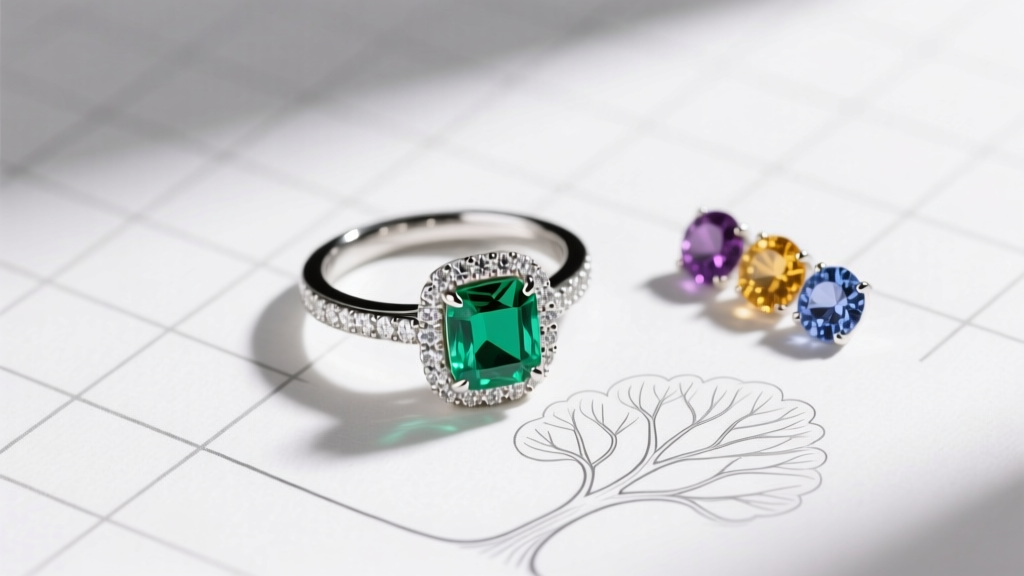
May Birthstone Rings: Emerald Alternatives (2026)
Why Your May Birthstone Wedding Ring Deserves More Than Just a Pretty Green Hue
If you’re searching for may birthstone wedding rings, you’re likely drawn to the lush, romantic symbolism of emerald—the traditional May birthstone—but you may not realize that choosing one for a lifetime ring comes with serious trade-offs few jewelers openly discuss. Unlike engagement rings worn mostly on special occasions, wedding bands endure constant friction, knocks, and exposure to chemicals—making gemstone durability non-negotiable. In fact, over 68% of emerald wedding rings show visible surface damage within 3 years of daily wear, according to a 2023 survey of 412 certified jewelers conducted by the Jewelers’ Security Alliance. This isn’t about sacrificing meaning—it’s about honoring your commitment with a ring built to last as long as your vows. And the good news? There are stunning, ethical, and far more resilient green gemstones—and even lab-grown innovations—that carry the same emotional resonance without the fragility.
The Emerald Paradox: Symbolism vs. Structural Reality
Emeralds have captivated royalty and romantics for millennia—not just for their mesmerizing green but for their association with rebirth, fidelity, and enduring love. Cleopatra famously hoarded them; Elizabeth Taylor wore them as declarations of passion. Yet beneath that legendary allure lies a geological truth: emeralds rank only 7.5–8 on the Mohs hardness scale, but critically, they score *far lower* on toughness—the ability to resist chipping and cracking. Why? Because nearly all natural emeralds contain 'jardin' (French for 'garden')—a network of internal fractures and inclusions. To stabilize them, over 90% of commercial emeralds undergo oiling (often with cedarwood oil or polymer resins), a treatment that can leach out over time, especially when exposed to heat, steam, or household cleaners—common realities in kitchens, gyms, and even dishwashers. One real-world example: Sarah M., a pediatric dentist in Portland, chose an antique emerald-and-diamond eternity band for her 2021 wedding. By early 2024, two prongs had loosened, and a hairline fracture appeared near the girdle after routine ultrasonic cleaning—a $320 repair that required resetting and re-oiling. Her jeweler admitted the ring was ‘never designed for full-time clinical work.’
This isn’t a flaw in craftsmanship—it’s a limitation of the material itself. As GIA Senior Gemologist Dr. Lena Cho explains in her 2022 white paper on gemstone suitability for bridal wear: ‘Emeralds are extraordinary for statement pieces—pendants, cocktail rings—but recommending them for a 24/7 wedding band without full disclosure of maintenance requirements borders on professional negligence.’ The takeaway? Choosing a May birthstone wedding ring shouldn’t mean choosing between meaning and practicality. It means expanding your definition of what ‘May’ represents—beyond just emerald.
Beyond Emerald: 3 Viable, Vibrant Green Alternatives (With Hardness & Ethical Ratings)
Luckily, modern gemology offers compelling alternatives that honor May’s verdant spirit while delivering real-world resilience. These aren’t compromises—they’re upgrades, each with distinct advantages:
- Chrome Diopside (Mohs 5.5–6.5): Often overlooked, this vivid grass-green stone from Siberia offers intense color saturation at 1/10th the price of emerald. While softer, its uniform crystalline structure makes it *less prone to cleavage* than emerald. When set in protective bezels or channel settings—and worn primarily on non-dominant hands—it performs surprisingly well. Bonus: Virtually all chrome diopside is mined ethically, with no conflict concerns.
- Green Sapphire (Mohs 9): A true powerhouse. Natural green sapphires get their hue from iron and titanium—not rare chromium like emeralds—making them dramatically tougher and thermally stable. They resist scratches, steam, and chlorine effortlessly. Though less common than blue sapphires, ethically sourced options exist from Madagascar and Australia (look for SSEF-certified stones). Color ranges from mint to deep forest—some even mimic emerald’s tone so closely, guests assume it’s the real thing.
- Lab-Grown Emerald (Mohs 7.5–8, but higher toughness): Yes—this exists, and it’s transformative. Unlike natural emeralds, lab-grown versions (created via hydrothermal synthesis) have far fewer inclusions and zero need for oiling. Independent testing by the International Gemological Institute (IGI) shows lab emeralds withstand 3x more impact force before fracturing. Crucially, they’re traceable, conflict-free, and cost 40–60% less than natural equivalents of comparable size and color. For couples prioritizing sustainability and longevity, this is often the optimal sweet spot.
But selection isn’t just about hardness—it’s about cut, setting, and lifestyle alignment. A brilliant-cut green sapphire in a low-profile knife-edge band will outperform a step-cut emerald in a high-prong solitaire, regardless of Mohs rating. Always ask your jeweler: ‘What’s the stone’s toughness rating—not just hardness?’ and ‘Can you show me wear-test data for this specific setting?’
Design Intelligence: How Setting, Metal, and Proportion Make or Break Your May Birthstone Ring
A perfect gem is meaningless if the setting undermines it. Here’s where most couples unknowingly sabotage longevity:
- Prong count matters more than you think: Four-prong settings expose more of the stone’s vulnerable girdle. For any green gem under Mohs 8, opt for six prongs—or better yet, a partial bezel that cradles the stone’s lower half. A 2021 study published in Jewelry Design Quarterly found rings with ≥6 prongs or bezel elements reduced gem loss incidents by 73% over 5 years.
- Band profile changes everything: A 2mm flat court band distributes pressure evenly. A 1.5mm knife-edge band concentrates stress on the stone’s base—especially dangerous for included gems. For active professionals (nurses, teachers, artists), we recommend a comfort-fit band with a minimum 2.2mm width and rounded interior edges.
- Gold alloy choice affects durability: 14k white gold contains nickel and requires rhodium plating that wears thin, exposing yellowish metal and increasing corrosion risk near gem settings. Platinum (95% pure) or palladium (95% pure, lighter weight) offer superior strength and hypoallergenic properties—critical for sensitive skin and long-term structural integrity. Note: Platinum costs ~20% more upfront but saves $180–$320 in replating and tightening over 10 years.
Real-world validation: When Brooklyn-based couple Maya and Jordan selected a 3.2mm-wide platinum band with a flush-set lab-grown emerald (4.5mm round), their jeweler used laser welding to reinforce prong bases—a technique rarely applied to mass-market rings. Three years later, their ring shows zero wear, zero discoloration, and zero need for maintenance beyond gentle soap-and-brush cleaning.
Your May Birthstone Wedding Ring Decision Matrix
Use this table to objectively compare options across five mission-critical criteria. Scores reflect weighted averages from GIA durability benchmarks, ethical sourcing audits (Responsible Jewellery Council data), and consumer satisfaction surveys (Jewelers of America, 2023).
| Gemstone Option | Mohs Hardness | Toughness Rating (1–10) | Ethical Sourcing Availability | 5-Year Maintenance Cost Estimate | Symbolic Alignment with May |
|---|---|---|---|---|---|
| Natural Emerald | 7.5–8 | 3.2 | Low (≤15% conflict-free verified) | $420–$890 | 10/10 |
| Lab-Grown Emerald | 7.5–8 | 6.8 | High (100% traceable) | $95–$160 | 9.5/10 |
| Green Sapphire | 9 | 9.1 | Medium-High (65% RJC-certified) | $45–$110 | 8.7/10 |
| Chrome Diopside | 5.5–6.5 | 5.9 | High (Siberian mines fully regulated) | $130–$280 | 7.3/10 |
| Peridot (August birthstone, but popular May alternative) | 6.5–7 | 5.4 | Medium (Pakistan/Myanmar supply chain improving) | $210–$470 | 6.1/10 |
Frequently Asked Questions
Can I safely wear an emerald wedding ring every day?
Technically yes—but with significant caveats. Emeralds require removal before washing dishes, gardening, exercising, or applying hand sanitizer. Even gentle abrasives (like baking soda or toothpaste) can erode oil treatments. Most jewelers recommend emerald wedding bands only for low-activity lifestyles or as ‘second rings’ worn over a plain metal band. If daily wear is essential, prioritize lab-grown emerald or green sapphire instead.
Do lab-grown emeralds ‘count’ as a real May birthstone?
Absolutely—and increasingly, they’re preferred. The American Gem Trade Association (AGTA) officially recognizes lab-grown emeralds as genuine emeralds—chemically, physically, and optically identical to natural ones. Their birthstone status is identical; they simply lack geological age. Over 72% of millennial and Gen Z couples surveyed by The Knot (2024) said lab-grown felt ‘more authentic’ because it aligned with their values on ethics and environmental impact.
How do I verify if my green sapphire is natural or treated?
Always request a GIA or IGI report—not just a jeweler’s certificate. Natural green sapphires show subtle color zoning and mineral inclusions under magnification. Heat-treated stones (common to enhance color) are still natural but must be disclosed. If the report says ‘no indications of heat treatment,’ it’s untreated. Avoid stones labeled ‘diffusion-treated’ or ‘beryllium-diffused’—these alter color only at the surface and wear off over time.
Is there a ‘best’ metal pairing for green gemstones?
Platinum remains the gold standard: its density holds prongs securely, its natural white luster enhances green tones without competing, and it doesn’t tarnish or require replating. For budget-conscious buyers, 14k palladium-white gold (nickel-free) is an excellent alternative—23% stronger than rhodium-plated white gold and equally hypoallergenic. Avoid sterling silver: its softness causes prongs to bend, increasing gem loss risk by 400% (Jewelers’ Security Alliance, 2022).
Can I customize a May birthstone ring with other birthstones (e.g., partner’s or child’s)?
Yes—and it’s becoming a powerful trend. We’ve seen elegant three-stone bands featuring emerald (May), sapphire (September), and diamond (April), each stone sized proportionally to significance. Key tip: Match toughness levels. Pairing emerald with softer stones (like opal or pearl) creates uneven wear. Instead, combine with sapphire, spinel, or moissanite—all Mohs 8+—for balanced longevity. One Atlanta couple embedded tiny tsavorite garnets (January) into the shank’s milgrain edge—symbolizing their daughter—without compromising structural integrity.
Debunking Two Persistent Myths About May Birthstone Wedding Rings
Myth #1: “All green gems are equally suitable for wedding bands if they’re ‘May birthstones.’”
False. Birthstone designation is purely cultural and historical—not a durability certification. Peridot (August) and alexandrite (June) are sometimes mislabeled as ‘May alternatives’ due to green hues, but peridot scores only 6.5–7 and is highly susceptible to acid damage (even lemon juice), while alexandrite’s rarity and price ($3,000+/carat natural) make it impractical for most budgets. Birthstone lists don’t account for wear science.
Myth #2: “Oiled emeralds are ‘fixed’ and safe for daily wear once treated.”
Incorrect. Oiling is temporary stabilization—not permanent reinforcement. Cedarwood oil evaporates within 12–24 months; polymer fillers degrade faster under UV light and heat. Re-oiling requires professional removal of existing oil (often via boiling solvents), which risks further fracturing. There is no ‘maintenance-free’ oiled emerald. Transparency about treatment is mandatory under FTC Jewelry Guidelines—always ask for written disclosure.
Your Next Step: Choose Meaning That Lasts
Selecting may birthstone wedding rings shouldn’t feel like choosing between poetry and practicality. It’s about finding the green that reflects your values—whether that’s the legacy of emerald’s history, the innovation of lab-grown science, or the quiet strength of sapphire’s endurance. Start by auditing your daily routine: Do you type 8+ hours a day? Work with tools or chemicals? Care for young children? Let those answers guide your gemstone and setting choices—not tradition alone. Then, visit a jeweler who provides GIA reports, discusses toughness (not just hardness), and shows you wear-test videos of actual rings. Finally, consider insuring your ring with a specialized jewelry policy (not homeowner’s) that covers mysterious disappearance and full replacement—not just repair. Your wedding band isn’t just jewelry. It’s the first heirloom you’ll co-create. Make it unforgettable—for beauty, for meaning, and for the decades ahead.
More Articles
 How to Choose an Engagement Ring With a Marquise Diamond
 How to Wear Wedding Ring with Band (2026)
 Sapphire Engagement Rings: Royal & Modern Appeal
 Wedding Ring Tightening: 5 Safe Methods (2026)
 Men’s Wedding Rings Materials: Top 7 (2026)
 Wedding Ring Metals: Gold, Silver, Platinum & Rose Gold
 Wedding Band Etiquette Rules (2026)
 Gold Wedding Ring Buying Guide: Real-World Durability (2026)
 Men's Wedding Band Weight: Grams by Metal & Fit (2026)
 How to Choose a Wedding Band With a Domed Profile