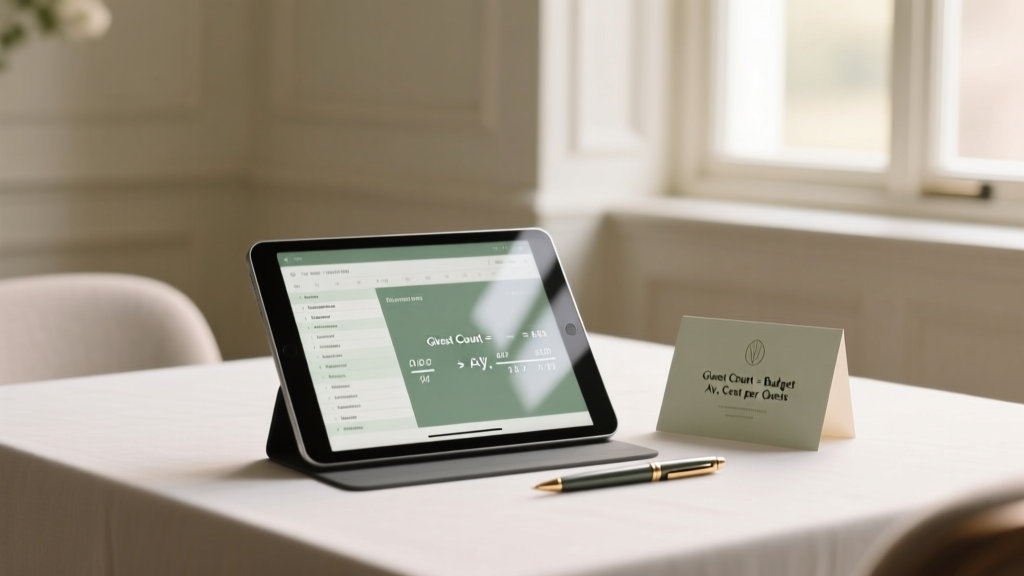
How Many Guests for a Wedding? Realistic Formula (2026)
Why 'How Many Guests for a Wedding' Is the First (and Most Stressful) Planning Decision You’ll Make
If you’ve just gotten engaged—or even if you’re six months into planning—you’ve likely stared at a blank spreadsheet, a half-filled RSVP card stack, or your phone’s Notes app wondering: how many guests for a wedding is actually realistic? This isn’t just a number—it’s the invisible foundation of your entire celebration. Get it wrong, and you risk blowing your budget by 37% (The Knot 2023 Real Weddings Study), overbooking a venue that feels cramped or underutilizing one that echoes with emptiness, alienating loved ones through unintentional omissions, or worse—facing vendor penalties for last-minute headcount changes. Yet most couples treat this like a gut feeling rather than a strategic calculation. In this guide, we break down exactly how to land on a guest count that honors your values, protects your finances, and sets your day up for genuine joy—not logistical whiplash.
Your Guest Count Is a Strategic Compromise—Not a Moral Test
Let’s start with a truth no planner will say out loud: There is no ‘right’ number—only the *right number for your specific reality*. That reality includes four non-negotiable pillars: budget, venue capacity & layout, relationship hierarchy, and logistical bandwidth. Ignore any one, and you’ll pay for it later—in dollars, emotional labor, or both.
Consider Maya and Derek, married in Asheville in 2023. They started with a ‘dream list’ of 280 names—until their $18,500 venue deposit required a minimum of 120 guests and capped at 160. Their $22,000 food-and-beverage budget allowed only $135 per person. Simple math: 160 × $135 = $21,600—leaving just $400 for cake, bar, and service fees. They realized they couldn’t afford their ‘dream list’ without sacrificing quality or going $12k over budget. So they applied a tiered filter—and landed at 142 guests. Not perfect. But intentional. And joyful.
Here’s how to replicate that clarity:
- Anchor to your hard numbers first: Total wedding budget ÷ estimated cost per guest (we’ll define this below) = your absolute ceiling.
- Validate against venue constraints: Does your ceremony + reception space comfortably seat that number? Remember: 12–14 sq ft per seated guest for dining; 25+ sq ft per guest for cocktail-style flow.
- Map relationships—not just names: Use our Relationship Tiers Framework (detailed next) to prioritize meaning over obligation.
- Build in a 5–8% buffer: For plus-ones, late additions from family pressure, or ‘soft yeses’ that become firm.
The Relationship Tiers Framework: Prioritize Meaning Over Mileage
Forget ‘must-invite’ vs. ‘maybe’. That binary creates guilt and indecision. Instead, sort every name into one of four evidence-based tiers—each with clear criteria and a recommended inclusion rate:
- Tier 1: Core Emotional Anchors (100% Invite)
People whose absence would fundamentally change the emotional resonance of your day—your parents, siblings, children (if applicable), grandparents who are present/active in your life, and your best friend(s) who’ve been there for major life milestones. Typically 25–35% of your final list. - Tier 2: Active Contributors (80–90% Invite)
Those who’ve invested time, energy, or support *recently*—e.g., coworkers you eat lunch with weekly, friends who helped you move or cared for you during illness, college roommates you still text daily. If you haven’t spoken in >18 months or interacted meaningfully in >12 months, they fall out of Tier 2. - Tier 3: Obligation Proximity (30–50% Invite)
This is where families get sticky. Think: second cousins, your aunt’s bridge group, your partner’s coworker you’ve met once. Inclusion here depends on *who’s paying*. If parents are funding 70%+ of the wedding, they get veto power on Tier 3 invites—but set boundaries early: ‘We’ll include up to X names from your side, and you choose which ones.’ - Tier 4: Legacy & Courtesy (0–10% Invite)
Names added out of tradition, not connection—e.g., your high school principal, your boss’s spouse (unless you socialize outside work), distant relatives you see only at funerals. Unless they’ve actively supported your relationship, skip them. Your wedding is not a civic event.
A real-world example: When Priya and James capped their list at 110, they invited 100% of Tier 1 (32 people), 85% of Tier 2 (41 people), 40% of Tier 3 (28 people), and 0% of Tier 4. They sent 109 invitations—and got 102 RSVPs. That 7-person gap? Exactly their built-in buffer.
The Budget-to-Guest Ratio: Your Secret Financial Compass
Most couples underestimate how tightly guest count drives cost. According to The Knot’s 2024 survey, the average U.S. wedding costs $30,400—and 52% of that goes to food, beverage, and venue (which scale linearly with headcount). Here’s how to reverse-engineer your number:
Start with your total budget. Subtract fixed, non-per-head costs first: photographer ($4,200), officiant ($500), marriage license ($100), attire ($2,800), stationery ($650), transportation ($1,100), and music ($2,400). Let’s say that’s $11,750. That leaves $18,650 for variable costs.
Now, allocate realistically:
- Venue rental (often has base fee + per-person charge): $8,200
- Catering (plated dinner avg. $42–$85/person): $6,300
- Bar package (open bar avg. $25–$45/person): $2,200
- Florals/decor (scales with guest count for centerpieces, escort cards, favors): $1,400
- Wedding cake & dessert station: $550
Total variable costs: $18,650. Now divide by your per-person estimates. Using mid-range averages ($65 catering + $32 bar + $12 decor + $5 cake = $114/person), your math is: $18,650 ÷ $114 ≈ 164 guests.
But wait—this is your *financial ceiling*, not your target. Now apply the venue constraint: if your dream barn venue maxes at 150 seated guests, your real target is 142–148 (accounting for buffer and no-shows). That’s how data beats desire.
Real-World Guest Count Benchmarks (and Why They’re Misleading)
You’ve seen the stats: ‘Average U.S. wedding has 131 guests.’ Or ‘Keep it under 100 for intimacy.’ These are averages—not advice. What matters is *your* context. Below is a comparative table showing how guest count shifts across key variables—with real planning implications:
| Factor | Small Wedding (≤60) | Mid-Size (61–150) | Large Wedding (151–300) | Mega Wedding (300+) |
|---|---|---|---|---|
| Budget Impact | Enables premium upgrades (e.g., lobster entree, live jazz, luxury linens) without inflation | Best value zone: bulk discounts kick in, but per-person costs stay manageable | Per-person catering/bar costs drop 12–18%, but fixed costs (coordination, security, rentals) spike 35–60% | Requires corporate-level logistics; often needs multiple vendors, staging zones, shuttle buses |
| Venue Flexibility | Access to boutique hotels, art galleries, private estates, rooftop bars | Widest selection: historic mansions, vineyards, ballrooms, gardens | Limited to convention centers, large resorts, fairgrounds, university campuses | Nearly exclusive to stadiums, parks, or custom-built tents—often requiring city permits |
| Planning Time | 6–10 months typical; fewer moving parts | 10–14 months ideal; allows vendor lead times | 14–18 months essential; top caterers book 18+ months out | 2+ years recommended; some venues require 3-year deposits |
| Emotional Load | High intimacy, low complexity—but pressure to make every moment ‘perfect’ | Balance of warmth and energy; easier to delegate tasks | Risk of feeling disconnected; requires strong day-of coordination & designated ‘greeters’ | Event-management focus over personal experience; many couples hire two coordinators |
Notice what’s missing? ‘What’s appropriate.’ Appropriateness is contextual. A 220-guest wedding makes perfect sense for a couple with three generations of extended family in one city—and zero sense for two transplants with 12 close friends living across five time zones. Your number isn’t about size. It’s about sustainability.
Frequently Asked Questions
How do I tell family members they’re not invited without hurting feelings?
Lead with empathy, not explanation. Say: ‘We love you deeply—and because we’re keeping our wedding intentionally small to focus on the people who’ve shaped our daily lives, we won’t be able to invite everyone we care about. We’d love to celebrate with you separately soon.’ Then follow up with a specific plan—a brunch, video call, or visit within 3 weeks. Action neutralizes ambiguity. Bonus: Handwrite the note. Digital messages feel dismissive for sensitive news.
Should I invite kids to my wedding?
Only if you’ve budgeted for and planned for them. A ‘kids welcome’ invite means: high chairs, kid-friendly menu options (not just chicken tenders), designated play area, babysitting services (or assigned adult supervisors), and seating that accommodates strollers. If you haven’t secured those, ‘adults only’ is not rude—it’s responsible. 78% of couples who invited kids without planning reported at least one meltdown-related crisis (Brides Magazine 2023 survey).
What if my partner and I disagree on guest count?
Run the numbers together—literally. Sit down with your shared budget doc, highlight fixed vs. variable costs, and calculate the financial impact of adding 10, 20, or 30 guests. Then discuss the emotional trade-offs: ‘If we add your cousin’s family (6 people), we lose $750 we’d allocated to our honeymoon fund—or cut photography hours by 2 hours.’ Frame it as shared stewardship, not compromise.
Do I have to invite someone who invited me to their wedding?
No—and doing so is the #1 driver of guest list bloat. Social reciprocity applies to casual events (birthday parties, baby showers), not weddings. Your wedding is a milestone—not a transaction. If declining feels uncomfortable, send a heartfelt card expressing joy for their marriage and sharing a photo from their big day. That fulfills the emotional debt without inflating your list.
How accurate are RSVPs? Should I expect no-shows?
Yes—and plan for them. Industry data shows 12–18% no-show rate for weekday weddings, 8–12% for Saturdays. But don’t rely on that buffer to pad your list. Instead, use it to refine final counts for catering: tell your caterer your *guaranteed minimum* (e.g., 95% of RSVPs) and your *maximum* (105%). Most will hold your final count 10 days pre-wedding—giving you time to adjust based on last-minute replies.
Common Myths
Myth 1: “You must invite all your coworkers.”
Reality: Unless you socialize with them outside work—or your workplace culture genuinely treats weddings as community events—skip them. One client invited her entire 42-person team… then spent $3,200 on meals for people she hadn’t spoken to in 6 months. She later admitted, ‘I thought it was expected. It wasn’t. It was exhausting.’
Myth 2: “The more guests, the more memorable the wedding.”
Reality: Memory formation thrives on emotional intensity and sensory richness—not crowd size. Neuroscience research (Journal of Consumer Psychology, 2022) shows guests recall intimate weddings with higher emotional detail and longer-lasting positive associations. A crowded ballroom creates ambient noise, fragmented interactions, and visual overload—diluting the moments that matter most.
Your Next Step: Run the 20-Minute Guest List Audit
You now know the framework. Don’t overthink it—act. Grab a notebook or open a fresh doc. Set a timer for 20 minutes and complete these three steps:
- List every person you’re considering—no filtering yet. Just names and brief context (e.g., ‘Sarah—college roommate, saw her at reunion last year’).
- Assign each to a Relationship Tier using the criteria above. Be ruthless. If you hesitate, it’s probably Tier 3 or 4.
- Apply your hard numbers: Multiply your Tier 1 + Tier 2 count by 1.05 (for buffer). Does it fit under your venue cap and budget ceiling? If yes, add Tier 3 selectively until you hit 95% of your target. Stop there.
Then—this is critical—share your draft list with your partner and one trusted, non-emotional friend (not your mom or bestie). Ask: ‘Does this feel true to who we are—not who we think we should be?’ If it does, you’re ready. If not, revise. Your guest list isn’t a reflection of your worth. It’s your first act of intentional design. And that’s where unforgettable weddings begin.
More Articles
 Wedding Flower Backdrop: 7 Steps to Save $1,200+ (2026)
 Wedding Videographer Rates: Real 2026 Prices & Savings
 Wedding Invitations Cost: Real Budget Breakdown
 Book Wedding Makeup Artist: Timeline for 2026
 Realistic, Psychology-Backed Proposal Planning
 Mini Dress Wedding Rules: Elegant, Risky, or Faux Pas?
 Cescaphe Wedding Cost Breakdown (2026)
 Wedding Day Calm: 7 Science-Backed Rituals (2026)
 Wedding Reception Dress: 7-Second Fit Check (2026)
 Wedding Violinist Cost in 2026: Real Pricing Guide