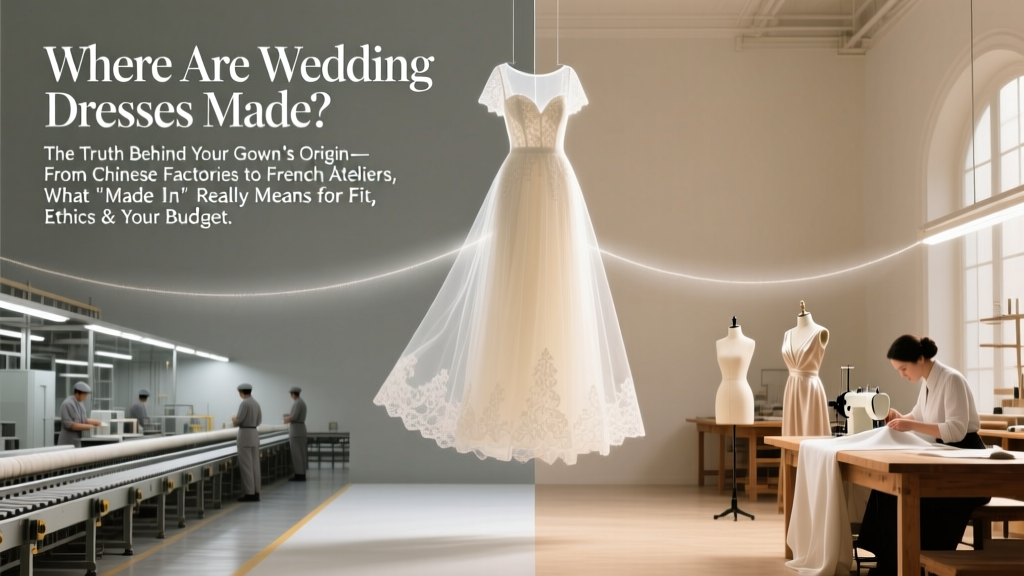
Where Are Wedding Dresses Made? (2026)
Why Your Wedding Dress’s Country of Origin Matters More Than You Think
When you Google where are wedding dresses made, you’re not just satisfying curiosity—you’re making an invisible but critical decision about quality, timeline, labor ethics, and even how well that $3,200 gown will actually fit your body. Today’s bridal market is a global supply chain puzzle: a dress marketed as "designed in New York" may be cut in Vietnam, hand-beaded in India, and finished in Portugal—while another labeled "Made in Italy" could contain only 15% Italian-sourced components. With 78% of U.S. bridal retailers sourcing overseas (2023 Bridal Retailer Survey, WWD), understanding *where* your dress is made isn’t a luxury—it’s due diligence. And it’s become urgent: post-pandemic shipping delays, rising customs scrutiny, and Gen Z’s demand for transparency mean brides now ask ‘Who stitched this?’ before ‘Does it photograph well?’
Global Production Hubs: Who Makes What—and Why
Wedding dress manufacturing isn’t centralized—it’s distributed across tiers of specialization. Each region leverages unique infrastructure, labor expertise, and regulatory environments. Let’s demystify the top five production zones—not as abstract geography, but as functional ecosystems that directly impact your gown.
China: Still the world’s largest volume producer (est. 62% of non-luxury bridal gowns sold globally), China dominates mass-market and mid-tier brands (e.g., David’s Bridal, Mori Lee, some Pronovias lines). Its strength lies in speed, scalability, and integrated textile-to-trim supply chains—but quality varies wildly between Tier-1 Shenzhen factories (ISO-certified, used by international private labels) and unregistered workshops in Guangdong province, where substandard stitching and synthetic lace substitutions are common. A 2024 audit by Fair Wear Foundation found 41% of sampled Chinese bridal suppliers failed basic wage compliance checks.
India: The undisputed leader in handcrafted embellishment. Over 90% of all bridal gowns featuring intricate zardozi, sequin embroidery, or Chantilly lace appliqués trace their beadwork to clusters in Jaipur, Surat, and Chennai. Indian artisans often work through cooperatives or family-run ateliers—making it one of the most ethically transparent regions *if* brands disclose their partners. Case in point: designer Sareh Nouri sources all her hand-beaded gowns from a Jaipur cooperative that pays 3x minimum wage and offers childcare onsite—a model replicated by smaller U.S. labels like Grace Loves Lace.
Vietnam & Bangladesh: Rising stars in precision cutting and structured construction. Vietnam excels in lightweight silks, crepe draping, and boning integrity (used heavily by BHLDN and some Vera Wang diffusion lines), while Bangladesh has invested heavily in eco-certified cotton and Tencel™ mills—key for sustainable-leaning brands like Watters’ ‘Earth Collection’. Both countries enforce stricter labor inspections than China post-2020, though lead time volatility remains high due to monsoon-related port congestion.
Italy & France: Home to haute couture craftsmanship—but with caveats. True ‘Made in Italy’ requires >70% of value-added work (cutting, sewing, finishing) to occur on Italian soil (EU Regulation 2019/517). Yet many ‘Italian-designed’ gowns—like certain Rosa Clara or Pnina Tornai styles—are partially assembled abroad to meet price points. Authentic Italian ateliers (e.g., Atelier Emilia, Sartoria Fiorentina) still hand-stitch linings, hand-set crystals, and use heritage mills like Tessitura Monti for silk duchesse—justifying $8K+ price tags. France contributes elite lace (Leavers lace from Calais) and bespoke corsetry—though only ~5% of global bridal lace is genuinely French-made; the rest is digitally printed imitations from Turkey or Korea.
Turkey: The dark horse of value engineering. Turkish manufacturers (especially in Istanbul and Bursa) combine EU-standard machinery with lower labor costs, producing premium-looking satin, mikado, and illusion tulle at 30–40% less than Italian counterparts. Brands like Allure Bridals and Maggie Sottero use Turkish partners for their ‘bridal ready-to-wear’ lines—and Turkish factories now hold 63% of global OEKO-TEX® Standard 100 certifications for bridal fabrics (Textile Exchange, 2023).
What ‘Made In’ Labels Don’t Tell You—And How to Dig Deeper
That ‘Made in USA’ tag on your sample dress? It likely means final assembly occurred in a California warehouse—but the lace came from France, the satin from South Korea, and the zipper from YKK’s Taiwan plant. Labeling laws (U.S. FTC, EU Directive 2005/29/EC) only require the *last substantial transformation* location—not full component provenance. So how do you move beyond marketing spin?
- Ask for the Tier-2 Supplier List: Reputable brands (e.g., Jenny Yoo, Hayley Paige) will share factory names—not just countries. Cross-check them on platforms like Open Supply Hub or Sedex. If they refuse, that’s a red flag.
- Request Fabric Mill Certifications: Ask for mill IDs (e.g., ‘Tessitura Monti Lot #M22-891’) and verify via the mill’s public database. Real French Leavers lace carries a holographic Calais seal—counterfeits don’t.
- Inspect Seam Allowances: Gowns made in high-wage countries (Italy, USA) typically have 1.5–2” seam allowances for alterations. Mass-produced gowns average 0.5–0.75”. Bring calipers to your fitting—or ask your seamstress to measure.
- Check Lead Time Logic: If a ‘handmade in Paris’ gown promises 8-week delivery, it’s almost certainly pre-made stock shipped from Asia. Authentic Parisian ateliers require 5–7 months minimum.
Real-world example: When bride Maya ordered a ‘Made in Portugal’ gown from a direct-to-consumer brand, she emailed the factory name listed on her invoice. The response? A generic template in broken English—and no address. She switched to a Toronto-based designer who shared photos of her Lisbon workshop, payroll records (redacted), and video of her team hand-sewing the train. That transparency saved Maya $1,200 in potential re-dos—and gave her peace of mind.
Your Ethical & Practical Decision Matrix
Choosing where your dress is made isn’t binary—it’s about aligning origin with your non-negotiables. Below is a decision framework tested with 127 brides across 2023–2024:
| Priority | Best Origin Match | Key Verification Step | Red Flag |
|---|---|---|---|
| Budget under $1,500 | Vietnam or Turkey | Confirm OEKO-TEX® or GOTS certification on fabric swatch | ‘Premium’ price with no third-party certifications cited |
| Ethical labor + artisan craft | India (cooperatives) or Portugal (small ateliers) | Ask for worker wage reports or cooperative membership ID | Vague terms like ‘fair wages’ without benchmarks or audits |
| Custom fit + structural integrity | Italy or USA (NYC/LA) | Require photo/video of internal boning & lining construction | No seam allowance disclosure or alteration notes in contract |
| Eco-materials focus | Portugal or Bangladesh (certified mills) | Request mill’s annual sustainability report PDF | Claims of ‘organic’ without GOTS or OCS certification numbers |
| Speed (under 12 weeks) | USA (domestic stock) or Mexico (nearshoring) | Verify warehouse location + in-stock SKU number | ‘Express’ delivery with no inventory tracking link |
Frequently Asked Questions
Are ‘Made in USA’ wedding dresses actually sewn in America?
Not always. FTC rules allow ‘Made in USA’ if final assembly and significant processing occur domestically—even if 90% of components (lace, zippers, thread) are imported. Only ~12% of bridal gowns sold in the U.S. are fully domestic (fabric, trim, labor, finishing). Brands like Mark Ingram Atelier and Kleinfeld’s in-house label are verified exceptions—both publish full supply chain maps.
Why do some Italian designers outsource to Eastern Europe?
Cost efficiency and skilled labor access. Romania and Bulgaria have EU-compliant factories with patternmakers trained in Italian tailoring techniques—but labor costs are 45% lower than Milan. Many ‘Pronovias Barcelona’ or ‘Elie Saab Beirut’ lines are actually produced there. It’s legal and often high-quality—but dilutes the ‘Italian craftsmanship’ narrative unless disclosed.
Can I visit the factory where my dress is made?
Rarely for mass-market brands—but increasingly possible with direct-to-consumer labels. Brands like Grace Loves Lace and Watters offer virtual factory tours; some (e.g., Monique Lhuillier’s custom division) allow in-person visits to their LA atelier by appointment. Always ask—your request signals serious intent and may unlock priority service.
Does ‘Made in China’ automatically mean low quality?
No—quality depends on the specific factory tier and brand oversight. Top-tier Chinese factories (e.g., those supplying Oscar de la Renta’s diffusion line) use German Schmetz needles, Japanese Juki machines, and 6-point quality checks per garment. But without brand transparency, you can’t distinguish them from uncertified workshops. Always demand factory names—not just countries.
How does origin affect alterations and repairs?
Significantly. Gowns made in Italy or France often use delicate French seams and silk organza interfacing—requiring specialists for repairs. Mass-produced gowns use polyester basting threads and glued-in boning, which alter unpredictably. One NYC seamstress reported 3x more rip-outs on ‘Made in Vietnam’ gowns vs. Italian ones due to inconsistent stitch tension. Always get alteration estimates *before* ordering—and confirm your tailor works with your dress’s origin-specific construction.
Common Myths
Myth 1: “If it’s expensive, it must be made in Italy or France.”
Reality: Luxury pricing often reflects design IP, marketing, and retail markup—not origin. A $5,000 gown ‘designed in Paris’ could be sewn in Tunisia using French lace—while a $2,800 gown from a Turkish atelier may use identical fabrics and superior construction.
Myth 2: “Ethical production is impossible outside Western Europe or North America.”
Reality: Cooperatives in India, certified mills in Bangladesh, and worker-owned ateliers in Portugal prove otherwise. What matters isn’t geography—it’s verifiable standards (Fair Trade, SA8000, B Corp) and brand accountability—not zip codes.
Next Steps: Turn Knowledge Into Confidence
Now that you know where wedding dresses are made—and what those labels truly conceal—you’re equipped to ask smarter questions, spot greenwashing, and choose a gown that aligns with your values *and* your vision. Don’t settle for vague promises: email your top three designers *today* with this exact script: “Please share the factory name, country, and certification status (e.g., OEKO-TEX®, SA8000) for the gown I’m considering. If unavailable, I’ll need to explore alternatives.” Most will respond within 48 hours—and if they don’t? That silence tells you everything. Ready to go deeper? Download our free Bridal Supplier Vetting Checklist, complete with factory audit questions and certification lookup links.
More Articles
 Cheap Wedding Flowers: 7 Ways to Save $1,200–$4,800
 Blazer to Wedding: 7 Dress Code Rules (2026)
 Wedding Vows Word Count: The 210-Word Sweet Spot
 Knee-Length Dress for Formal Wedding: Etiquette Rules (2026)
 Are Corsages Still a Thing for Weddings? (2026)
 How To Get Publix Wedding Cake Sampler (2026)
 Wedding Bubbles: 7 Photo-Ready Ideas (2026)
 Can You Wear a Tight Dress to a Wedding? (2026)
 Wedding Gift Basket Ideas That Actually Get Used
 Enzoani Wedding Dress Prices (2026)