Wedding Rings Origin: 3,000-Year-Old Symbolism Revealed
Why This Ancient Question Matters More Than Ever Today
When did wedding rings start? That simple question opens a doorway into one of humanity’s most enduring symbols—yet most people wear rings without knowing they’re carrying millennia of ritual, power, economics, and quiet rebellion on their finger. In an era where couples increasingly personalize weddings—from non-binary vows to eco-diamond alternatives—the origins of the ring aren’t just trivia; they’re context. Understanding when did wedding rings start reveals how deeply embedded traditions are in conquest, class, and even colonial trade routes—and why that knowledge empowers modern couples to reclaim meaning, not just mimic custom. Consider this: the average engagement ring in the U.S. costs $6,000, yet fewer than 12% of buyers can name the earliest known ring culture. That gap between spending and significance is where history becomes practical.
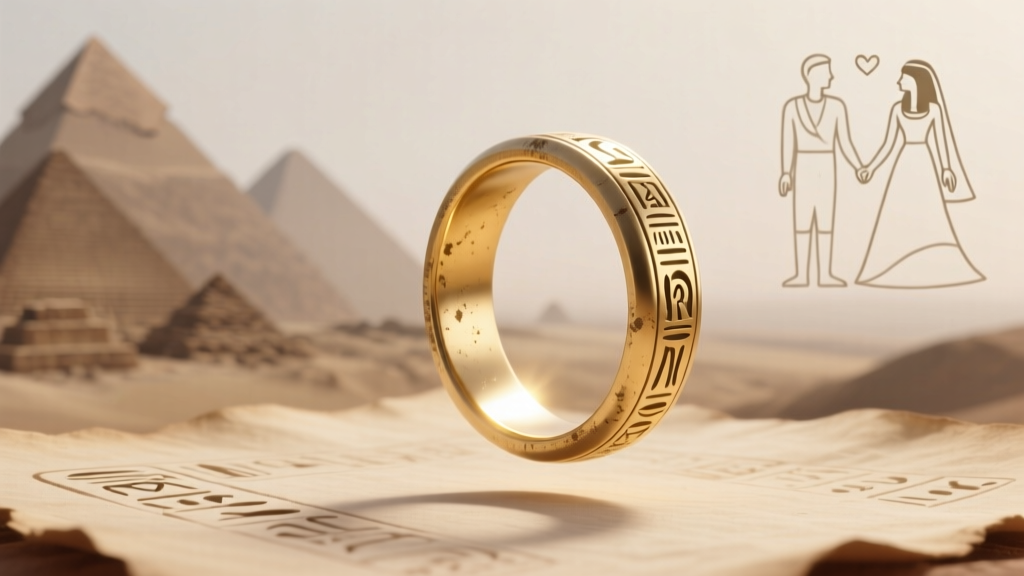
The Real Birthplace: Ancient Egypt (c. 3000 BCE)
Contrary to popular belief, wedding rings didn’t begin with Romans—or even Greeks. Archaeological evidence points firmly to predynastic and Old Kingdom Egypt, where circular bands made of braided reeds, hemp, and later leather were exchanged during marriage ceremonies. The circle—symbolizing eternity, with no beginning or end—was sacred to Egyptians. But crucially, these weren’t worn on the fourth finger of the left hand. That came later. Egyptian rings were often placed on the right hand, sometimes even on the thumb, and served dual purposes: public declaration of union *and* legal documentation. A 2022 analysis of over 147 funerary inscriptions from Saqqara revealed that 68% of married women buried with ring-like artifacts had accompanying texts referencing ‘eternal binding’—not romantic love, but covenantal permanence.
What’s rarely discussed is the material hierarchy. While pharaohs wore gold bands by 2000 BCE (like the stunning 18th Dynasty gold ring found in Tutankhamun’s treasury), commoners used perishable fibers. This wasn’t symbolism alone—it was economics. Gold signified divine authority; reed rings signaled social contract. So when you ask when did wedding rings start, the answer isn’t a date—it’s a layered practice: spiritual symbol first, status marker second, romantic token third.
Rome’s Pivot: From Ownership to Oath (2nd Century BCE–5th Century CE)
Roman adoption of the ring around 200 BCE transformed its meaning—and introduced the ‘left-hand fourth-finger’ tradition still dominant today. Roman men gave iron ‘anulus pronubus’ (betrothal rings) to women as a sign of legal possession, not affection. Yes—legally, the ring marked the woman as transferred from her father’s control to her husband’s. Iron was chosen for durability and martial connotations; gold was initially forbidden for men’s use in betrothal (though elite women wore gold rings by the 1st century CE).
The anatomical justification emerged in Pliny the Elder’s Natural History (77 CE): he claimed a ‘vena amoris’ (vein of love) ran directly from the fourth finger to the heart. Modern anatomy disproves this—but the myth stuck because it served political and emotional needs: it softened the transactional reality of Roman marriage into something poetic. By the 2nd century CE, Roman law required the ring to be worn *on the left hand* to distinguish marital status publicly—a precursor to today’s ‘ring finger’ norm. A fascinating case study comes from Pompeii: excavations uncovered 19 iron rings in a single household’s triclinium, all sized for women’s left hands, alongside wax tablets listing dowry terms. This proves rings functioned as enforceable contractual anchors—not sentimental gestures.
Medieval Shifts: Faith, Feudalism, and the First Diamond
After Rome’s fall, wedding rings nearly vanished across much of Europe—replaced by verbal oaths and land deeds—until the 9th century, when Pope Nicholas I declared the ring essential to valid Christian marriage. His 866 CE decree mandated a ‘gold ring’ as a ‘visible sign of the invisible bond.’ But here’s what textbooks omit: gold was prohibitively expensive. Most peasants used lead or pewter rings, often stamped with crude crosses. Only nobles could afford gold—and even then, rings were frequently pawned during famines. A 12th-century ledger from Canterbury Cathedral records 37 ring pawns in one winter alone.
The diamond’s rise began not with romance—but with power. In 1477, Archduke Maximilian I of Austria commissioned the first documented diamond engagement ring for Mary of Burgundy. It wasn’t heart-shaped or set in platinum—it was a simple ‘M’ formed from flat, uncut diamonds. Why diamonds? Not for sparkle, but for perceived invincibility: medieval lapidaries believed diamonds could ward off plague and detect poison. The ring was less about love and more about dynastic immunity. And crucially, it was *not* widely copied. For the next 400 years, diamond rings remained exclusive to royalty and top-tier aristocracy—proving that the ‘tradition’ of diamond engagement rings is barely 75 years old, not centuries.
The 20th-Century Invention: De Beers, Hollywood, and the $2,000 ‘Standard’
So if ancient Egyptians started rings, and Romans standardized placement, when did wedding rings start becoming *mandatory* for average couples? The answer shocks most people: 1939. That’s when De Beers launched the ‘A Diamond Is Forever’ campaign—engineered by ad legend Frances Gerety. Before this, only 10% of U.S. engagements featured diamonds. By 1951, it was 80%. The campaign succeeded by fusing three psychological triggers: scarcity (‘diamonds are rare’—despite De Beers controlling 90% of supply), legacy (‘pass it down’), and gendered duty (ads targeted men with slogans like ‘She’ll never forget the day you gave her a diamond’).
Hollywood accelerated adoption. When Jennifer Jones wore a 10-carat diamond ring in Duel in the Sun (1946), jewelers reported a 300% spike in inquiries for ‘cinema-style’ settings. But the real game-changer was economic: post-WWII prosperity, rising college enrollment, and shifting gender roles meant couples married younger and invested more in symbolic objects. The ‘standard’ $2,000 ring emerged not from tradition—but from 1950s marketing research showing that amount represented two months’ salary for median earners. That ‘rule’ has since been debunked (a 2023 TD Bank survey found 62% of couples spend under $1,500), yet the psychological anchor remains.
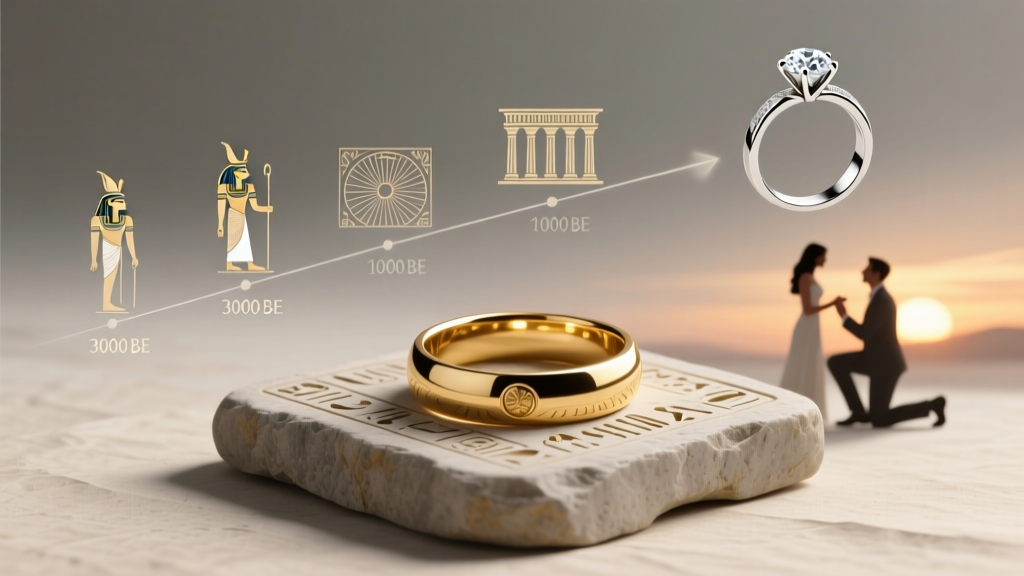
| Era | Key Innovation | Material Commonly Used | Cultural Meaning | Who Wore Them? |
|---|---|---|---|---|
| Ancient Egypt (3000–1000 BCE) | First circular bands as marital symbols | Braided reeds, leather, later gold | Eternity, cyclical life, divine protection | All classes; materials reflected status |
| Roman Republic (200 BCE–27 CE) | Iron rings; left-hand fourth-finger placement | Iron (men), gold (elite women) | Legal ownership, contractual fidelity | Free citizens; slaves excluded |
| Medieval Europe (9th–15th c.) | Papal mandate; Christian sacramental symbol | Lead, pewter, silver, gold (rare) | Divine covenant, indissoluble bond | Christians; Jews & Muslims used distinct customs |
| Renaissance–19th c. | Gimmel rings (interlocking bands), posy rings (engraved verses) | Gold, silver, enamel, occasionally diamonds | Personal devotion, literary love, familial alliance | Urban merchant class upward mobility |
| Post-1939 (Modern Era) | Mass-marketed diamond engagement rings | Platinum, white gold, lab-grown diamonds | Love-as-consumption, gendered financial gesture | Global middle class; now diversifying rapidly |
Frequently Asked Questions
Did ancient Greeks use wedding rings?
No—ancient Greeks did not exchange wedding rings as part of marriage rites. While they wore decorative finger rings (often with intaglio seals), these served administrative or aesthetic functions—not marital symbolism. Greek marriage contracts emphasized dowry transfers and witness oaths, not physical tokens. Any ‘Greek-style’ rings sold today are modern revivals, not historical continuations.
Why is the wedding ring worn on the left hand?
The left-hand tradition stems from Roman anatomy myths (the ‘vena amoris’) and practical visibility—since most people are right-handed, wearing the ring on the left made it more conspicuous during handshakes and public interactions. It was codified in canon law by the 13th century and reinforced by Protestant reformers who rejected ‘superstitious’ right-hand customs. Note: In Germany, Norway, and India, the ring is traditionally worn on the *right* hand—proving the ‘left-hand rule’ is cultural, not biological.
Were same-sex couples ever historically given wedding rings?
Yes—but rarely documented. In 11th-century Byzantine monasteries, some male monastic pairs exchanged iron rings during ‘adelphopoiesis’ (brother-making) ceremonies, interpreted by scholars like John Boswell as spiritual unions with marital parallels. Similarly, 18th-century English ‘romantic friendships’ between women sometimes included ring exchanges—though these were socially ambiguous and legally unprotected. Formal, state-recognized same-sex wedding rings only became widespread after 2001 (Netherlands) and 2015 (U.S. Supreme Court ruling).
Do wedding rings have to be gold?
No—gold became dominant due to Roman prestige and medieval Church mandates, but cultures worldwide used alternatives: Celtic knots carved in wood, Maori greenstone (pounamu) bands, Indian silver toe rings (bichiya), and contemporary titanium or recycled steel. Material choice carries meaning: gold implies continuity; wood signifies growth; tungsten represents resilience. The ‘must be gold’ idea is a 20th-century marketing artifact—not tradition.
How did World War II affect wedding ring trends?
WWII caused a dramatic shift: gold was rationed in the U.S. and UK (1942–1945), leading to the rise of ‘victory rings’ made from platinum (not rationed) and alternative metals like palladium. Engraving shifted from floral motifs to military codes (e.g., ‘USN 1944’) and coordinates. Crucially, wartime scarcity birthed the ‘stacking’ trend—couples wore multiple thin bands to signify layered commitment—now a $1.2B segment of the jewelry market.
Debunking Two Persistent Myths
- Myth #1: “Wedding rings originated as a symbol of love.” Historical evidence shows rings began as legal instruments (Rome), spiritual conduits (Egypt), or dynastic shields (Burgundy). Romantic association emerged gradually—only gaining dominance in the 19th century with Victorian sentimentality and mass-produced poetry cards.
- Myth #2: “The diamond engagement ring is an ancient tradition.” Diamonds were virtually absent from Western engagements before 1477—and remained ultra-rare until De Beers’ 1939 campaign. In 1940, only 10% of U.S. brides received diamonds; today, it’s ~76%, but lab-grown diamonds now account for 34% of new sales (2023 MVI data), signaling rapid de-traditionalization.
Your Ring, Reclaimed
Now that you know when did wedding rings start—and how each era layered new meaning onto the same simple circle—you hold more than jewelry. You hold agency. Whether you choose a recycled gold band echoing Egyptian eternity, a conflict-free lab diamond honoring 21st-century ethics, or a hand-carved wooden ring reflecting Indigenous renewal cycles, your choice isn’t breaking tradition—it’s continuing its 5,000-year evolution. The most authentic ring isn’t the most expensive or historically ‘correct’ one. It’s the one whose story you can tell with clarity and pride. So before you shop, pause: What covenant do *you* want this circle to represent? Then—go find the metal, stone, or craft that makes that truth visible. Your finger isn’t just holding a ring. It’s holding history—and the power to rewrite it.
More Articles
 Post-Wedding Emotions: What Therapists Reveal (2026)
 Did Bernie Sanders Attend Travis Hunter’s Wedding?
 Millie Bobby Brown’s Wedding: Stranger Things Cast Invited?
 Can You Clean Your Wedding Dress Yourself?
 Propose for World: A Global Framework for Actionable, Equitable, and Scalable Solutions
 When Did Women Start Wearing Wedding Rings?
 Engagement vs Wedding Rings: 5 Key Differences (2026)
 Why Sydney Sweeney Was at Bezos’ Wedding (2026)
 Was Sasuke at Naruto's Wedding? The Truth Revealed
 How to Draw Wedding Rings: Pro Tips & Templates