# Do Jews Wear Wedding Rings? The Complete Guide to Jewish Wedding Ring Traditions
You've heard that Jewish weddings have unique customs, but what about the rings? The answer surprises many people: Jewish law technically only requires *one* ring — and it's not always worn the way you'd expect. Whether you're planning a Jewish wedding or simply curious, here's everything you need to know about rings in Jewish tradition.
## The Halachic (Jewish Law) Requirement: Only One Ring
Under traditional Jewish law (*halacha*), only the groom is required to give a ring to the bride — not the other way around. This ring exchange is the legal act (*kinyan*) that formalizes the marriage. For the ring to be valid under Jewish law, it must meet three criteria:
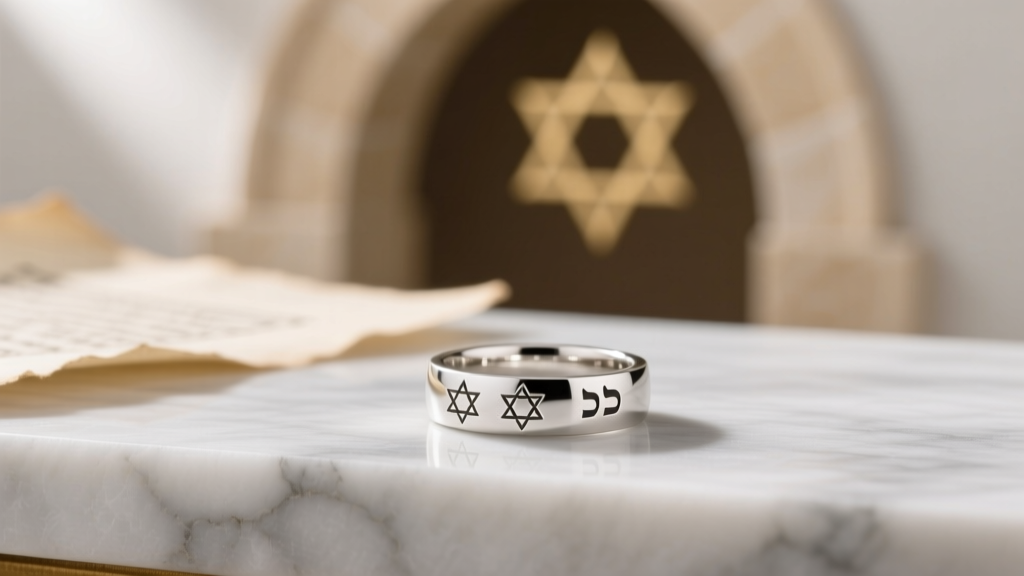
- **Made of plain metal** — no gemstones, no engravings, no hollow bands
- **Owned outright by the groom** — not borrowed or leased
- **Worth at least a *perutah*** — a nominal monetary value
The plain band requirement exists so the bride can accurately assess its value without being misled by decorative stones. Most commonly, a simple gold band is used.
## Which Hand Does the Ring Go On?
During the ceremony, the groom places the ring on the bride's **right index finger** — not the left ring finger as in Western tradition. This is because the right index finger is considered the most prominent and accessible finger, making the act of giving clearly visible to the required witnesses (*eidim*).
After the ceremony, many Jewish brides move the ring to their left ring finger, following the broader Western custom. Others keep it on the right hand. Both are perfectly acceptable.
## Do Both Partners Exchange Rings Today?
In modern practice — especially in Conservative, Reform, and Reconstructionist communities — a **double ring ceremony** is extremely common. The bride gives the groom a ring as well, often after the formal halachic exchange.
In Orthodox communities, the double ring exchange is more nuanced:
- Some rabbis permit it after the formal ceremony concludes
- The bride's ring to the groom is treated as a gift, not a legal act
- The sequence matters: the groom's ring to the bride always comes first
Sephardic and Ashkenazic communities may also have slightly different customs around timing and which hand is used.
## Engagement Rings in Jewish Tradition
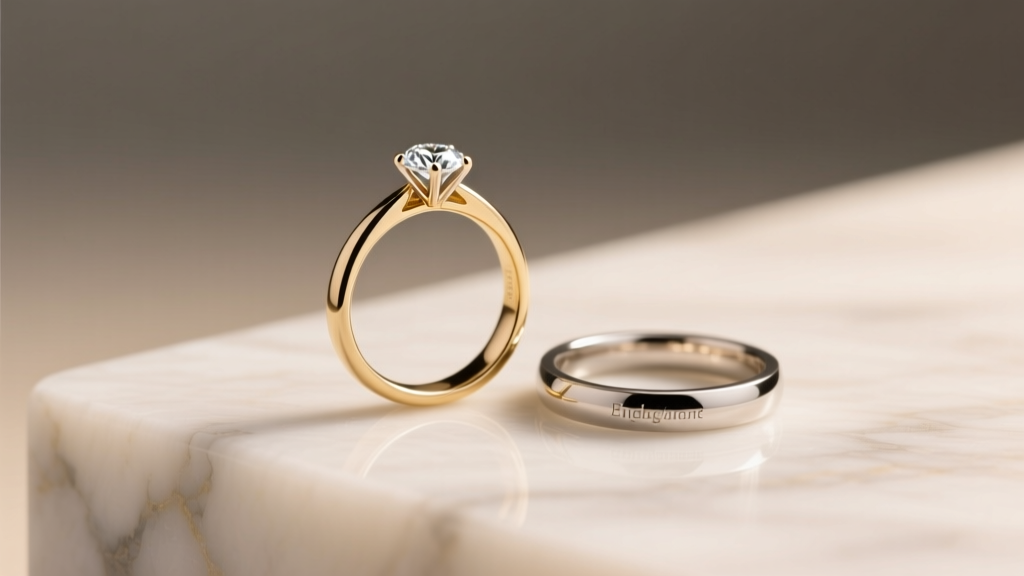
Engagement rings are not a traditional Jewish requirement — they are a modern Western custom that Jewish communities have widely adopted. Historically, the *erusin* (betrothal) was formalized through a contract, not a ring. Today, diamond engagement rings are common in most Jewish communities, with no religious restrictions on style or stones for engagement (as opposed to the wedding band itself).
## Common Mistakes and Myths
**Myth 1: Jewish couples don't exchange rings — they use a cup of wine.**
The cup of wine (*kos shel bracha*) is part of the blessings recited during the ceremony, but the ring is the central legal act of Jewish marriage. The two are not interchangeable.
**Myth 2: The wedding ring must be gold.**
Jewish law requires the ring to be made of metal and have monetary value, but it does not specify gold. Silver, platinum, and other metals are all acceptable. The key requirement is that it be a plain, solid band — not the material itself.
## Conclusion
Jewish wedding ring customs blend ancient legal requirements with modern personal expression. The core tradition — a plain band given by the groom, placed on the bride's right index finger — remains the halachic foundation. Everything else, from double ring ceremonies to which finger you wear it on afterward, reflects the beautiful diversity within Jewish communities worldwide.
Planning a Jewish wedding? Talk to your officiant early about ring requirements for your specific denomination and community — small details can make a big difference in ensuring your ceremony is both meaningful and valid.
 Wedding Ring Payout: 7 Real Factors (2026)
 How Much Is My Old Wedding Ring Worth? (2026)
 Favors Common Mistakes
 How to Choose a Ring for a Proposal at the Beach
 Rubellite and Pink Tourmaline Engagement Ring Options
 Wedding Website RSVP Management: Cut Chaos, Save Time
 Meteorite Wedding Bands Out-of-This-World Material
 Wedding Ring Stacking Rules (2026)
 How to Choose a Wedding Ring for Wide Fingers
 Can You Use Engagement Ring as Wedding Band?