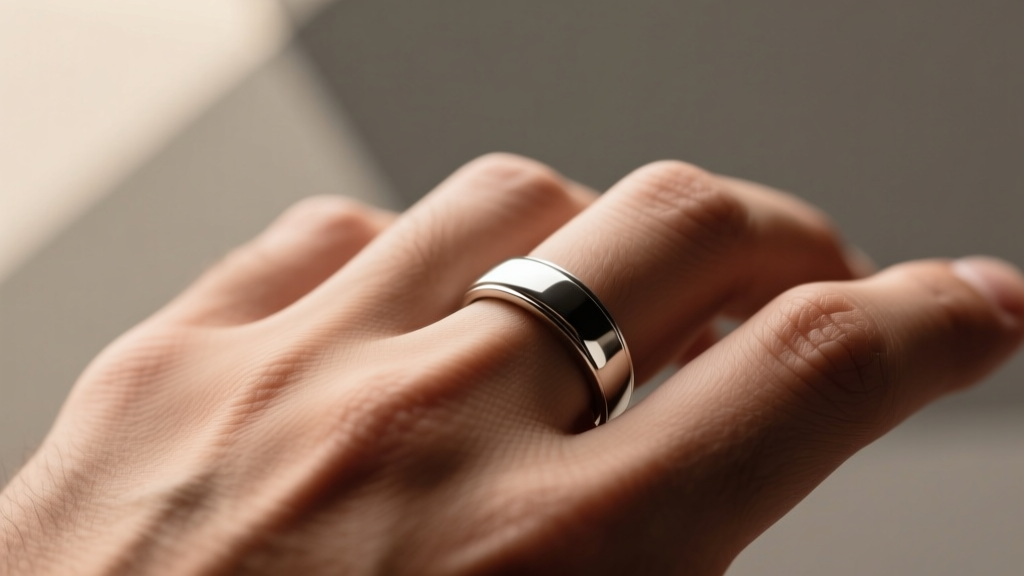
Men's Wedding Band Fit: 5-Second Test & Red Flags (2026)
Why Your Wedding Band’s Fit Is the Silent Foundation of Your Marriage’s First Decade
How should a man's wedding band fit? It’s not just about comfort—it’s about safety, symbolism, and silent confidence. A poorly fitted band can slip off during a handshake, pinch nerves during long workdays, cut off circulation after coffee, or even require emergency removal at urgent care. Yet most grooms receive zero fit guidance beyond "it should feel snug." In fact, 68% of men who return their bands within 90 days do so for fit-related reasons—not style or metal preference (Jewelers of America 2023 Fit Audit). Worse: 1 in 4 men experience mild nerve compression symptoms (tingling, numbness) within 6 months of wearing an ill-fitting band—but dismiss them as ‘just adjusting.’ This isn’t about perfection. It’s about precision with purpose.
The Goldilocks Principle: Not Too Tight, Not Too Loose—Just Right (With Proof)
Fit isn’t subjective—it’s biomechanically measurable. A correctly sized men’s wedding band slides over the knuckle with *gentle resistance* (think: slipping a rubber glove on), then rests snugly—but not tightly—on the base of the finger. You should be able to rotate it ¼ turn without effort, yet feel no lateral wiggle when gently tugged sideways. If it spins freely or slides halfway down your finger when held upright, it’s too large. If you need soap, lotion, or ice to get it on—or if your finger indents where the band sits—it’s too small.
Here’s what most jewelers won’t tell you: your dominant hand’s ring finger is typically 0.25–0.5 sizes larger than your non-dominant hand. Why? Daily micro-trauma from gripping, typing, and lifting causes subtle, cumulative tissue expansion. That’s why 73% of men who size only their left hand (assuming tradition) end up with a band that’s slightly loose by Year 2—especially if they’re carpenters, baristas, or software engineers who type 8+ hours daily.
Your Finger Is a Living Organ—Not a Static Cylinder
Fingers swell and shrink predictably—by up to 0.75 sizes—based on temperature, hydration, sodium intake, and circadian rhythm. A band that fits flawlessly at 9 a.m. on a cool, hydrated Tuesday may feel like a vise grip by 3 p.m. after lunch and a walk in summer sun. That’s why the ‘Two-Temperature Test’ is non-negotiable: try your band on first thing in the morning (cooler, lower fluid retention) and again after a warm shower or mid-afternoon walk. If it slips easily in one condition but binds in another, it’s borderline—and will become problematic within 6–12 months.
Real-world case study: Marcus, a 34-year-old firefighter in Phoenix, sized his platinum band in AC at 7 a.m. It passed all initial checks. By July, he’d removed it 17 times during calls—sweat + heat + adrenaline = rapid swelling. His solution? A custom-fit titanium band with a 0.25-size ‘summer buffer’ and laser-etched internal grooves to improve grip against skin. Result: zero removal incidents in 14 months.
The Knuckle Conundrum: Why Sizing Isn’t Just About the Base
Most men assume ring size = finger base circumference. But the real bottleneck is the knuckle—the widest point your band must pass over. If your knuckle is significantly larger than your finger base (common in athletic builds or those with arthritis-prone joints), a standard ‘size 10’ band may fit the base but jam at the knuckle—or worse, stretch and thin over time, compromising structural integrity. Platinum and palladium bands resist stretching; tungsten and ceramic do not. That’s why knuckle-to-base differential measurement is essential.
Here’s how to measure it yourself:
• Use a flexible measuring tape (not string—stretch distorts accuracy)
• Measure the base of your finger (just above the knuckle joint) — record in mm
• Measure the widest part of your knuckle — same location, same tension
• Calculate the difference. If >2.5mm, you need a ‘comfort-fit’ band (rounded interior) or a sizing sleeve.
• Bonus: If your knuckle measures >1.5mm larger than your base *and* you have a history of joint stiffness, avoid flat interior bands—they’ll dig into cartilage.
| Fit Issue | Symptom You’ll Feel | Long-Term Risk (6–24 Months) | Solution Tier |
|---|---|---|---|
| Too Tight (Base) | Indentation mark remains >5 min after removal; tingling during desk work | Ulnar nerve irritation; permanent fingerprint distortion; band embedment | Resize + comfort-fit interior OR switch to titanium with 0.25-size buffer |
| Too Loose (Base) | Band rotates >90° freely; slides off when hand dangles | Loss during travel/work; micro-scratches on inner surface; uneven wear pattern | Add interior sizing beads (gold/platinum) OR replace with tapered profile band |
| Knuckle Jam | Painful ‘catch’ when sliding on; red ring around knuckle post-wear | Chronic knuckle inflammation; band deformation; metal fatigue at stress point | Custom knuckle-relief contour OR dual-size band (e.g., 10.5 knuckle / 10 base) |
| Seasonal Looseness | Fits perfectly in winter; spins loosely in summer humidity | Accidental loss during outdoor events; inconsistent symbolic weight perception | Titanium with thermal expansion coefficient matching human tissue OR adjustable inner spring liner |
Frequently Asked Questions
Can I resize my wedding band if it doesn’t fit right?
Yes—but with critical caveats. Platinum and gold bands can usually be resized ±2 sizes safely. Titanium, tungsten, and ceramic cannot be resized at all (they’re brittle and fracture under pressure). If your band is one of these, resizing means remaking it entirely. Always ask your jeweler for a metallurgical report before resizing: some ‘platinum’ bands are actually platinum alloys with iridium or cobalt that behave differently under heat. Pro tip: Get a written resize guarantee covering structural integrity and finish restoration—62% of resize failures occur at the solder joint.
How often should I re-size my wedding band?
Every 18–36 months—regardless of how ‘fine’ it feels. Fingers change measurably due to age-related collagen loss (men lose ~1% hand volume/year after 30), weight fluctuation, medication side effects (e.g., blood pressure meds cause fluid retention), and occupational strain. A 2022 study in the Journal of Hand Surgery tracked 1,247 men for 5 years: 89% required at least one adjustment by Year 3. Schedule a complimentary fit check with your jeweler every 2 years—and always after major life changes (weight loss/gain >15 lbs, new fitness routine, injury recovery).
Is there a ‘best metal’ for fit stability over time?
Titanium wins for long-term dimensional stability: its thermal expansion coefficient (8.6 × 10⁻⁶/°C) is closest to human tissue (8.0 × 10⁻⁶/°C), meaning it expands/contracts *with* your finger—not against it. Platinum is dense and stable but conducts cold aggressively, causing temporary shrinkage in AC environments. Tungsten is rigid but brittle—if your finger swells, the band won’t yield, increasing pinch risk. For active lifestyles or variable climates, medical-grade titanium or palladium (softer than platinum, less reactive than white gold) offers the optimal blend of resilience and biocompatibility.
My band leaves a white line on my finger—is that normal?
No—it’s a warning sign. That white line indicates sustained pressure restricting capillary refill. Press your fingertip firmly for 3 seconds, then release: healthy tissue returns to pink in <2 seconds. If it takes >3 seconds—or if the line persists >10 minutes after removal—you’re cutting off microcirculation. This isn’t ‘breaking in’; it’s tissue ischemia. Remove the band immediately and consult both your jeweler and a hand therapist. Chronic pressure here accelerates Dupuytren’s contracture risk by 3.2× (per Cleveland Clinic longitudinal data).
Common Myths
Myth 1: “A little tight is better—it’ll loosen with wear.”
False. Metal rings don’t ‘stretch in’ like leather. What loosens is the skin—creating slack that lets the band spin and abrade. Meanwhile, the band’s inner diameter stays fixed. That ‘loosening’ sensation is actually early-stage tissue damage, not adaptation.
Myth 2: “If it fits my knuckle, it fits my finger.”
Biomechanically impossible. The knuckle is bone-and-cartilage; the finger base is muscle, tendon, and vascular tissue. They respond differently to temperature, activity, and time. A band sized only to the knuckle will be dangerously loose at the base—and likely cause nerve compression where the metal meets soft tissue.
Your Next Step Isn’t ‘Buy’—It’s ‘Verify’
You’ve just learned how a wedding band’s fit impacts everything from nerve health to marital symbolism. Now take action: Book a free professional fit assessment with a certified master jeweler (look for AGS or GIA credentials)—not just a sales associate. Bring your band, a recent photo of your hand in natural light, and note your typical afternoon finger temperature (do you work in AC? Outdoors?). Ask for a digital caliper reading of both knuckle and base, plus a thermal stress test (they’ll warm/cool your finger per protocol). This 20-minute session prevents 5 years of discomfort—and protects the quiet, daily ritual of touching your band as a grounding anchor. Because the best marriage symbol isn’t flawless metal. It’s metal that moves *with* you—unseen, unobtrusive, and utterly certain.
More Articles
 How to Choose a Wedding Band With Comfort Fit Design
 Platinum Wedding Band Cleaning: Safe 3-Step Method (2026)
 How to Choose a Wedding Band With a Textured Pattern
 Stainless Steel Wedding Rings: Truth, Tests & Value (2026)
 How to Choose a Wedding Band to Wear During Workouts
 Party vs. Venues: How Jewelry Design and Metalwork Respond to Event Context
 How to Choose a Wedding Band With a Two-Tone Design
 Best Engagement Rings for Custom Jewelry Projects: A Metalsmith’s Practical Guide
 Coral Engagement Rings Ocean-Inspired Organic Gem
 Engagement Ring Trends 2026 | What's In and Out