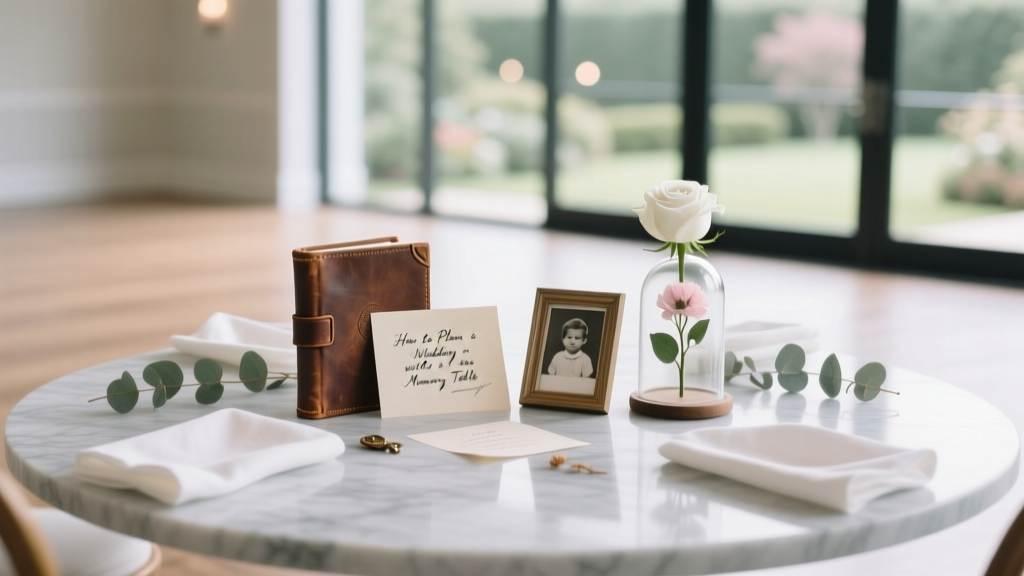
How to Plan a Wedding With a Memory Table
Weddings are full of joyful “firsts,” but they also carry echoes of the people who helped shape your story. If someone you love can’t be there—because they’ve passed away, are deployed, are ill, or simply can’t travel—a memory table can bring their presence into the day in a way that feels tender, intentional, and deeply personal.
Couples often tell me they want to honor loved ones without turning the reception into something heavy or uncomfortable. The good news: a thoughtfully planned wedding memory table can be both heartfelt and beautifully woven into your wedding décor. It can offer guests a gentle moment to reflect, while giving you and your partner a sense of peace—like you’ve made room for everyone who belongs in your story.
This guide walks you through exactly how to plan a memory table for a wedding: what to include, where to place it, how to manage logistics, and how to do it in a way that feels right for your family.
What Is a Wedding Memory Table (and Who Is It For)?
A wedding memory table is a small display—often photos, keepsakes, candles, and a sign—created to honor loved ones who aren’t present at the wedding. Most couples use it to remember family members who have passed, but it can also include:
- A parent who can’t attend due to health issues
- A sibling stationed overseas
- A best friend who couldn’t travel
- A grandparent who passed recently and feels especially close to the day
There’s no single “right” way to do it. The best wedding memorial table is one that feels authentic to you, respectful to your families, and practical for your venue and timeline.
Step-by-Step: How to Plan a Memory Table for Your Wedding
Step 1: Decide the Purpose and Tone
Start by answering one question together: What do we want guests to feel when they see this? That clarity makes every other decision easier.
- Quiet and classic: framed photos + a simple sign + one candle
- Warm and story-driven: photos + small personal items (recipe card, fishing lure, military insignia)
- Faith-based: photos + scripture/prayer card + rosary + candle
- Minimalist: one framed collage + “In loving memory” sign
Real-world scenario: If one partner lost a parent and the other has a large, lively family, you might choose a subtle memory table near the ceremony entrance rather than a prominent display next to the dance floor. That way it’s meaningful without pulling focus.
Step 2: Choose Who to Include (and Set Gentle Boundaries)
This can be the most emotional part—especially if families have different expectations. Keep it simple and kind.
A helpful rule: include immediate family and grandparents first, then consider others if space and emotional bandwidth allow.
Checklist for deciding:
- Who would we naturally name if we said, “We wish they were here today”?
- Will including this person create conflict or pain for someone else?
- Do we have a photo or meaningful item that represents them well?
- Can we keep the display cohesive (not crowded)?
Pro tip: If you’re worried about leaving someone out, consider a wording shift from listing names to a broader message like “In loving memory of those who are forever in our hearts.” You can still include specific photos without feeling pressure to represent every relative.
Step 3: Pick the Right Location at Your Venue
Placement affects how the memory table feels and how guests interact with it. You want it visible, but not in a high-traffic bottleneck.
Best places for a wedding memory table:
- Near the ceremony entrance: quiet, reflective moment before guests sit
- Near the guestbook or welcome sign: natural “pause point” for guests
- In the cocktail hour area: gives guests time to browse without crowding
- Near the bar (with care): works for casual weddings, but keep it tasteful and away from spills
Avoid: next to speakers, directly by the dance floor, or anywhere candles could be knocked over.
Step 4: Gather Items for the Display
Memory tables are most beautiful when they look curated rather than random. Choose a few meaningful pieces, then style them like a small vignette.
Common items to include:
- Framed photos (matching frames look polished)
- A small sign with a short message
- Candles (real or LED)
- Fresh flowers or greenery that matches your wedding décor
- Personal keepsakes (one or two per person, if at all)
- Reserved seat charm or small memorial token (optional)
Meaningful keepsake ideas (real couples use these all the time):
- Grandpa’s pocket watch placed beside his photo
- A handwritten recipe card from a beloved aunt framed under glass
- A single rose and a military photo for a parent who served
- A favorite book with a bookmark note: “We carry your love with us”
Budget note: You don’t need to buy everything new. Borrow frames from family, thrift matching frames, or print photos in black-and-white for a cohesive look. LED candles can be reused at home afterward.
Step 5: Write Signage That Feels Like You
The sign sets the tone. Keep it short, sincere, and easy to read from a few feet away.
Popular memory table wording ideas:
- “In loving memory of those who are forever in our hearts.”
- “Today we celebrate with loved ones near and far.”
- “We know you would be here today if heaven weren’t so far away.”
- “Your love is part of our story.”
Pro tip: If you’re including people who are alive but absent (deployment, illness), choose a sign that covers both: “With us in spirit, always.”
Step 6: Decide Whether to Mention It in the Ceremony
You don’t have to make an announcement for a memory table to be meaningful. But some couples appreciate a brief acknowledgment.
Your options:
- No mention: memory table stands quietly on its own
- Program note: one-line dedication on the back of the ceremony program
- Officiant mention: a short sentence during opening remarks
- Moment of reflection: brief pause (best for intimate ceremonies)
Example script (simple and warm): “As we gather to celebrate, we also hold in our hearts loved ones who cannot be with us today. Their love and influence remain part of this moment.”
Step 7: Assign Setup and Protect Your Keepsakes
This is the part couples forget until the morning of the wedding: who is actually setting it up, and how do you keep items safe?
Setup checklist:
- Pack everything in one labeled bin: “Memory Table — Setup”
- Add a printed photo of how you want it arranged (seriously helpful)
- Assign one person to set it up: planner, day-of coordinator, trusted friend
- Ask venue staff about table size, linens, and candle rules
- Decide when items will be collected at the end of the night
Safety tip: Avoid placing irreplaceable originals (like medals, letters, or jewelry) unless you have a secure plan. Use copies or symbolic substitutes whenever possible.
Timeline Advice: When to Plan the Memory Table
A memory table is small, but it’s still a “project.” Here’s a realistic timeline that keeps it stress-free.
- 3–5 months out: decide who to include; request photos from relatives
- 2–3 months out: choose frames/signage style; order any custom sign
- 4–6 weeks out: print photos; test layout at home on a small table
- 1–2 weeks out: finalize items; create the setup bin and instructions
- Wedding week: confirm placement with venue/planner; pack LED candles if needed
Real-world scenario: If you’re waiting on a relative to find a photo of a grandparent, set a deadline: “If we don’t have it by next Friday, we’ll use the photo from the anniversary album.” This prevents last-minute scrambles.
Budget Considerations (From Simple to Styled)
You can plan a wedding memorial table on almost any budget. Here’s what couples typically spend:
- $25–$75: thrifted frames + printed photos + a simple printed sign
- $75–$200: matching frames + small floral accent + nicer signage (acrylic/wood)
- $200–$500+: larger display + custom calligraphy + dedicated floral arrangement + specialty candles/lanterns
Where to save:
- Print photos in standard sizes (5x7, 8x10) to avoid custom framing costs
- Use greenery from your florist’s extra stems or repurpose ceremony flowers
- Choose LED candles to avoid venue candle fees or fire safety issues
Where to splurge (if it matters to you):
- A well-designed sign that matches your wedding stationery
- One cohesive set of frames (it instantly looks intentional)
Common Mistakes to Avoid (and What to Do Instead)
- Mistake: Making the table too crowded.
Do instead: Use fewer, larger photos or a single collage frame for a clean look. - Mistake: Placing it where guests bump into it.
Do instead: Choose a quiet corner near the entrance or guestbook area. - Mistake: Using open-flame candles without checking venue rules.
Do instead: Bring LED candles or use lanterns with enclosed flames if allowed. - Mistake: Forgetting who will set it up and tear it down.
Do instead: Assign it like any other vendor task and include it in the day-of timeline. - Mistake: Including items that could get lost or stolen.
Do instead: Use copies, replicas, or symbolic pieces—save originals for a private moment at home.
Wedding Planner Pro Tips for a Beautiful, Thoughtful Memory Table
- Keep the design consistent with your wedding décor: Match frame colors to your metals (gold, silver, black) and keep photo edits uniform (all color or all black-and-white).
- Use height for a professional look: Add a small riser, stacked books, or a wooden crate under one frame to create dimension.
- Make it easy to understand at a glance: A clear sign + 3–7 photos is plenty for most weddings.
- Consider a private “memory moment” instead of a big display: Some couples prefer to look at the table together before guests arrive, especially if grief feels close.
- Coordinate with your photographer: Ask for 2–3 detail shots of the memory table early in the day, before guests gather around it.
FAQ: Planning a Wedding Memory Table
How many photos should be on a wedding memory table?
Most couples find that 3 to 7 framed photos looks balanced and intentional. If you have more people to include, consider a collage frame or a small photo album placed on the table for guests to flip through.
Should we include people who are alive but can’t attend?
You can. If a loved one is absent due to illness, deployment, or travel limits, a memory table can still be a sweet acknowledgment. Choose wording that fits both situations, like “With us in spirit” rather than strictly “In loving memory.”
Is a memory table appropriate for the reception, or should it be at the ceremony?
Either works. Ceremony placement tends to feel quieter and more reflective. Reception placement can be lovely near the guestbook or entry area—just avoid high-energy spots like the dance floor or near speakers.
Do we need to announce the memory table during the ceremony?
No. Many couples prefer a quiet tribute with no announcement. If you do want to acknowledge it, keep it to one gentle sentence from the officiant or a small note in the program.
What if our families disagree about who should be included?
This is common. Decide together on a clear guideline (immediate family only, grandparents only, or a general tribute sign). If needed, offer another option: a private memorial note in your getting-ready space or a small charm on your bouquet can honor someone without expanding the public display.
Can we do a memory table without it feeling sad?
Yes. The key is tone and styling. Warm photos, soft florals, a simple message, and a thoughtful placement can make it feel like a loving presence rather than a heavy moment.
Your Next Steps: A Simple Plan You Can Start Today
If you want to move forward without overthinking it, here’s a quick action list:
- Make your short list of who you’re honoring (start with immediate family/grandparents).
- Choose your placement (near ceremony entrance or guestbook is usually easiest).
- Pick 3–7 photos and one simple sign message.
- Decide on candles (LED is simplest) and one floral/greenery accent.
- Create a labeled setup bin and assign one person to handle it on the wedding day.
Most of all, give yourselves permission to keep it simple. A memory table doesn’t need to be elaborate to be powerful. If it reflects genuine love and remembrance, it will feel exactly right.
Looking for more wedding planning support? Explore more practical, heartfelt planning guides on weddingsift.com.
More Articles
 Botox Before Wedding: Ideal Timeline (2026)
 Do You Tip a Wedding Cake Baker? (2026)
 How Much to Give a Couple for Their Wedding (2026)
 Wedding Insurance Coverage: 7 Overlooked Scenarios (2026)
 Wedding Card Etiquette: When to Skip It (2026)
 Wedding Witness Requirements: Who Qualifies in 2026
 Wedding Invitation to Catholic Priest: Exact Protocol (2026)
 Surprise Wedding Planning: Legal & Guest Tips (2026)
 Micro Wedding Size: Guest Count & Space Needs (2026)
 Wedding Reception Cost: Real 2026 Breakdown