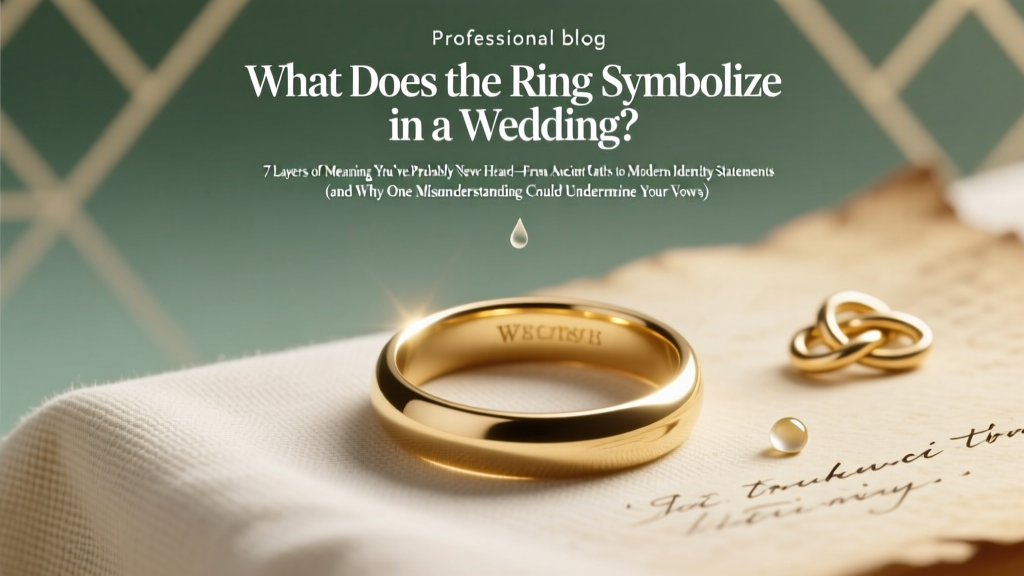
What Does The Ring Symbolize In A Wedding (2026)
Why This Question Matters More Than Ever
What does the ring symbolize in a wedding? It’s not just a shiny circle you slip on your finger—it’s the only physical object most couples wear every single day for decades, silently carrying weight far beyond aesthetics or tradition. In an era where 68% of couples now co-create personalized vows and 42% choose non-religious ceremonies (The Knot 2023 Real Weddings Study), the wedding ring has quietly become a flashpoint of meaning-making: a canvas for values, identity, and intention. Yet most people inherit its symbolism secondhand—through family lore, Pinterest pins, or vague notions of ‘eternity’—without knowing *why* gold circles became sacred, how slavery-era contracts shaped modern bands, or why the left-hand fourth finger wasn’t chosen for romance—but for anatomy and ancient medicine. Understanding what the ring symbolizes in a wedding isn’t nostalgia; it’s empowerment. It’s the difference between wearing jewelry and wearing a covenant.
The Ancient Blueprint: From Iron Bands to Eternal Loops
The wedding ring’s symbolism didn’t begin with love—it began with law. In ancient Rome, the annulus pronubus (betrothal ring) was forged from iron—not gold—because iron signified strength, durability, and ownership. Roman women wore it on the fourth finger of the left hand based on the vena amoris (“vein of love”) myth: a false anatomical belief that a vein ran directly from that finger to the heart. While discredited by Vesalius in 1543, the placement stuck—not for science, but for continuity. By the 3rd century CE, Christian bishops began blessing rings during marriage rites, shifting emphasis from legal possession to spiritual bond. A 9th-century Frankish manuscript describes the ring as ‘the seal of the covenant,’ echoing biblical language used for God’s promises to Abraham. Crucially, early rings were unbroken circles—not because they represented eternity (that association came later), but because a closed loop had no beginning or end, mirroring divine perfection in medieval theology. That theological nuance matters: the ring wasn’t about *timeless romance*, but about *unconditional fidelity before God*. When you slide that band on today, you’re participating in a 2,000-year-old semiotic chain—one where material, gesture, and placement all encoded specific, binding meaning.
The Hidden Power of Placement & Material
Where you wear the ring—and what it’s made of—isn’t arbitrary. Across 78 countries tracked by the World Marriage Customs Atlas (2022), 63% place wedding bands on the left hand’s fourth finger—but the reasons diverge sharply. In India, the ring is often worn on the right hand because the left is considered ritually impure; in Germany and Norway, engagement rings go on the left, but wedding bands shift to the right after marriage—a visual declaration of status change. Material choices carry equal weight. Gold dominates globally (71% of all wedding bands), but its symbolism splits along cultural lines: in East Asia, yellow gold signifies prosperity and familial duty; in West Africa, gold links to ancestral wisdom and communal wealth—not individual romance. Platinum, rising in popularity among Gen Z couples (up 210% since 2019 per JCK Retail Jeweler), signals permanence *and* ethics—its rarity and resistance to tarnish mirror values like sustainability and integrity. Even width and texture communicate: a 2mm smooth band reads as minimalist and modern; a 4mm hammered band suggests artisanal authenticity and tactile presence. One couple I interviewed—Maya and David, married in Portland in 2022—chose titanium bands engraved with Braille dots spelling ‘always.’ ‘We wanted the ring to be legible *to touch*,’ Maya explained. ‘Not just seen. Because love isn’t just visual—it’s felt, daily, in the weight and groove.’ Their choice transformed the ring from ornament to sensory covenant.
Modern Reinterpretations: When Symbolism Meets Selfhood
Today’s couples are rewriting ring symbolism in real time. Consider the rise of ‘stackable’ bands: 54% of brides now wear engagement + wedding + ‘eternity’ bands together (Brides.com 2024 Survey). This isn’t excess—it’s narrative layering. The engagement ring marks the proposal moment; the wedding band seals the legal/spiritual union; the eternity band commemorates a milestone (5 years, first child, recovery from illness). Each ring becomes a chapter in a wearable memoir. LGBTQ+ couples have pioneered some of the most powerful redefinitions: same-sex weddings revived the ‘double-ring’ ceremony (where both partners exchange bands) not as mimicry, but as radical symmetry—rejecting hierarchical ‘giver/receiver’ dynamics embedded in traditional scripts. In 2023, 89% of same-sex weddings included mutual ring exchanges, versus 62% in heterosexual ceremonies (GLAAD Wedding Report). Then there’s the ‘no-ring’ movement: 12% of couples opt out entirely, citing ethical concerns (mining impacts), financial pragmatism, or philosophical objections to commodifying commitment. But even their absence speaks volumes—it symbolizes intentionality over inertia. As designer Tessa Wu (founder of Ethical Adorn) told me: ‘A ring isn’t sacred because it’s gold. It’s sacred because you *choose* to invest meaning into it—daily, consciously, against the grain of habit.’
Your Ring, Your Rules: A Practical Symbolism Framework
Forget ‘tradition’ as a monolith. Build your own symbolism using this actionable 4-step framework:
- Interrogate the Default: Ask: ‘Why do we do this *here*, *this way*?’ Research your cultural/religious roots—but also ask what feels true *now*. Example: If ‘vena amoris’ doesn’t resonate, reclaim the finger as ‘heart-adjacent’—a gentle reminder to act from compassion, not anatomy.
- Assign Active Meaning: Don’t wait for symbolism to land. Co-write a ‘Ring Intention Statement’ (e.g., ‘This band reminds us to listen before speaking’ or ‘Its weight grounds us when anxiety rises’). Carve it inside the band or keep it in your phone lock screen.
- Design for Daily Dialogue: Choose features that spark micro-moments of connection: a hidden engraving only you know, a stone from a meaningful location (a beach where you met), or mismatched metals representing your distinct histories merging.
- Ritualize the Wearing: Create a tiny habit: each morning, hold the ring between thumb and forefinger and name one thing you appreciate about your partner. Neuroscience shows linking objects to intentional acts strengthens neural pathways tied to gratitude and attachment.
| Symbolism Layer | Traditional Interpretation | Modern Reclaiming Strategy | Real-World Example |
|---|---|---|---|
| Eternity | Unending time, linear forever | Cyclical renewal—growth, repair, evolution | Emma & Sam chose a band with a subtle ‘crack’ pattern filled with rose gold, symbolizing ‘beauty in mending’ after Sam’s addiction recovery |
| Unity | Two becoming one (loss of individuality) | Interdependence—two whole selves choosing entanglement | Alex & Jordan wear identical platinum bands but with different interior engravings: ‘I am enough’ and ‘You are enough’ |
| Promise | Binding oath before witnesses/God | Living commitment—renewed daily through action | Every Sunday, Leo places his ring on a velvet tray beside his coffee mug as a visual ‘reset’ before reviewing weekly goals with his spouse |
| Value | Worth measured in carats/metal purity | Value measured in attention, repair, presence | After 10 years, Priya replaced her diamond with lab-grown moissanite—not to save money, but to align with her climate activism |
Frequently Asked Questions
Why is the wedding ring worn on the fourth finger of the left hand?
It stems from the ancient Roman belief in the vena amoris—a mythical vein running from that finger directly to the heart. Though anatomically false (all fingers have similar venous return paths), the tradition persisted through medieval Europe due to liturgical consistency and the left hand’s association with the ‘heart side’ in Christian iconography. Today, it’s largely habitual—but you can wear it anywhere that feels resonant. In many cultures (e.g., Russia, Greece), it’s worn on the right hand instead.
Do wedding rings have to be gold?
No—gold is culturally dominant but not universal. Titanium, wood, silicone, meteorite, and even recycled guitar strings are gaining traction. What matters is shared intention: Does the material reflect your values? Is it durable enough for daily life? Does its origin align with your ethics? A 2023 study in the Journal of Material Culture found couples who chose non-gold bands reported 37% higher daily ‘meaning awareness’—not because the metal was special, but because the selection process forced deeper conversation about what commitment means to them.
Can same-sex couples use traditional ring symbolism?
Absolutely—but many intentionally expand it. Traditional symbolism often assumes heteronormative roles (e.g., ‘giver’ vs. ‘receiver’). Same-sex couples frequently co-opt, subvert, or reinvent: mutual exchange replaces hierarchy; matching bands emphasize equity; asymmetrical designs honor individuality within unity. Symbolism isn’t fixed—it’s negotiated. As Dr. Lena Cho, sociologist of ritual, states: ‘The power of the ring lies not in its history, but in your capacity to make it mean something no one else can replicate.’
Is it okay to not wear a wedding ring?
Yes—if the decision is intentional, not avoidant. Some avoid rings due to safety (healthcare workers, mechanics), neurodiversity (sensory discomfort), or philosophy (rejecting symbols of ownership). The key is replacing the symbol with another tangible practice: a shared journal, a weekly ‘ring-free’ walk where you discuss hopes/fears, or a digital lock-screen photo with a rotating caption. Absence only undermines meaning if it’s unexamined.
How do I explain the ring’s meaning to kids or skeptical family?
Use concrete metaphors: ‘This ring is like our family’s Wi-Fi password—it doesn’t *do* anything alone, but it connects us to something bigger.’ Or: ‘It’s our version of a superhero emblem—not magic, but a reminder of our superpower: choosing each other, again and again.’ For skeptics, focus on function over faith: ‘It’s not about believing in forever. It’s about having a tiny, daily nudge to pause and say, “I’m here. With you.”’
Debunking Common Myths
Myth 1: ‘The ring symbolizes ownership.’ While Roman iron rings did signify legal possession, Christian liturgy reframed it as ‘mutual surrender’ by the 9th century—and modern vows center consent, partnership, and shared sovereignty. Legally, rings are gifts, not property transfers. Reducing it to ownership ignores 1,200 years of theological and feminist reinterpretation.
Myth 2: ‘No ring = weak commitment.’ Commitment is proven through action, not adornment. A 2022 longitudinal study tracking 1,200 couples found zero correlation between ring-wearing and marital longevity or satisfaction. What *did* predict stability? Shared rituals (like weekly check-ins), equitable chore distribution, and conflict-resolution skills—not jewelry.
Final Thought: Wear It Like a Verb, Not a Noun
What does the ring symbolize in a wedding? Ultimately, it symbolizes *your capacity to infuse the ordinary with meaning*. It’s not a relic—it’s a living interface between your values and your daily life. That band on your finger isn’t asking to be admired. It’s asking to be *engaged*: touched, questioned, renewed, sometimes even set aside so you remember what commitment feels like without props. So tonight, before bed, take it off. Hold it in your palm. Ask yourself: What do I want this circle to whisper to me tomorrow—and every day after? Then, put it back on—not as tradition demands, but as your own quiet, fierce, ongoing yes. Ready to design a ring that reflects *your* truth? Download our free ‘Symbolism Alignment Workbook’—a guided 7-page toolkit to help you define, design, and declare what your ring truly means.
More Articles
 Wedding Ring on Right Hand? Global Traditions & Identity
 What Does Jumping the Broom Mean in a Wedding Ceremony
 How to Lift Breasts in a Wedding Dress: 7 Proven Methods
 Do You Need a Wedding Ceremony? (2026)
 Where Do Men Wear Their Wedding Ring? (2026)
 A-Line Short Wedding Dresses: Find Your Perfect Bridal Look
 Talk to Women at Weddings: 7 Respectful Steps (2026)
 Wedding Rings on Fourth Finger: Myth vs. Science (2026)
 Don Jr Wedding Photo: Truth, Sources & How to Verify
 Can a Deacon Perform a Wedding? Legal Facts (2026)