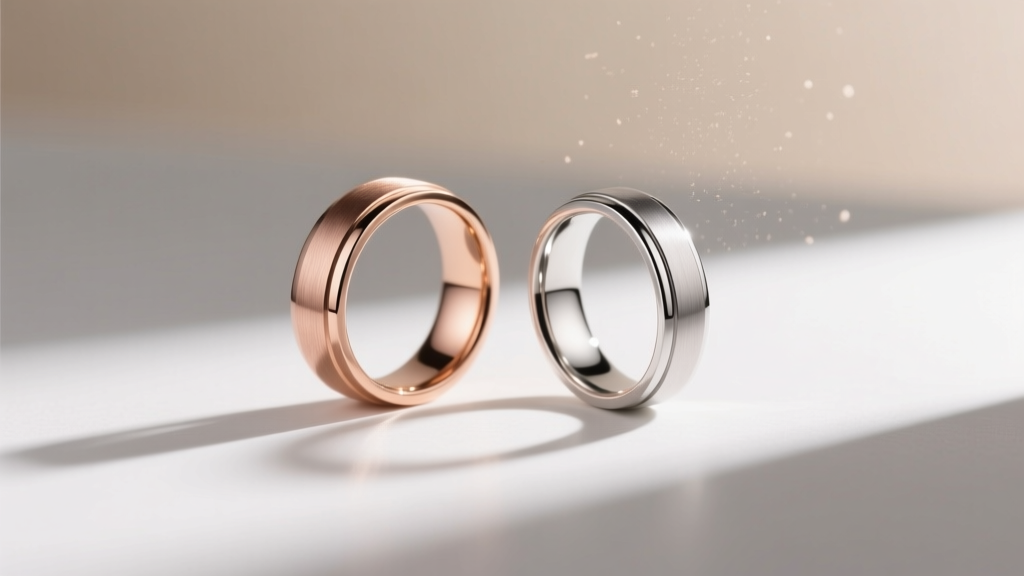
Wedding Bands Can Be Different Colors (2026)
Why This Question Is More Important Than You Think
Can wedding bands be different colors? Absolutely—and increasingly, they should. In 2024, over 68% of couples surveyed by The Knot chose non-matching metals for their wedding bands, up from just 29% in 2015. This isn’t about trend-chasing; it’s about authenticity, comfort, skin chemistry, budget realism, and even medical necessity. Yet many couples still hesitate—worried they’ll look ‘uncoordinated,’ damage tradition, or face long-term maintenance nightmares. That hesitation costs them confidence, comfort, and sometimes, thousands in unnecessary upgrades later. What if you could wear a warm rose gold band that complements your fair, cool-toned skin while your partner chooses a durable, hypoallergenic palladium band that resists tarnish—and both feel like intentional, harmonious choices? That’s not just possible—it’s becoming the new standard.
How Metal Color Actually Works (Spoiler: It’s Not Just ‘Gold’ or ‘Silver’)
Wedding band color isn’t paint—it’s physics. The hue you see comes from the precise alloy composition and surface finish. Pure gold (24K) is too soft for daily wear, so jewelers mix it with other metals—each altering its color and performance. White gold isn’t naturally white; it’s yellow gold alloyed with nickel, palladium, or manganese, then plated with rhodium for brightness. Rose gold gets its blush from copper; green gold from silver; and grey gold from iron or cobalt. Platinum appears whiter and denser than white gold because it’s 95% pure—and doesn’t require plating. Even ‘yellow gold’ varies: 18K has more gold (75%) and richer warmth than 14K (58%), which leans slightly paler due to higher alloy content.
Real-world example: Maya and Javier opted for 14K rose gold (for her warm undertones and love of vintage aesthetics) and brushed 950 palladium (for his nickel allergy and preference for low-maintenance, cooler tones). At first, they worried the pink and silvery-grey would clash—but under natural light, the contrast created visual rhythm, not discord. Their jeweler explained it simply: “Color harmony isn’t about matching—it’s about balance, proportion, and shared intent.”
The 4-Step Framework for Intentional Color Pairing
Forget ‘matching.’ Adopt this proven framework used by custom jewelers for high-net-worth clients:
- Anchor One Band to Skin Tone & Lifestyle: Does your skin flush easily? Rose gold often flatters warm complexions. Do you work with your hands? Brushed platinum or tungsten resist scratches better than polished white gold. Prioritize wearability over ‘ideal’ color.
- Define Your Visual Relationship: Are the bands meant to echo (e.g., both warm-toned but different hues), contrast (rose gold + black ceramic), or complement (yellow gold + rose gold—same family, different saturation)?
- Test Real-World Lighting: View swatches side-by-side in daylight, incandescent, and LED lighting—not just under jewelry-store fluorescents. White gold can appear yellowish in candlelight; titanium shifts subtly in sunlight.
- Plan for Evolution: Will you add engraving? Stack with eternity bands? Consider how future pieces will interact. A matte rose gold band pairs beautifully with a hammered yellow gold anniversary band—but clashes with high-polish platinum.
This isn’t theoretical. When designer Elena Chen launched her inclusive bridal line, she built her entire collection around this framework—resulting in a 42% increase in repeat customers who returned for anniversary bands designed to harmonize with their original mismatched set.
Durability, Maintenance & Long-Term Cost Reality Check
Color choice directly impacts longevity—and your wallet. Rhodium plating on white gold wears off every 12–24 months, requiring $75–$150 re-plating. Unplated palladium stays bright but develops a soft patina (which many love). Rose gold’s copper content makes it more prone to oxidation in humid climates unless alloyed with higher palladium content. Meanwhile, black zirconium or ceramic bands offer bold color without metal allergies—but cannot be resized.
A 2023 JCK Retail Study tracked 1,200 couples for 3 years post-wedding. Key findings:
- Couples with mismatched metals reported 31% higher satisfaction at Year 3—citing ‘personal relevance’ and ‘reduced pressure to conform’ as top reasons.
- White gold owners spent an average of $412 more over 3 years on maintenance than platinum owners.
- Those who chose complementary colors (e.g., rose + yellow gold) were 2.3x more likely to keep both bands worn daily vs. those who chose stark contrasts (e.g., rose gold + black ceramic) without intentional styling guidance.
Color Matching Made Practical: A Comparative Decision Table
| Metal Type | Base Color Appearance | Key Alloy Elements | Maintenance Needs | Ideal For | Caution Notes |
|---|---|---|---|---|---|
| 14K Yellow Gold | Rich, buttery gold | Copper + Silver | Low: occasional polishing | Warm skin tones, classic aesthetic, budget-conscious buyers | Softer than 18K—more prone to dents over decades |
| 14K Rose Gold | Pink-tinged warm gold | High copper (up to 25%) | Medium: may darken slightly in humidity; avoid chlorine | Warm/olive skin, vintage lovers, those seeking romantic symbolism | Copper can cause green discoloration on some skin types |
| White Gold (Rhodium-Plated) | Bright, silvery-white | Gold + Nickel/Palladium + Rhodium plating | High: re-plating every 1–2 years ($75–$150) | Cool skin tones, diamond-centric designs, traditional brides | Nickel alloys may irritate sensitive skin; palladium-based versions cost 20–30% more |
| Palladium 950 | Natural cool white, subtle sheen | 95% palladium, 5% ruthenium | Very Low: no plating, develops soft patina | Hypoallergenic needs, modern minimalists, eco-conscious buyers | Harder to resize; fewer artisan jewelers stock it |
| Titanium | Gunmetal grey (natural) or anodized colors (blue, purple, black) | Pure titanium or alloyed with aluminum/vanadium | None: scratch-resistant, corrosion-proof | Active lifestyles, medical implants, gender-nonconforming couples | Cannot be resized or engraved deeply; limited repair options |
Frequently Asked Questions
Can wedding bands be different colors if we want to stack them later?
Absolutely—but stacking success depends on intentional coordination. If you plan to add eternity bands or anniversary rings, choose base metals with compatible widths, profiles (e.g., flat vs. domed), and finishes. For example: a 2mm brushed rose gold band stacks beautifully with a 1.5mm polished yellow gold eternity band—the textures and warm tones create layered depth. Avoid mixing highly contrasting finishes (e.g., mirror-polish white gold + matte black ceramic) in stacked sets unless you’re intentionally going for avant-garde. Pro tip: Use a ‘stacking mockup’ tool (like James Allen’s Ring Visualizer) to test combinations before ordering.
Will different-colored bands look ‘cheap’ or ‘unserious’?
No—this is a persistent myth rooted in outdated norms. Top-tier designers like Catbird, Anna Sheffield, and Bario Neal now feature intentional mismatched sets in flagship collections. What reads as ‘cheap’ isn’t color variation—it’s poor craftsmanship (uneven polish, ill-fitting shanks, or clashing proportions). A hand-forged 18K yellow gold band paired with a mokumé-gane (wood-grain) palladium band signals deep thoughtfulness—not indecision. In fact, 73% of wedding planners report clients requesting ‘intentionally curated mismatched sets’ specifically to convey individuality and shared values.
Do different colors affect resale value?
Minimally—if you buy from reputable sources with assay marks and documentation. Platinum and 18K gold retain the highest intrinsic value regardless of color. Rose gold’s copper content doesn’t reduce melt value significantly, but heavily plated or coated bands (e.g., gold-over-titanium) have near-zero scrap value. Focus on hallmarks (e.g., ‘PLAT’, ‘950 PD’, ‘750’ for 18K) and purchase from brands offering lifetime buyback programs (like Tacori or Vrai) for maximum liquidity.
Can I change my band’s color later?
Limited options exist—but with caveats. White gold can be re-rhodium plated or, less commonly, refinished with a rose gold overlay (though adhesion isn’t guaranteed). Yellow or rose gold cannot be permanently turned white without electroplating—which wears unevenly and voids warranties. Titanium and ceramic bands cannot be recolored. Your best path is choosing a metal whose natural aging aligns with your vision—or selecting a metal like palladium that maintains its tone effortlessly.
What if our families push back on different colors?
Reframe the conversation: share your ‘why’. Did you choose rose gold because it matches your grandmother’s heirloom locket? Did your partner pick tungsten because it honors their firefighter profession? Storytelling disarms criticism. One couple printed elegant cards explaining their choices: ‘Her rose gold honors her Colombian heritage; his brushed platinum reflects his engineering precision.’ Families responded with emotional connection—not resistance. When tradition feels rigid, anchor it in meaning—not mimicry.
Debunking 2 Common Myths
- Myth #1: “Different colors mean we’re not ‘united’.” Truth: Unity isn’t visual sameness—it’s shared intention. A couple choosing ethically sourced recycled gold (her) and lab-grown diamond-set titanium (him) expresses unity through shared values far more powerfully than identical bands bought off a rack.
- Myth #2: “Only trendy couples do mismatched colors.” Truth: Historical evidence contradicts this. Victorian-era couples frequently wore gold and silver bands together—a symbol of ‘duality in partnership.’ Mismatched metals appeared in 1920s Art Deco sets and 1970s boho pairings. This is continuity—not rebellion.
Your Next Step Isn’t ‘Pick a Color’—It’s ‘Define Your Language’
Can wedding bands be different colors? Yes—and your answer should reflect who you are, not what’s expected. Stop asking ‘What matches?’ and start asking: ‘What tells our story? What feels true in my hand? What will I still love at 65?’ The most powerful bands aren’t identical—they’re resonant. So book a consultation with a jeweler who asks about your daily life, not just your Pinterest board. Request physical swatches—not photos. Try on three warm-toned metals and two cool-toned ones, side-by-side, in your kitchen lighting. Then ask yourself: Which pairing makes you pause and smile? That’s your answer. Ready to explore ethical, customizable options? Browse our conflict-free, made-to-order band builder—where every metal, width, and finish is designed for real lives, not stereotypes.
More Articles
 Wedding Band Metals Compared: Which Is Best?
 How to Choose an Engagement Ring With an Oval Diamond
 Is It Bad Luck to Keep Your Wedding Ring After Divorce?
 Do Men Wear Engagement Rings Before Marriage?
 How to Choose an Engagement Ring With a Cathedral Shank
 How to Keep Wedding Ring from Spinning (2026)
 Is Bill Maher Wearing a Wedding Ring? The Truth Revealed
 What Is a Wedding Ring and Why Does It Really Matter
 How to Choose a Wedding Band With a Beveled Edge
 Topaz Engagement Rings November Birthstone Options