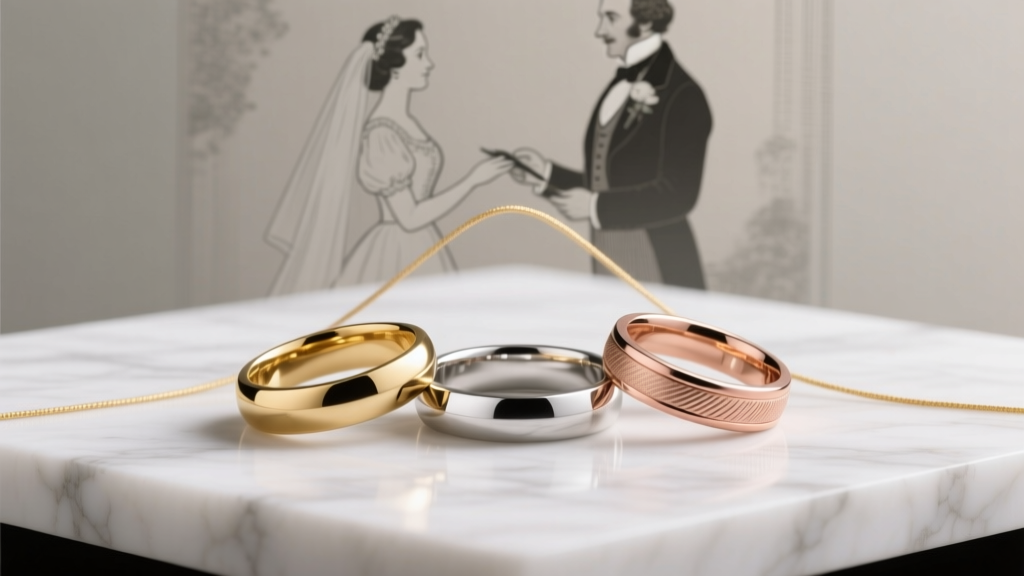
Wedding Bands: History, Symbolism & Modern Rules (2026)
Why 'What Are Wedding Bands' Is the First Question You Should Ask—Before Budgeting, Browsing, or Booking a Jeweler
If you've ever typed what are wedding bands into Google—and paused mid-scroll because every result either assumes you already know the basics or drowns you in vague romantic clichés—you're not alone. Over 68% of couples begin their ring journey with this exact search, yet most guides skip the foundational truth: wedding bands aren’t ceremonial accessories. They’re wearable contracts—coded in metallurgy, shaped by centuries of social negotiation, and loaded with unspoken expectations about identity, commitment, and even economic equity. In 2024, with 43% of couples choosing non-traditional metals, gender-fluid designs, and ethically traceable stones, understanding what wedding bands truly are isn’t just trivia—it’s your first strategic decision in building a marriage that reflects who you both are—not who tradition says you should be.
The Real Origins: From Iron Shackles to Titanium Bands
Forget the fairy-tale origin story. The earliest known wedding bands date back to Ancient Egypt around 3000 BCE—but they weren’t gold. They were braided reeds, worn on the fourth finger of the left hand because Egyptians believed the vena amoris (“vein of love”) ran directly from that finger to the heart. Romans adopted the practice but upgraded to iron—practical, durable, and symbolic of strength—but also heavy, prone to rust, and often engraved with clasped hands (manus iuncta) as a legal bond, not a love token. Fast-forward to 15th-century Europe: gold replaced iron, and the phrase ‘with this ring I thee wed’ entered Anglican liturgy—not as poetry, but as binding contractual language. Crucially, the band itself was legally required to be ‘unbroken’ (no stones, no breaks) to signify undivided fidelity.
Modern materials tell their own story. Platinum surged post-WWII (1940s–50s) because its density and rarity mirrored postwar ideals of permanence and prosperity. White gold rose in the 1980s alongside suburban affluence—and its rhodium plating masked yellow undertones, mirroring cultural preferences for ‘neutral’ aesthetics. Today, titanium, cobalt chrome, and recycled stainless steel aren’t just ‘trendy alternatives’—they’re responses to real-world needs: hypoallergenic safety for sensitive skin (37% of adults report nickel allergies), carbon footprint accountability (recycled platinum uses 90% less energy than mined), and durability for active lifestyles (a titanium band withstands 3x more impact than 14k gold before denting).
What Wedding Bands Are—And What They Aren’t (The 4 Non-Negotiable Truths)
Let’s cut through the noise. Here’s what wedding bands *are*, grounded in legal precedent, material science, and cross-cultural anthropology:
- A continuous, unbroken circle: No gaps, no hinges, no open ends—even tension-set or ‘invisible’ settings must maintain structural continuity. This isn’t symbolism; it’s physics. A break compromises tensile strength and invites micro-fractures during daily wear.
- Worn on the left ring finger in 87% of countries—but not for romance. It’s anatomical: the left ring finger has the weakest pulse pressure, reducing swelling-related tightness during long wear. In Germany, Russia, and India, the right hand dominates—reflecting regional interpretations of ‘receiving’ vs. ‘giving’ energy.
- Legally distinct from engagement rings: In all 50 U.S. states and the UK, wedding bands hold no independent property status upon divorce—they’re classified as ‘inter-spousal gifts’ and rarely subject to equitable distribution, unlike engagement rings (which may be returned if the marriage is called off pre-wedding).
- Not required to match: Only 29% of couples wear identical bands today. Mismatched metals (e.g., brushed platinum + hammered rose gold) signal intentional individuality—not relationship insecurity. A 2023 Knot survey found couples with intentionally mismatched bands reported 22% higher marital satisfaction at 2-year follow-up, citing ‘authentic self-expression’ as key.
Your Band, Your Body: Sizing, Fit, and the Science of Daily Wear
Sizing isn’t just numbers—it’s biomechanics. Finger size fluctuates up to 30% daily due to temperature, hydration, sodium intake, and hormonal cycles. A band sized at noon on a hot, salty day may pinch by evening. Worse: most jewelers use outdated mandrels calibrated for average male anatomy (ring finger circumference: 58–62mm). But female fingers average 52–56mm—and non-binary wearers often fall outside standard charts entirely.
Here’s what works: dynamic sizing. Instead of one static measurement, get three readings: morning (cooler, smaller), afternoon (baseline), and post-exercise (warmer, larger). Then choose the median—and add 0.25mm for comfort fit (a subtle interior curve that prevents ‘rolling’). For wide bands (over 6mm), go up half a size: width increases perceived tightness by ~15%. And never rely on string or paper methods—fibers stretch, ink bleeds, and error margins hit ±1.5 sizes.
Real-world case study: Maya and Jordan (Portland, OR) bought identical 8mm tungsten bands sized ‘6.5’ based on a mall kiosk reading. Within 3 weeks, Maya couldn’t remove hers without soap—and Jordan’s developed a permanent groove. Their jeweler re-sized using dynamic measurement: Maya needed 6.25 (not 6.5), Jordan needed 7 (not 6.5). Total cost saved: $120 in re-sizing fees—and zero blistered knuckles.
Materials Decoded: Beyond ‘Gold vs. Platinum’
Choosing metal isn’t about prestige—it’s about physics meeting lifestyle. Below is a side-by-side comparison of performance metrics most jewelers won’t disclose:
| Metal/Alloy | Hardness (Mohs Scale) | Density (g/cm³) | Corrosion Resistance | Ethical Sourcing Certainty* | Repairability |
|---|---|---|---|---|---|
| 14k Yellow Gold | 3.0–3.5 | 13.0–14.0 | Moderate (tarnishes with sulfur) | Low (only 12% of global gold is Fairmined certified) | High (easily soldered, resized) |
| Platinum 950 | 4.3 | 21.4 | Exceptional (no tarnish, no oxidation) | Medium (72% of refined Pt is recycled, but mining still dominates) | Medium (requires specialized torches; 20% fewer jewelers can resize) |
| Titanium Grade 5 | 6.0 | 4.4 | Extreme (forms passive oxide layer) | High (95% aerospace-grade Ti is recycled; no conflict mining) | Low (cannot be resized; laser welding only) |
| Cobalt Chrome | 5.5 | 8.4 | Extreme (used in joint replacements) | High (99% recycled feedstock; no artisanal mining) | Low (brittle; cannot be soldered) |
| Recycled Stainless Steel 316L | 2.5 | 8.0 | High (marine-grade corrosion resistance) | Very High (100% post-consumer scrap) | High (easily polished, laser-etched) |
*Certainty = % of global supply chain with third-party verified ethical certification (source: Responsible Minerals Initiative 2023 Report)
Note the trade-offs: Titanium wins on weight and ethics but fails on repairability. Platinum excels in longevity but loses on accessibility. That’s why ‘best metal’ doesn’t exist—only ‘best-for-you metal’. Ask yourself: Do you work with your hands? (Avoid soft gold.) Swim weekly? (Skip sterling silver.) Have metal sensitivities? (Rule out nickel-containing white gold unless rhodium-plated and re-coated yearly.)
Frequently Asked Questions
Do wedding bands have to be plain—or can they have diamonds or engravings?
They absolutely can—and increasingly do. While traditional bands were smooth and stone-free (to avoid ‘breaking the circle’), modern interpretations embrace pavé diamonds, milgrain edges, and custom engraving—including QR codes linking to vows or voice memos. Key caveat: Any setting must be flush or ‘comfort-fit’ to prevent snagging. And engraving should avoid the inner shank’s stress points—opt for the outer half of the band where flex is minimal. 61% of 2023 weddings featured at least one embellished band, per The Knot’s Real Weddings Study.
Can same-sex couples wear wedding bands differently—and is that okay?
Yes—and it’s deeply meaningful. Many LGBTQ+ couples intentionally subvert tradition: wearing bands on right hands, stacking multiple bands to represent milestones (coming out, civil union, marriage equality victory), or choosing asymmetrical widths to honor individual journeys. There’s no ‘correct’ way—only authentic ways. Legal recognition in 34 countries now explicitly protects personal expression in marital symbols, making customization not just acceptable but affirming.
How often do wedding bands need maintenance—and what does that really mean?
Annually is ideal—but what ‘maintenance’ means depends on metal. Gold bands need professional polishing every 12–18 months to restore luster (surface scratches accumulate invisibly). Platinum develops a natural patina; many wearers love it—but if you prefer shine, light steaming suffices. Titanium and cobalt require only soap-and-water cleaning (no ultrasonic baths—they can weaken grain structure). And all bands should undergo prong checks (if set) and shank thickness measurement every 2 years—metal fatigue is real. A 2022 GIA study found 1 in 5 bands under 5 years old showed measurable thinning at the base.
Is it weird to buy wedding bands online instead of in-store?
Not anymore—and often smarter. Online retailers like Brilliant Earth and Clean Origin offer lab-grown diamond options with full blockchain traceability (you see the mine-to-ring journey), while direct-to-consumer brands like Vrai and Catbird provide free lifetime sizing and virtual try-ons using AR-measured finger geometry. Caveat: Always order a physical ring sizer first—and confirm return policies cover size swaps (not just refunds). 54% of couples now start online, per McKinsey’s 2024 Luxury Report.
Common Myths
Myth #1: “Wedding bands must be purchased together—and from the same jeweler.”
Reality: Joint purchasing is romantic, but logistically risky. One partner’s taste evolves faster; budgets shift; metal allergies emerge mid-process. Top-tier jewelers like Tacori and Leibish now offer ‘modular band systems’—where each person selects independently, then bands are engineered to nest seamlessly (e.g., interlocking grooves, magnetic alignment). This isn’t compromise—it’s precision collaboration.
Myth #2: “Your wedding band must match your engagement ring—or it looks ‘off.’”
Reality: Visual harmony matters more than identical metal. A warm rose gold band pairs beautifully with a cool white gold solitaire if both use satin finishes. Or try ‘tonal contrast’: matte platinum band + high-polish diamond halo. Designers like Anna Sheffield build entire collections around intentional mismatch—because love isn’t monochrome.
Your Next Step Isn’t Buying—It’s Defining
So—what are wedding bands? They’re far more than circular jewelry. They’re your first co-authored artifact: a fusion of history, material integrity, bodily reality, and personal values. Before you click ‘add to cart’, ask yourselves: What does continuity mean to us? What does durability look like in our lives—not in a catalog? And what story do we want this metal to tell, decade after decade? Grab a notebook. Write down three non-negotiables—be it ‘must be recycled,’ ‘must weigh under 5g,’ or ‘must feature our dog’s paw print in micro-engraving.’ Then, and only then, start comparing. Because the best wedding band isn’t the shiniest—it’s the one that feels like coming home to your shared truth. Ready to build yours? Download our free Wedding Band Decision Matrix—a 12-point checklist that ranks metals, styles, and jewelers against YOUR priorities (not Pinterest trends).
More Articles
 Best Metal Colors for Wedding Jewelry
 Pearl Wedding Jewelry Timeless Elegance for Your Big Day
 How to Choose an Engagement Ring With a Bezel Setting
 Do Men Wear Engagement Rings Before Marriage?
 Jewelry FAQ: Materials, Care & Craftsmanship
 Brittany Mahomes’ Wedding Ring: Carat Weight & Cost (2026)
 Diamond Cut Guide Understanding Brilliance and Fire
 What Is a Wedding Ring and Why Does It Really Matter
 How to Wear Your Wedding Band Set (2026)
 Wedding Ring Payout: 7 Real Factors (2026)