## What Side Does Your Wedding Ring Go On? The Truth Revealed
You're days away from the altar and suddenly realize: which hand — which *finger* — does the wedding ring actually go on? You're not alone. This question trips up nearly every couple, and getting it wrong on your wedding day is the kind of thing that ends up in photos forever. The answer depends on tradition, culture, and personal choice — but here's everything you need to know to wear your ring with total confidence.
---
## The Western Tradition: Left Hand, Fourth Finger
In the United States, the United Kingdom, Canada, and Australia, the wedding ring goes on the **left hand, fourth finger** (the ring finger). This tradition dates back to ancient Rome and the belief in the *Vena Amoris* — the "vein of love" — thought to run directly from that finger to the heart.
The standard order in Western tradition:
1. **Engagement ring** worn on the left ring finger during the engagement
2. On the wedding day, the engagement ring is **moved to the right hand** temporarily
3. The **wedding band is placed first** on the left ring finger during the ceremony
4. After the ceremony, the engagement ring is **moved back on top** of the wedding band
This stacking order keeps the wedding band closest to the heart — a meaningful detail many couples care deeply about.
---
## Right-Hand Traditions Around the World
Not every culture follows the left-hand rule. In many countries, the wedding ring goes on the **right hand**:
- **Germany, Austria, Norway, Spain, India, Greece** — right hand is traditional
- **Russia, Poland, Ukraine, Bulgaria** — right hand, often tied to Orthodox Christian customs
- **Brazil and Colombia** — right hand until marriage, then sometimes switched to the left
- **Jewish tradition** — the ring is placed on the **right index finger** during the ceremony, then often moved afterward
If you or your partner come from one of these backgrounds, honoring that tradition is completely valid — and increasingly common in multicultural weddings.
---
## Same-Sex Couples and Modern Couples: Your Rules
There is no universal law governing which hand or finger a wedding ring must go on. Same-sex couples, non-binary individuals, and modern couples increasingly choose based on:
- **Personal comfort** — some people find the left hand awkward for daily tasks
- **Cultural heritage** — honoring one or both partners' backgrounds
- **Practical reasons** — dominant hand wear, job requirements, or medical conditions
- **Aesthetic preference** — some prefer how rings look on the right hand
The only rule that matters: **both partners agree and feel good about it.** Discuss it before the ceremony so there's no confusion at the altar.
---
## Common Myths About Wedding Ring Placement
**Myth 1: There is one universally correct hand for a wedding ring.**
Fact: As shown above, right-hand traditions are just as historically valid as left-hand ones. Nearly half the world wears wedding rings on the right hand. Neither is wrong.
**Myth 2: The Vena Amoris is a real anatomical vein.**
Fact: Modern anatomy has confirmed no such direct vein exists. The tradition is romantic folklore, not biology. That doesn't make it less meaningful — but it does mean you're free to choose your hand without worrying about "breaking" a medical rule.
---
## Your Simple Next Step
Decide together — before the wedding day — which hand and which order you'll wear your rings. Tell your officiant so they place the band correctly during the ceremony. If you're following Western tradition: **left hand, ring finger, wedding band goes on first and sits closest to your hand.** If you're honoring another tradition, wear it proudly on whichever hand carries that meaning for you.
The most important thing isn't which side the wedding ring goes on — it's that you and your partner are on the same page.
 How to Choose a Wedding Band With a Two-Tone Design
 How to Keep Wedding Ring and Engagement Ring Together
 How to Choose a Wedding Band With a Matte Finish
 Cheap vs Premium Wedding Venues Compared
 Wedding Ring Cleaning: 90-Second Pro Method (2026)
 How to Restore an Old Family Engagement Ring
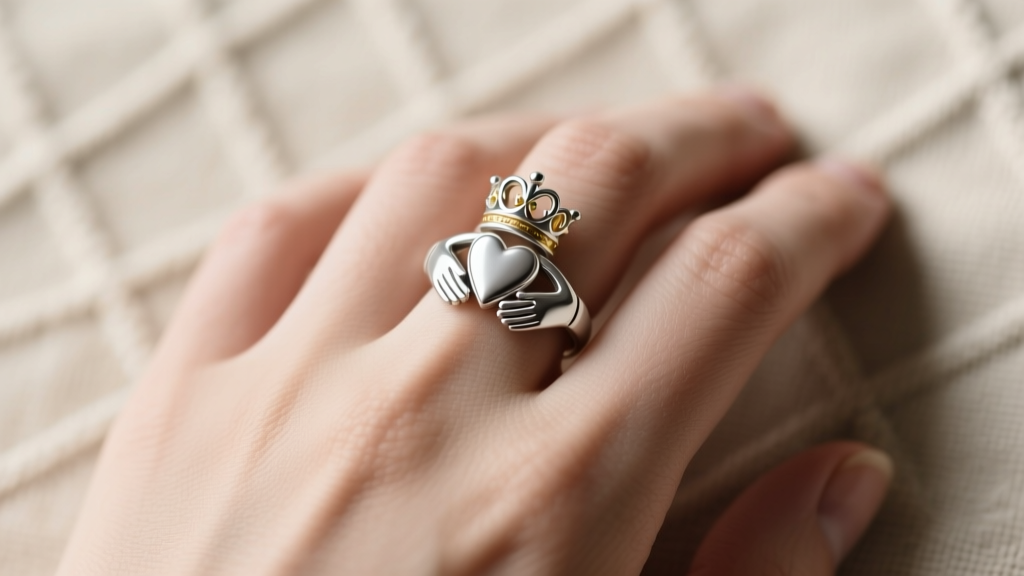 Irish Wedding Ring: Claddagh Placement & Metal Guide (2026)
 How to Choose an Engagement Ring for Short Fingers
 How to Choose an Engagement Ring With a Tension Setting
 How Much Is My Wedding Band Worth? (2026)