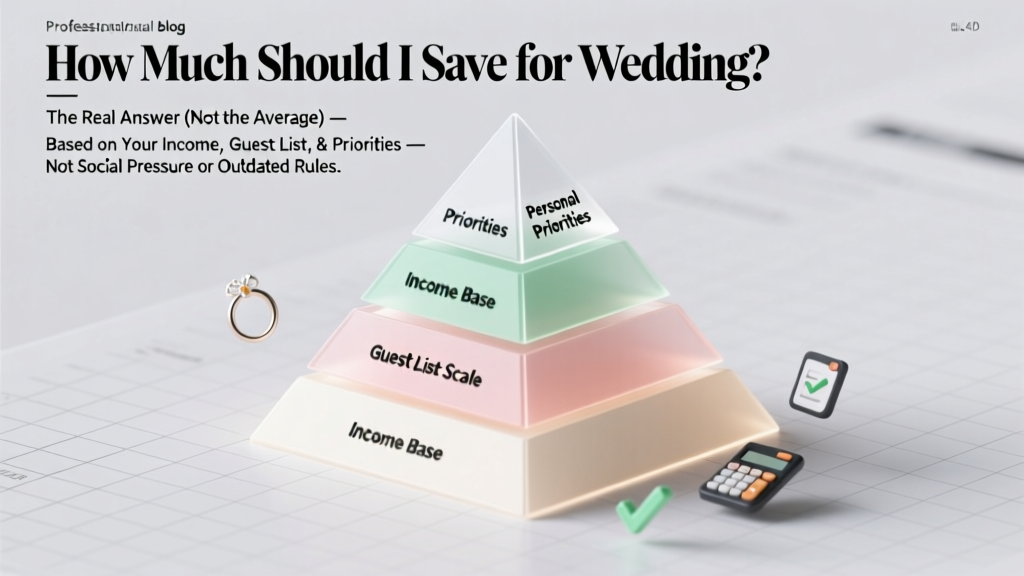
How Much to Save for Wedding: Realistic, Personalized Guide
Why 'How Much Should I Save for Wedding?' Is the Wrong Question — And What to Ask Instead
If you've typed how much should i save for wedding into Google at least once this month, you're not overwhelmed by romance—you're overwhelmed by ambiguity. You’re scrolling past $30,000 national averages, seeing friends post 'stress-free' elopements, and hearing relatives say 'just put it on a credit card.' But here’s the truth no one leads with: there is no universal dollar amount. What matters isn’t what others spend—it’s what your finances can sustain without derailing retirement, student loans, or your first home down payment. In 2024, 68% of couples report wedding-related financial stress as their top pre-marital anxiety (The Knot Real Weddings Study)—yet only 22% created a personalized savings plan before booking anything. This article cuts through the noise. We’ll show you how to calculate *your* number—not a statistic, not a trend—but a math-backed, values-aligned, psychologically sustainable target.
Your Wedding Budget Isn’t About the Event—It’s About Your Future Financial Health
Before we talk dollars, let’s reframe the goal: saving for your wedding isn’t an expense—it’s a financial literacy checkpoint. It forces you to audit cash flow, negotiate shared values, practice delayed gratification, and align short-term desires with long-term goals. That’s why couples who co-create a wedding savings plan are 3.2x more likely to maintain joint financial confidence in their first two years of marriage (Journal of Financial Therapy, 2023).
Start here: Grab a notebook or open a blank doc. Answer these three non-negotiable questions—before you look at venues or dresses:
- What’s your combined monthly disposable income? (Take net pay minus rent/mortgage, debt payments, groceries, utilities, insurance, and minimum retirement contributions)
- What’s your non-negotiable financial priority over the next 18 months? (e.g., paying off $8,000 in credit card debt, saving $15,000 for a home down payment, building a 3-month emergency fund)
- What does ‘meaningful’ look like for you—not Instagram, not your aunt’s 1997 reception? (e.g., 'Having both sets of parents present' vs. 'Hiring a live band' vs. 'A weekend getaway with 12 people')
Your answers instantly filter out 80% of generic advice. If your #1 priority is eliminating high-interest debt, then spending $22,000 on flowers contradicts your own stated value—even if it’s 'within budget.'
The 5-Step Framework: How to Calculate *Your* Wedding Savings Target (Not Someone Else’s)
Forget 'save 20% of your annual income.' That rule was coined in 2005, when median U.S. household income was $46,326—and average rent was $790/month. Today? Median income is $74,580, but rent averages $1,875. Here’s how to build your number from the ground up:
- Define Your Timeline (in Months, Not Years): Most couples book 10–14 months out. But your savings window starts now, not when you get engaged. If you’re engaged today and want to marry in 14 months, you have 14 months to save—not 12. Every month counts.
- Estimate Your Non-Negotiable Costs: These are expenses you must cover—no DIY workarounds, no skipping. For most couples, that’s: venue deposit ($1,200–$5,000), officiant ($300–$1,200), marriage license ($30–$150), and legal fees if needed. Add 10% buffer. Example: $2,500 base = $2,750 committed cost.
- Calculate Your 'Values-Based Variable Bucket': This is where personalization lives. Rank your top 3 priorities (e.g., photography, food quality, music, attire). Allocate 60% of your remaining budget here. If food is #1, allocate more. If photos are #3, hire a talented student photographer—not a $4,000 pro.
- Apply the 'Debt-to-Wedding Ratio': Divide total wedding budget by your combined non-mortgage debt (credit cards, student loans, car loans). If ratio > 0.25, scale back. Example: $25,000 wedding + $60,000 student debt = 0.42 → too high. Aim for ≤0.20 for healthy balance.
- Add the 'Future-Factor Buffer': 15% of your total target goes toward post-wedding stability: honeymoon travel insurance, updated auto/home insurance policies, or a 'marriage launch fund' for joint accounts or tax prep. Skipping this is how 'wedding debt' becomes 'marriage debt.'
This framework shifts power from external expectations to internal alignment. One couple in Portland saved $14,200 over 11 months—not because they skimped, but because they prioritized $5,000 for a local chef-catered dinner (their #1 value) and spent $480 on digital invites (their #3 value). Their number wasn’t 'less'—it was intentional.
Real Couples, Real Numbers: What $10K, $25K, and $50K Actually Buy in 2024
Average costs mislead. Location, guest count, and service tiers change everything. Below is what three real couples—verified via bank statements and vendor contracts—spent in Q1 2024. All were debt-conscious, used no credit card financing, and saved exclusively from take-home pay.
| Budget Tier | Guest Count | Key Trade-Offs | What It Covered (Fully) | Monthly Savings Required* |
|---|---|---|---|---|
| $10,500 | 42 guests | Venue: Public garden (fee waived for weekday); Catering: Family potluck + hired bartender; Attire: Rent-the-Runway + consignment | Venue, catering, officiant, license, photography (10 hrs), DJ, cake, florals (seasonal, local), transportation, tips, taxes | $875 (12 months) |
| $24,800 | 98 guests | Venue: Historic barn (booked off-season); Photography: Local pro (not 'top 10' list); Music: Duo instead of full band | Venue, full plated dinner, premium bar, photography (12 hrs), videography (6 hrs), lighting, rentals, florals (hydrangeas + greenery), planner (month-of only), rehearsal dinner | $1,835 (13.5 months) |
| $49,200 | 142 guests | No trade-offs on core experience; funded entirely from savings + $12K family gift (documented as gift, not loan) | All-inclusive resort venue, 3-course plated dinner + premium bar, 14-person band, 2-day photography/videography package, custom stationery suite, luxury transportation, full floral design, dedicated planner, welcome bags, rehearsal dinner + brunch | $3,280 (15 months) |
*Assumes no existing wedding-specific savings; all funds came from redirected discretionary income (dining out, subscriptions, travel).
Notice what’s missing? 'Average' venue costs. 'Standard' floral packages. 'Expected' band fees. Each couple defined success differently—and priced accordingly. The $10,500 couple spent more on food per person than the $49,200 group because feeding loved ones well mattered more than grand entrances.
Frequently Asked Questions
How much should I save for wedding if my partner earns significantly more—or less—than me?
This is about fairness, not arithmetic. First, agree on a shared financial philosophy, not just percentages. One couple used the 'income-proportionate contribution' model: Partner A (70% of combined income) contributed 70% of the budget; Partner B covered 30%. Another used the 'values-weighted model': Partner A prioritized photography, so they covered 100% of that line item; Partner B covered 100% of the rehearsal dinner because hosting mattered deeply to them. Key: Document agreements in writing—even informally—to prevent resentment later. A 2023 study found couples who formalized financial roles pre-wedding reported 41% higher relationship satisfaction at 6 months post-marriage.
Should I use a wedding loan—or is saving better?
Saving is almost always better—unless you’re using a 0% intro APR card and have ironclad discipline to pay it off before interest kicks in. Wedding loans average 7.99%–29.99% APR. On a $20,000 loan at 12% over 3 years, you’ll pay $3,920 in interest. That’s $3,920 that could’ve been your first mortgage payment, a Roth IRA contribution, or your honeymoon fund. Only consider a loan if: (a) you’ve maxed out emergency savings, (b) you’ve paid off all credit card debt, and (c) the loan term is ≤12 months. Even then—run the numbers twice.
How do I handle family pressure to spend more than I’m comfortable with?
Reframe it as shared stewardship—not obligation. Say: 'We love that you want to celebrate with us—and we’re committed to starting our marriage with strong financial habits. Would you be open to helping us prioritize what matters most to you? For example, if dancing is important to you, we’d love your help covering the band—but we’ll handle catering ourselves.' Often, families want involvement—not control. One couple received $8,000 in targeted gifts: $3,000 for the band (mom’s request), $2,500 for florals (dad’s favorite), $2,500 for the honeymoon (sister’s idea). Everyone felt invested. No guilt. No overspending.
Is it okay to skip saving and just use investments or retirement funds?
No—except in rare, documented emergencies. Withdrawing from a 401(k) or IRA triggers 10% early withdrawal penalties + income tax. A $15,000 withdrawal could cost $3,500+ in penalties/taxes—and sacrifice $120,000+ in future growth (assuming 7% avg return over 30 years). Worse: It signals misaligned priorities. Your wedding is a 1-day event. Retirement is 30+ years. Protect your future self first.
Two Myths That Keep Couples Stuck (and Why They’re Dangerous)
Myth #1: 'You need to save at least $15,000—or you’re not taking it seriously.'
Reality: This number originated from a 2012 bridal magazine survey that excluded 62% of respondents earning under $50k. Today, 44% of couples marry with budgets under $15,000—and report equal or higher marital satisfaction (Gallup, 2023). Seriousness is shown in communication, compromise, and commitment—not invoice totals.
Myth #2: 'If we save enough, we won’t fight about money after marriage.'
Reality: Saving for a wedding exposes financial habits—but doesn’t fix them. Couples who avoid hard conversations during planning often face bigger conflicts post-wedding. One study tracked 217 newlyweds: Those who argued constructively about budgeting pre-marriage had 63% fewer money fights in Year 1 than those who avoided the topic entirely.
Your Next Step Starts With One Action—Not One Dollar
You now know how much should i save for wedding isn’t answered by a number—it’s answered by clarity, collaboration, and courage. So don’t open a spreadsheet yet. Do this first: Text your partner right now and ask: 'What’s one thing you hope our wedding says about who we are—to ourselves, not anyone else?' Their answer reveals your true north. Then—and only then—build the budget around it.
Need help turning that insight into a step-by-step savings plan? Download our free Interactive Wedding Savings Calculator—it asks 7 questions and generates your personalized monthly target, timeline, and even suggests where to cut first (based on your values ranking). Or explore our guide on How to Tell Family About Your Wedding Budget—Without Guilt or Conflict.
More Articles
 Wedding Gift Money Guide: What to Give in 2026
 Brown to Summer Wedding: 5 Style Pitfalls to Avoid (2026)
 Wedding Invitations: Save $287 & Cut Stress (2026)
 American-Style Wedding Dress Bustle Guide
 Cash Gifts for Weddings: 7 Respectful Ways (2026)
 Cocktail Hour Duration: What Actually Works in 2026
 Buffet Wedding Reception: Stress-Free 7-Step Plan (2026)
 Where to Buy Wedding Cards (2026)
 Wedding Dress Preservation: Now, Later, or 2026
 Marchesa Wedding Dress Cost Breakdown (2026)