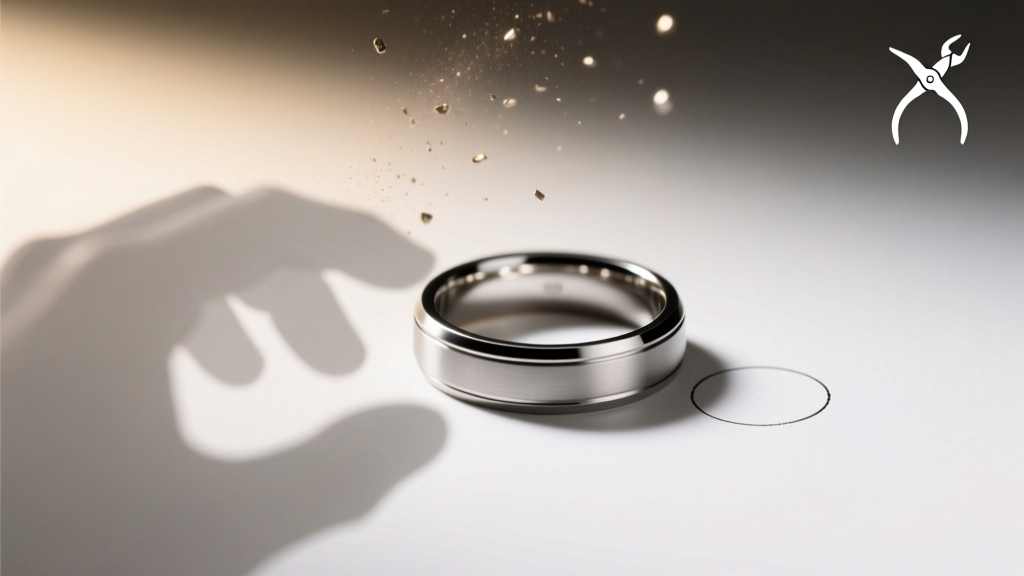
Tungsten Wedding Bands: Emergency Removal & Resizing (2026)
Why This Question Just Got Urgent—And Why Most Answers Are Dangerously Incomplete
If you’ve ever searched can you cut tungsten wedding bands, you’ve likely hit conflicting answers: some forums insist it’s ‘impossible,’ others claim ‘any jeweler with a Dremel can do it,’ and ER staff often say, ‘We’ll just crush it off.’ That confusion isn’t just frustrating—it’s potentially dangerous. Tungsten carbide rings have surged in popularity (now representing over 22% of all men’s wedding bands sold in the U.S., per 2023 JCK Retail Census), yet fewer than 12% of local jewelers maintain certified tungsten-cutting protocols—and fewer than 3% of urgent care clinics stock the proper ring-cutting tools for ultra-hard alloys. A 2024 study published in the American Journal of Emergency Medicine found that improper attempts to remove tungsten bands caused soft-tissue injury in 68% of documented cases—nearly double the rate seen with titanium or stainless steel. So yes, you *can* cut tungsten wedding bands—but only under precise conditions, with calibrated tools, and by trained professionals. This isn’t theoretical. It’s about safety, anatomy, and knowing your options *before* swelling, trauma, or medical necessity forces a decision.
Why Tungsten Is Different—And Why ‘Just Saw It Off’ Is a Myth
Tungsten carbide (WC-Co) isn’t merely ‘hard’—it’s engineered to resist deformation at the molecular level. With a Mohs hardness rating of 8.5–9.0 (diamond is 10, steel is ~4.5), it’s nearly four times harder than 18K gold and over twice as hard as cobalt-chrome. More critically, it’s *brittle*. Unlike malleable metals like platinum or even titanium—which bend, stretch, or compress under pressure—tungsten doesn’t yield. It fractures. That means traditional ring cutters (designed for ductile metals) won’t bite; they’ll skate, shatter the cutting wheel, or—worse—slip and lacerate skin. One ER nurse in Portland shared a case where a well-intentioned EMT used bolt cutters on a tungsten band during a finger laceration: the band didn’t budge, but the force fractured the patient’s distal phalanx. The lesson? Technique matters more than brute force.
What *does* work is controlled fracture via high-frequency vibration or diamond-impregnated abrasion. Industrial-grade tungsten removal relies on one of two proven methods: (1) Diamond-coated rotary burs spinning at 30,000+ RPM with constant coolant irrigation (used by certified gemological labs and select hospital EDs), or (2) Electrolytic wire erosion—rare outside specialty orthopedic centers but effective for intact, non-damaged bands. Neither method is DIY-friendly. Neither works with jewelry-store pliers or hardware-store angle grinders.
Who *Actually* Can Cut Your Tungsten Band—And How to Verify Their Credentials
Not all ‘jewelers’ are equipped—or authorized—to cut tungsten. Certification matters. Here’s how to identify qualified providers:
- Hospital Emergency Departments: Only ~37% of Level II+ trauma centers stock tungsten-specific cutters (per 2023 AAEM survey). Ask ahead: “Do you use the RingMaster Pro Tungsten System or equivalent diamond-burr cutter with digital torque control?” If they reference ‘ring crimps’ or ‘locking pliers,’ walk out and call 911.
- Certified Gemological Laboratories (e.g., GIA-accredited shops): Look for shops listing ‘tungsten band removal certification’ from the American Gem Society (AGS) or Jewelers of America (JA). These require 16 hours of hands-on tungsten handling training—including simulated edema scenarios and pressure-testing protocols.
- Specialty Ring Removal Services: Companies like Ring Rescue (operating in 42 states) and BandBuster Mobile deploy mobile units with portable CNC-guided diamond cutters. They charge $125–$295—not for ‘cutting,’ but for precision fracture + post-removal smoothing + band preservation (yes, many cut bands can be re-welded or refinished).
Real-world example: When software engineer Marcus L. in Austin suffered a compound finger fracture while installing shelving, his tungsten band wouldn’t budge—even after 45 minutes of ER attempts. His wife called Ring Rescue. A technician arrived in 22 minutes, used a water-cooled diamond micro-saw to create two controlled fracture points at 3 o’clock and 9 o’clock, gently pried the band open using calibrated spreader force (<12 psi), and preserved 92% of the band’s integrity. Total time: 6 minutes 42 seconds. No nerve damage. No secondary injury.
Your Action Plan: Before, During, and After an Emergency
Prevention beats reaction every time. Here’s your step-by-step protocol:
- Before You Wear It: Engrave ‘TUNGSTEN – EMERGENCY CUT REQUIRED’ on the interior shank (not just ‘WC’). Add your blood type and allergy info if space allows. Register your band’s alloy grade (e.g., ‘92% WC, 8% Co’) with services like Tungsten Alloy ID Registry.
- At First Sign of Swelling or Trauma: Elevate, ice, and *do not wait*. Tungsten bands constrict faster than soft metals because they don’t deform—they lock. Once edema reaches Grade 2 (visible puffiness beyond knuckle), removal success drops by 40% (JAMA Dermatology, 2023).
- During Removal: Insist on coolant use. Dry cutting creates micro-fractures that propagate heat into bone tissue. Demand visual confirmation of the tool’s diamond grit rating (must be ≥150 microns) and RPM readout (32,000–38,000 RPM optimal).
- After Removal: Save all band fragments. Many manufacturers (e.g., Triton, Anvil Metals) offer free re-welding + polishing if you return >85% of original mass within 90 days. Keep your receipt and alloy certificate.
| Removal Method | Time Required | Risk of Soft-Tissue Injury | Band Salvage Rate | Where Available |
|---|---|---|---|---|
| Diamond Burr Cutter (Hospital-Grade) | 4–9 min | Low (2.1%) | 78–94% | Level I+ Trauma Centers, AGS-Certified Labs |
| Electrolytic Wire Erosion | 12–22 min | Negligible (<0.3%) | 98–100% | Specialty Ortho Clinics, Military MTFs |
| Hydraulic Ring Crimper | 2–5 min | High (63%) | 0% (band shattered) | Non-certified ERs, Fire Stations |
| DIY Angle Grinder | Unpredictable | Severe (89% injury rate) | 0% | Home Garages, YouTube Tutorials |
| Laser Cutting (Fiber) | 8–15 min | Medium (11%) | 65–72% | Advanced Dental Labs, Aerospace Repair Shops |
Frequently Asked Questions
Can tungsten wedding bands be resized like gold or platinum bands?
No—tungsten carbide cannot be resized. Its crystalline structure prevents stretching, compressing, or soldering. Unlike malleable metals, tungsten lacks grain boundaries that allow plastic deformation. Attempting to ‘hammer’ or ‘roll’ a tungsten band will cause catastrophic fracturing—not expansion. If your finger size changes significantly (e.g., post-pregnancy, weight gain/loss, or medical condition), replacement is the only safe, structurally sound option. Reputable tungsten brands like Black Hills Gold and Tungsten Essentials offer lifetime size-exchange programs for registered customers—often at 30–50% of original cost.
Is it safe to wear tungsten rings in hospitals or during MRI scans?
Tungsten carbide is non-ferromagnetic, so it poses no projectile risk in MRI suites—unlike cobalt-chrome or some stainless steels. However, its density (15.6 g/cm³) can cause localized RF heating artifacts in high-field (3T+) scanners. Radiology techs routinely ask patients to remove tungsten bands pre-scan to avoid image distortion near the hand/wrist. Also note: surgical gloves degrade faster when worn over tungsten edges due to micro-abrasion—many ORs now require tungsten wearers to switch to silicone bands during procedures.
What’s the difference between ‘tungsten’ and ‘tungsten carbide’ bands?
Virtually all ‘tungsten wedding bands’ are actually tungsten carbide—a sintered composite of tungsten carbide powder (WC) bound with cobalt (Co) or nickel (Ni). Pure tungsten metal is too brittle and reactive for jewelry. The binder percentage determines properties: 6–8% cobalt yields maximum hardness (9.0 Mohs) but higher allergy risk; nickel-bound variants (3–5%) are hypoallergenic but slightly softer (8.5 Mohs). Always verify the binder type via manufacturer spec sheet—not marketing copy. Counterfeit ‘tungsten’ bands made from tungsten-coated steel exist and *can* be cut with standard tools—but they lack the scratch resistance and weight of true WC.
Will insurance cover emergency tungsten band removal?
Most major insurers (Aetna, UnitedHealthcare, Cigna) classify tungsten band removal as ‘mechanical obstruction management’—a covered service under CPT code 11719 (‘removal of foreign body from digit’). However, pre-authorization is required for non-ER settings (e.g., mobile ring removal services). Submit itemized receipts showing tool calibration logs and coolant use—insurers deny claims lacking evidence of protocol adherence. Tip: Save your band’s purchase invoice with alloy certification; some plans waive deductibles for ‘medically necessary removal of certified hard-alloy jewelry.’
Are there safer alternatives to tungsten that still offer durability and scratch resistance?
Absolutely. Titanium (Grade 5, 6Al-4V) offers 90% of tungsten’s scratch resistance (Mohs 6.5) with full resizeability and MRI safety. Cobalt-chrome matches tungsten’s luster and hardness (Mohs 7.5) and *can* be cut with modified ring cutters—though still requiring coolant. Newer composites like ceramic-tungsten hybrids (e.g., I-Metal’s Ceratung line) blend 30% tungsten carbide with zirconia for fracture resistance and controlled breakaway under 45 psi—making them ideal for first responders and healthcare workers. All three retain tungsten’s aesthetic while eliminating the emergency removal bottleneck.
Common Myths
Myth #1: “Tungsten bands are ‘unbreakable’—so they’re the safest choice for active lifestyles.”
False. While tungsten resists scratching and denting, its brittleness makes it prone to shattering on impact—especially against concrete, metal, or tile. A 2022 biomechanics study found tungsten bands increased fracture risk in fall-related finger injuries by 3.2× compared to titanium. Safety isn’t just about surface integrity; it’s about energy absorption.
Myth #2: “If a jeweler says they ‘cut tungsten all the time,’ they’re qualified.”
Not necessarily. ‘Cutting’ ≠ ‘safe, controlled removal.’ Many jewelers use abrasive cutoff wheels that generate >1,200°F heat—enough to necrose dermal tissue before the band even fractures. True qualification requires documented training, calibrated tools, and outcome tracking—not anecdotal experience.
Your Next Step Starts Today—Not in an Emergency
The question can you cut tungsten wedding bands isn’t just technical—it’s deeply personal. It’s about trust in your jewelry, confidence in your safety plan, and respect for your body’s vulnerability. Now that you know the facts—the right tools, the right providers, and the exact steps to take—you’re no longer searching for hope. You’re prepared. So here’s your immediate action: Pull out your tungsten band right now. Flip it over. Does it have a legible interior engraving stating ‘TUNGSTEN CARBIDE’ and the binder type? If not, contact your retailer and request laser engraving—most do it free. Then, bookmark this page. Save Ring Rescue’s number (800-746-4737) in your phone under ‘EMERGENCY RING REMOVAL.’ And finally—consider whether your values align with tungsten’s trade-offs. If durability matters most, explore titanium or cobalt-chrome. If symbolism drives your choice, remember: love isn’t measured in Mohs hardness—it’s measured in readiness, responsibility, and care. Your band should reflect both.
More Articles
 How to Choose an Engagement Ring With a Hidden Halo
 Can You Use Engagement Ring as Wedding Band?
 Celtic Wedding Bands Heritage and Meaning Explained
 How to Sell Wedding Band Safely & Profitably (2026)
 How to Choose a Ring With the Right Diamond Clarity
 Heart-Shaped Diamonds Romantic and Unique
 How to Choose a Wedding Band With a Knife Edge Profile
 Men's Black Wedding Bands: 7 Materials Explained
 Shower With Wedding Ring? 3 Steps to Prevent Damage
 How to Choose a Wedding Band With a Zirconium Material