# What Are Men's Black Wedding Bands Made Of? 7 Materials Explained
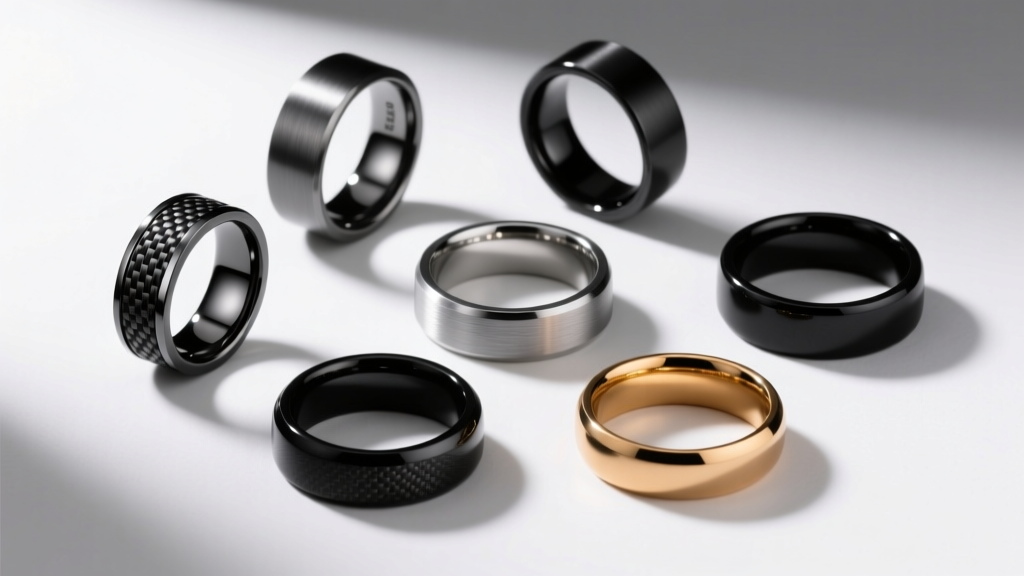
You've decided on a black wedding band — bold, modern, and distinctly masculine. But standing in front of a display case or scrolling through listings, you realize every ring looks similar yet carries a wildly different price tag. The secret is in the material. What a ring is made of determines its durability, comfort, weight, and whether it will still look great in 20 years.
## The 7 Most Common Materials in Men's Black Wedding Bands
### 1. Tungsten Carbide
Tungsten is the most popular choice for black wedding bands, and for good reason. It ranks 9 on the Mohs hardness scale, making it nearly scratch-proof. Black tungsten bands are created through a physical vapor deposition (PVD) coating process that bonds a black finish to the metal's surface. They're heavy, which many men prefer as a sign of quality, and they typically cost between $50–$300. The trade-off: tungsten cannot be resized and can shatter under extreme pressure rather than bending.
### 2. Ceramic
High-tech ceramic (zirconium oxide) is jet black all the way through — not a coating. That means the color never fades or chips. Ceramic bands are extremely lightweight, hypoallergenic, and scratch-resistant, though they can crack if dropped on hard surfaces. Prices range from $80–$400. For men with metal allergies, ceramic is often the top recommendation.
### 3. Titanium
Titanium offers an excellent strength-to-weight ratio. Black titanium bands are typically anodized or PVD-coated to achieve their dark finish. They're biocompatible, corrosion-resistant, and comfortable for everyday wear. Unlike tungsten, titanium can be cut off in an emergency. Expect to pay $100–$500. The coating on anodized titanium can wear over time with heavy use.
### 4. Black Zirconium
Zirconium starts as a silver-gray metal and is heat-treated to form a natural black oxide layer on the surface. This layer is harder than the base metal and more durable than most coatings. Black zirconium bands have a rich, deep color and a slightly organic look. They're lightweight, hypoallergenic, and priced between $200–$800. This is one of the few materials where the black color is a structural transformation, not just a surface treatment.
### 5. Cobalt Chrome
Cobalt chrome is a biomedical-grade alloy used in joint replacements — so it's built to last. Black cobalt bands use PVD coating and are known for their bright, polished finish that resembles white gold. They're heavier than titanium but lighter than tungsten, and they can be polished back to a high shine if the coating wears. Prices typically fall between $150–$600.
### 6. Carbon Fiber
Carbon fiber bands are made from woven carbon strands set in resin, often combined with a metal inner sleeve for structural integrity. The result is an ultra-lightweight ring with a distinctive woven texture. Carbon fiber is not a metal, so it won't conduct electricity — a practical benefit for electricians and mechanics. These rings run $100–$400 and are virtually impossible to resize.
### 7. Black Gold and Black Rhodium-Plated Precious Metals
For those who want the prestige of gold or platinum with a black aesthetic, black rhodium plating or black gold alloys are available. Black gold is typically yellow gold alloyed with cobalt or treated with ruthenium plating. These are the most expensive options, ranging from $500 to several thousand dollars, and require periodic re-plating as the finish wears.
## 2 Common Misconceptions About Black Wedding Bands
**Misconception 1: "Black rings are just painted metal that will peel off quickly."**
Modern black finishes use PVD (physical vapor deposition) technology, which bonds material at a molecular level — far more durable than paint or simple plating. Ceramic and black zirconium go further: their color is structural, not a surface layer at all. With normal wear, a quality black band holds its finish for years.
**Misconception 2: "All black wedding bands are the same weight and feel."**
Material makes an enormous difference in wearability. Tungsten is roughly four times heavier than titanium. Carbon fiber is lighter than most metals entirely. Before buying, consider your daily activities — a heavy tungsten ring may feel uncomfortable for someone who works with their hands all day, while a lightweight ceramic band might feel insubstantial to someone who prefers a substantial feel.
## How to Choose the Right Material for You
Ask yourself three questions: How active is your lifestyle? Do you have metal sensitivities? And is resizability important to you? Manual laborers and athletes often do best with titanium or ceramic for their combination of durability and lightweight comfort. Those with allergies should prioritize ceramic or titanium. Anyone concerned about long-term fit changes should avoid tungsten and carbon fiber, which cannot be resized.
## Final Thoughts
Men's black wedding bands are made from a wider range of materials than most buyers realize — each with distinct trade-offs in durability, weight, color permanence, and price. Tungsten and ceramic dominate the market for good reason, but black zirconium and carbon fiber offer compelling alternatives for specific lifestyles. Take the time to handle rings in person when possible, and always ask the jeweler specifically what the black finish is made of and how it was applied. That single question will tell you everything you need to know about how the ring will age.
*Ready to find your perfect black band? Visit a reputable jeweler and ask to compare tungsten, ceramic, and titanium side by side — the difference in weight and feel alone will make your decision much easier.*
 How to Choose a Wedding Band With a Cobblestone Pattern
 Engagement Ring Settings Explained for First-Time Buyers
 How to Choose a Wedding Band With a Domed Profile
 Wedding Band Order: Top or Bottom? (2026)
 How to Choose a Wedding Band With a Knife Edge Profile
 Wedding Rings Gold or Silver? The Truth (2026)
 Emerald Engagement Rings Symbolism and Care Guide
 How to Choose an Engagement Ring With a Tension Setting
 24K Gold Wedding Band Value: What It’s Really Worth
 How to Choose an Engagement Ring for Small Hands