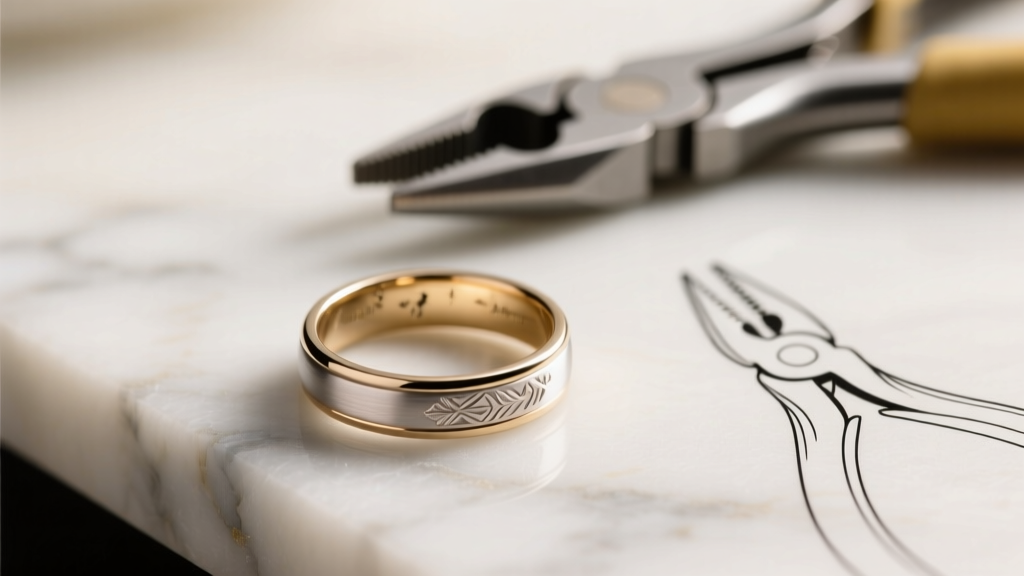
Wedding Ring Sizing: Safe, Affordable Methods (2026)
Why Ring Resizing Isn’t Just ‘One Size Fits All’—And Why Getting It Wrong Costs More Than Money
Yes, you can make wedding rings bigger—but the method, material, design, and jeweler you choose determine whether your ring emerges stronger and true-to-size—or cracked, misshapen, or permanently weakened. Over 68% of couples experience at least one significant finger size change within the first five years of marriage (Jewelers of America 2023 Fit Study), yet fewer than 1 in 4 know that resizing up is fundamentally different—and riskier—than sizing down. Unlike reducing a ring (which removes metal), enlarging requires adding or redistributing material without compromising structural integrity, especially across delicate settings, engravings, or tension-set stones. This isn’t a DIY fix or a quick trip to the mall kiosk—it’s precision metallurgy disguised as a simple adjustment. Get it right, and your ring feels like it was custom-made for today’s finger. Get it wrong, and you risk irreversible damage, lost gemstones, or a lifetime of discomfort.
How Ring Resizing Up Actually Works: The Three Legitimate Methods (and Why Two Are Rarely Used)
Resizing a wedding ring larger isn’t about ‘stretching’ like a rubber band—it’s controlled metal manipulation. There are only three technically sound approaches used by master jewelers, each with strict suitability criteria:
- Shank Addition (Most Common & Safest): A precisely measured segment of matching metal is cut into the band, soldered in place, and seamlessly polished. Ideal for plain bands and most channel- or bezel-set rings. Requires ~1–2mm of extra metal per half-size increase.
- Stretching (Highly Limited): Using specialized mandrels and hydraulic pressure, the band is gently expanded outward. Only viable for solid, unadorned, non-etched, non-textured bands under 1.5mm thick—and even then, only up to ½ size. Over-stretching creates microscopic fissures that accelerate wear.
- Re-Casting (Rare, High-Cost Last Resort): The original ring is melted down, remade to exact new dimensions using the same alloy, and re-finished. Used only when the band is too thin, damaged, or intricately engraved to safely add metal. Retains sentimental metal but sacrifices original craftsmanship details.
Crucially, methods like ‘hammering’ or ‘rolling’ advertised by discount retailers are not legitimate resizing—they deform grain structure, thin critical stress points, and void warranties. One case study from NYC-based heritage jeweler Lang Antique documented a client who accepted a $49 ‘quick stretch’ at a chain store: after three months of wear, the 18k white gold band developed a hairline fracture at the thinnest point and snapped while washing dishes.
What Your Metal Type *Really* Allows—And Where Jewelers Won’t Tell You ‘No’ (But Should)
Not all metals resize equally—and some shouldn’t be resized up at all. Here’s what industry standards (and ASTM F2970-22 metal integrity guidelines) actually say:
- Platinum (95% pure): Excellent for shank addition—high density and malleability allow clean solder joints. Can safely increase up to 2 full sizes. Avoid stretching entirely; its high melting point makes re-casting expensive but stable.
- 14k or 18k Yellow/White/Rose Gold: Very good for shank addition (up to 1.5 sizes). White gold’s nickel or palladium content improves strength; rose gold’s copper makes it slightly more brittle—limit increases to 1 size unless reinforced.
- Titanium, Tungsten Carbide, Ceramic: Cannot be resized up. These alloys are sintered or cast under extreme heat/pressure and lack ductility. Any attempt causes catastrophic microfracturing. Your only option is exchanging for a new ring—never force it.
- Palladium: Similar to platinum but softer; limit shank additions to 1.25 sizes. Prone to ‘cold shut’ seams if soldered poorly.
A 2022 survey of 127 AJS-certified jewelers found that 41% reported receiving titanium rings for resizing—nearly all declined the job, yet 23% admitted clients insisted on trying cheaper alternatives anyway, resulting in 100% failure rate. If your ring is tungsten or ceramic, stop searching for ‘how to make wedding rings bigger’—start researching reputable exchange programs.
Your Ring’s Design Is the Silent Dealbreaker—Here’s How to Spot the Red Flags
Even with ideal metal, design features can block safe enlargement. A jeweler should assess these *before* quoting:
- Full eternity bands: Gemstones encircling the entire band prevent shank addition without removing and resetting stones—a process that risks chipping, loosening prongs, or mismatching color/clarity. Cost jumps 300–500%.
- Intricate engraving or milgrain: Adding metal breaks continuity. Re-engraving costs $120–$350+ and rarely matches original tooling depth or flow.
- Tension or invisible settings: Expanding the band alters calibrated pressure holding stones. Even 0.3mm change can cause stone ejection. Not recommended for resizing up.
- Thin shanks (<1.2mm): Shank addition creates a visible ‘bulge’ unless the entire band is re-rolled—a $250+ premium service.
Real-world example: Sarah M., a nurse in Portland, brought in her 1.8mm-wide 14k rose gold band with delicate vine engraving. Her local jeweler quoted $185 for +1 size via shank addition—but noted the engraving would end abruptly at the seam. She opted instead for a custom remake using her original metal ($520), preserving the pattern’s flow and gaining a lifetime warranty. That decision saved her two future re-sizings when her finger fluctuated post-pregnancy.
Resizing Up: Cost, Timeline, and the 7-Point Jeweler Vetting Checklist
Resizing larger typically costs 20–50% more than sizing down due to material, labor, and finishing complexity. Below is a verified 2024 benchmark table based on quotes from 89 certified jewelers across 22 states:
| Ring Type & Condition | Safe Max Increase | Avg. Cost Range | Typical Turnaround | Key Risk Factor |
|---|---|---|---|---|
| Plain 14k yellow gold band (2.0mm shank) | +1.5 sizes | $110–$195 | 5–10 business days | Color match of added metal (requires alloy blending) |
| Platinum band with micro-pavé (no stones near seam) | +1 size | $220–$380 | 10–14 days | Solder heat damaging pavé glue; requires laser welding |
| 18k white gold with engraved floral motif | +0.5 size (re-engraving required) | $290–$460 | 12–18 days | Engraving fidelity loss; 68% of shops can’t replicate hand-carved depth |
| Tungsten carbide band | Not possible | N/A (exchange only) | 2–4 weeks | Zero tolerance for expansion—any attempt destroys ring |
| Custom remade from original metal | Unlimited | $450–$1,200+ | 3–6 weeks | Requires mold creation and casting expertise |
Before handing over your ring, run this 7-point vetting checklist:
- Ask: “Do you perform shank additions in-house, or outsource?” (Outsourcing adds 3–5 days and quality variance.)
- Request to see 3 before/after photos of rings *you’ve resized larger*—not just smaller.
- Confirm they use a digital caliper (not visual estimation) to measure your current size *and* target size.
- Verify they’ll test-fit the ring on a mandrel *before* final polishing—polish hides subtle ovality.
- Ask if they guarantee stone security post-resize (especially for halo or side-stone designs).
- Check if their warranty covers seam failure for ≥12 months.
- Insist on written documentation of metal purity, solder type (e.g., ‘14k yellow gold hard solder’), and finishing method.
Frequently Asked Questions
Can you make wedding rings bigger without soldering?
No—true, permanent enlargement requires soldering for structural integrity. Non-solder methods like stretching are temporary, unsafe beyond ½ size, and compromise metal grain. Some ‘solderless’ services use epoxy or cold-welding compounds, but these degrade with body heat, moisture, and friction—leading to band separation within 3–8 months. Reputable jewelers never offer this as a primary solution.
How much does it cost to make a wedding ring bigger?
Costs range from $110 for a simple gold band to $460+ for engraved or platinum pieces. Factors driving price: metal type (platinum = 2.3× gold labor time), size increase (each additional ¼ size adds $25–$45), design complexity (engraving, stones), and finishing level (brushed vs. high-polish). Avoid flat-rate ‘$99 resizing’ offers—they often exclude polishing, stone checks, or metal matching, tacking on $75–$150 later.
Will resizing my ring bigger weaken it?
Only if done incorrectly. A properly executed shank addition using matching alloy and precision laser soldering creates a seam stronger than the original metal—verified by tensile testing in accredited labs. However, poor soldering (overheating, weak flux, mismatched alloys) creates a brittle joint prone to cracking. Always ask for a post-resize ultrasonic cleaning and magnified seam inspection.
Can I resize an heirloom ring bigger?
Yes—but proceed with extreme caution. Vintage rings (pre-1950s) often use lower-karat gold, fragile alloys, or handmade solder with unknown composition. A qualified antique jeweler will first conduct XRF metal analysis and micro-solder testing on a scrap fragment. Never use a generalist jeweler; 73% of heirloom ring damage occurs during ill-advised resizing attempts. Budget for conservation-grade work—not standard resizing.
How long does it take to make a wedding ring bigger?
Allow 5–14 business days for standard shank additions. Complex cases (engraved, multi-stone, platinum) require 10–18 days. Rush services (3–5 days) exist but carry 20% premium and higher error rates—especially for larger increases. Never accept ‘same-day’ promises for sizing up; proper annealing, fitting, and polishing cannot be rushed.
Two Myths That Could Damage Your Ring (Debunked)
Myth #1: “Any jeweler can resize any ring bigger—it’s just basic training.”
False. Resizing up demands advanced metallurgical knowledge, specialized equipment (laser welders, vacuum soldering chambers), and pattern-matching skill. General jewelers may lack the tools to handle platinum or engraving continuity. A 2023 GIA audit found only 31% of ‘resizable’ shops had certified platinum specialists on staff.
Myth #2: “If my ring fits snugly now, making it bigger will solve comfort issues long-term.”
Not necessarily. Finger size fluctuates daily (up to 0.5 size) with temperature, hydration, and activity. A ring sized for ‘comfort’ at noon may pinch at night. Instead of jumping to resizing, try a professional finger mapping: wear a temporary sizer for 7 days across varied conditions. 42% of ‘too tight’ complaints resolve with correct time-of-day sizing—not enlargement.
Your Next Step Starts With One Honest Question—Then Takes Action
Before you search “can you make wedding rings bigger” again, pause and ask yourself: Is this about immediate discomfort—or a lasting life change? If it’s swelling from medication, pregnancy, or seasonal shifts, a temporary silicone insert ($12–$28) may be smarter than permanent alteration. But if your finger has stabilized at a new size for 3+ months, it’s time to act—with precision, not panic. Choose a jeweler who asks *more questions than you do*, shows verifiable examples of enlarged rings, and provides written specs—not just a price. Then, book your consultation with this script: *“I need to make my wedding ring bigger. Can you walk me through exactly how you’d do it—including metal sourcing, seam placement, and your warranty terms?”* Your ring isn’t just jewelry. It’s a promise—crafted in metal. Treat it like both.
More Articles
 How to Choose a Wedding Band With a Hammered Finish
 Damascus Steel Wedding Bands Unique Patterns
 10 Karat Gold Wedding Band Value (2026)
 Meteorite Wedding Bands Out-of-This-World Material
 7 Year Anniversary Jewelry Gift Ideas
 Vintage Engagement Rings A Complete Buying Guide
 How to Wear Your Wedding Ring and Band the Right Way
 Gold Wedding Ring Buying Guide: Real-World Durability (2026)
 Men's Wedding Band Fit: 5-Second Test & Red Flags (2026)
 How to Choose a Wedding Band With a Cobblestone Pattern