## The Secret to Stacking Wedding Rings Most Couples Get Wrong
You've got an engagement ring, a wedding band, and maybe an anniversary band on the way — and suddenly you're staring at your finger wondering how to make them all work together. Stacking wedding rings is one of the most personal expressions of your love story, but done wrong, it can scratch stones, warp bands, or just look cluttered. Done right, it's effortlessly elegant. Here's exactly how to do it.
---
## The Golden Rule: Order Matters
The most common question is simple: which ring goes where?
Traditionally, the wedding band sits closest to your heart — meaning it goes on your finger **first**, below the engagement ring. This is the classic stacking order:
1. **Wedding band** (innermost, closest to hand)
2. **Engagement ring** (middle)
3. **Anniversary band or stackable ring** (outermost)
This order isn't just tradition — it's practical. The wedding band takes the most daily friction against your palm, so placing a simpler metal band there protects your more delicate engagement ring setting.
**Pro tip:** Many brides temporarily move their engagement ring to their right hand during the ceremony so the wedding band can be placed first, then slide the engagement ring back on top.
---
## Matching Metals, Stones, and Widths
Stacking wedding rings successfully comes down to three compatibility factors:
### Metal Compatibility
Mixing metals is trendy and totally fine — rose gold, yellow gold, and white gold can all coexist beautifully. However, be aware that **harder metals scratch softer ones**. Platinum (harder) next to 14k gold (softer) will eventually leave marks. If you're mixing, consider a thin buffer band or choose rings of similar hardness.
### Stone Settings
Prong-set stones are the trickiest to stack. High-profile solitaires can catch on adjacent bands and loosen over time. Look for:
- **Flush or bezel-set stones** on stackable bands — they sit flat and won't snag
- **Low-profile settings** on your engagement ring if you plan to stack
- **Curved or contour bands** designed specifically to hug your engagement ring's shape
### Width Proportions
A general rule: your wedding band should be **equal to or narrower** than your engagement ring's band. A 2mm band under a 4mm engagement ring looks intentional. A 5mm band under a delicate solitaire looks mismatched.
---
## How to Stack 3 or More Rings Without Looking Cluttered
The "more is more" approach works — but only with intention. Here's how to stack wedding rings with multiple bands:
- **Vary textures, not just metals.** Combine a hammered band, a plain polished band, and a pavé band for visual interest without chaos.
- **Use odd numbers.** Three or five rings stack more naturally than two or four.
- **Create a focal point.** Your engagement ring should remain the visual anchor. Flank it with thinner, simpler bands.
- **Mind the knuckle.** If rings extend past your knuckle when stacked, sizing up by a half size on the outer bands helps with comfort and prevents spinning.
- **Consider a ring guard or wrap.** These are single pieces designed to frame your engagement ring — they give the stacked look without the management of multiple separate rings.
---
## Common Myths About Stacking Wedding Rings
**Myth 1: Stacking rings will always damage them.**
Not true — if you match metals thoughtfully and choose appropriate settings, stacking causes minimal wear. The real culprit is mismatched hardness or high-prong settings rubbing against each other. A jeweler can assess your specific rings and recommend protective measures like rhodium plating or setting adjustments.
**Myth 2: Your engagement ring must always go on top.**
This is purely personal preference. Some people prefer the engagement ring closest to the hand for sentimental reasons; others put it on top for visibility. There's no rule — wear what feels right and looks best to you. The "wedding band closest to heart" tradition is meaningful, but it's not a law.
---
## Your Next Step
Stacking wedding rings beautifully comes down to three things: intentional order, compatible metals and settings, and proportional widths. Start with your wedding band innermost, choose bands that complement rather than compete with your engagement ring, and don't be afraid to mix metals if you do it thoughtfully.
**One simple action:** Bring all your rings to a trusted jeweler and ask them to assess compatibility before you commit to a stacking style. A 15-minute consultation can save you from scratched stones or uncomfortable fits — and help you build a stack you'll love wearing every day.
 Wedding Bands: History, Symbolism & Modern Rules (2026)
 Eternity Ring vs Wedding Band: What Jewelers Won’t Tell You
 How to Choose an Engagement Ring With a Unique Band
 How to Choose an Engagement Ring With a Vintage Engraving
 Make Your Own Wedding Ring: Save $2,800+ (2026)
 How to Choose a Wedding Band With a Damascus Steel Pattern
 How Heavy Is a Wedding Ring? (2026)
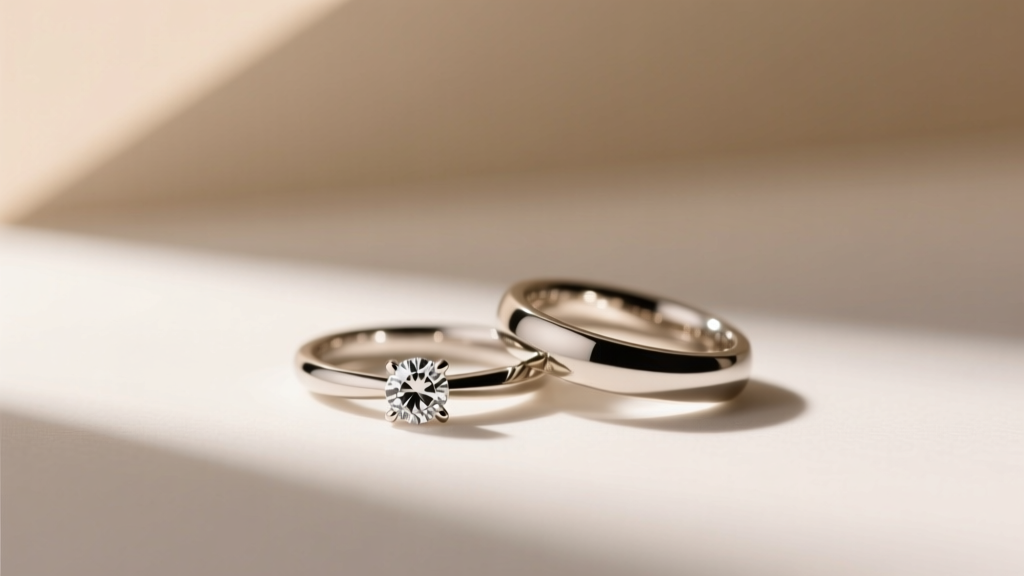 How to Pair Engagement and Wedding Rings Together
 How to Choose an Engagement Ring With a Heart-Shaped Diamond
 How to Choose an Engagement Ring for Small Hands