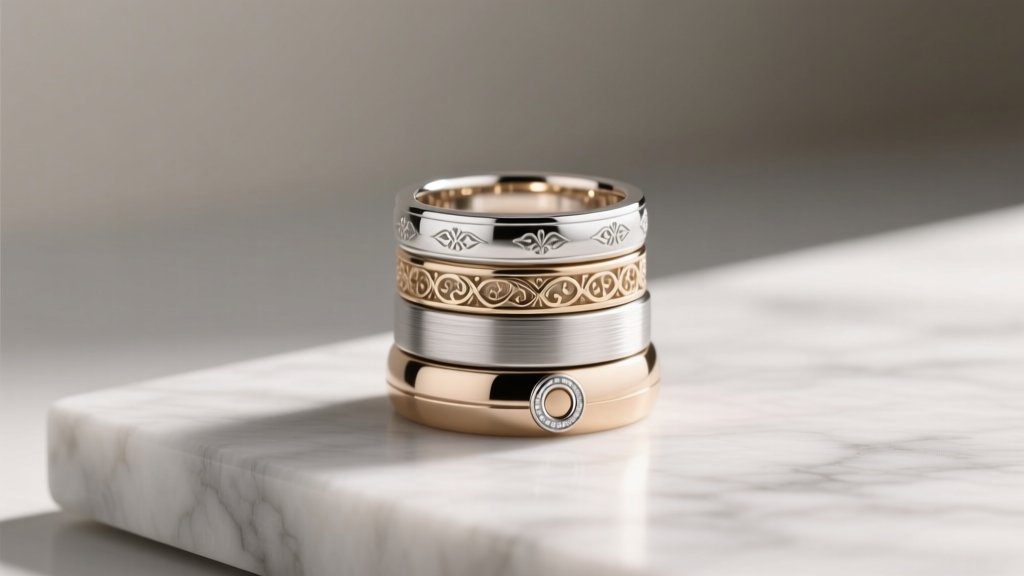
How to Choose a Wedding Band That Stacks Beautifully
A stacked bridal set looks effortless when it’s done right: your engagement ring and wedding band sit flush, feel comfortable, and create a balanced profile from every angle. When it’s not done right, you’ll notice it every day—bands that spin, gaps that catch on sweaters, prongs that get knocked, or a stack that feels bulky between your fingers.
Choosing a wedding band that stacks beautifully isn’t only about aesthetics. The right match protects your engagement ring, improves comfort, and helps your rings wear evenly over time. Whether you’re aiming for a sleek, minimal look or a modern mixed-metal stack with sparkle, a few jeweler-level details will help you choose with confidence.
Below is a practical guide to stacking wedding bands—covering fit, metal choices, settings, gemstone details, price ranges, and the common mistakes couples make when shopping for a matching band.
Start With Your Engagement Ring: Shape, Height, and “Sit Flush” Potential
Your engagement ring is the anchor of the stack. Before you fall in love with a band, identify the features that control how a wedding band will sit next to it.
Center stone shape and how it affects band fit
- Round brilliant solitaires typically stack easily with straight bands—especially with a higher-set head.
- Oval, pear, and marquise often create a longer “footprint,” which can make a straight band leave a gap unless the setting is lifted.
- Princess and emerald cut styles can stack cleanly, but watch corners (princess) and sharp edges (emerald) that may rub against a band.
- Halo and vintage-inspired engagement rings may need a contour or notched band to avoid pressing on delicate pavé or milgrain.
Setting style: the biggest factor in gaps
- Prong settings (4-prong or 6-prong) often allow more flexibility; the height of the head determines whether a band can sit flush.
- Bezel settings can be very stack-friendly, but the bezel’s outer edge may push a straight band away if it’s wide.
- Cathedral settings may block a band unless the cathedral shoulders taper enough near the base.
- Basket settings can create a clean “rail” for a band to nestle against—excellent for stacking when designed with clearance.
Measure the profile (a jeweler trick)
Ask for your engagement ring’s head height (how high the center stone sits), shank width (band width in mm), and whether the ring is designed to sit flush with a straight band. If you’re shopping online, request side-view photos. A beautiful top view can hide a gap.
Choose the Right Band Style for a Seamless Stack
Band style determines whether your stack looks tailored and intentional or mismatched.
Straight bands (classic and timeless)
A straight wedding band is the most traditional choice and works best when your engagement ring has enough clearance at the base. For a cohesive look, match the band width to your engagement ring’s shank (or go slightly thinner for a delicate “frame”).
Contour, curved, and chevron bands (made to fit)
If your engagement ring has a low setting, a halo, or a prominent basket, consider:
- Curved/contour bands that hug the engagement ring’s shape.
- Chevron (V-shaped) bands that create a pointed silhouette—popular with oval, pear, and marquise diamonds.
- Notched bands designed with a small cut-out to nest around a basket or protruding detail.
These styles are a modern trend that also solves a practical problem: they reduce gaps and help prevent the rings from knocking against each other.
Open bands and “gap” designs (modern and flexible)
An open wedding band has a small space at the top, allowing it to wrap around a center stone or setting without custom carving. This is a great option for unique engagement ring shapes, but it needs strong craftsmanship to avoid bending over time.
Eternity, half-eternity, and anniversary-style stacks
- Full eternity bands sparkle all the way around but can’t typically be resized and may feel more “structured” in a stack.
- Half-eternity bands offer sparkle on top with more comfort and easier resizing.
- Three-stone anniversary bands can stack beautifully when paired under a solitaire, but watch for height differences.
Metal Matters: Matching, Mixing, and Durability
Metal choice affects color harmony, wear-and-tear, maintenance, and long-term value.
Platinum (premium, durable, naturally white)
Platinum is dense and excellent for prongs and settings that need strength. It develops a soft patina over time rather than losing metal quickly. Platinum stacks feel substantial; just be aware that platinum-on-platinum rings can show contact marks where they rub—normal wear, not damage.
White gold (bright finish, lower cost, needs upkeep)
14K or 18K white gold is usually rhodium plated for a bright white finish. For stacked wedding rings, plan on re-plating every 12–24 months depending on wear. If your engagement ring is white gold, matching your band helps keep color consistent as plating wears.
Yellow gold (timeless, on-trend again)
Yellow gold is a classic that’s also a major current trend in bridal jewelry. It pairs beautifully with warm diamonds and vintage-inspired settings. In stacks, 14K yellow gold tends to hold up well for daily wear; 18K offers richer color but is slightly softer.
Rose gold (romantic, flattering, slightly more delicate)
Rose gold gets its blush tone from copper. It’s durable, but some people prefer to avoid it if they have metal sensitivities. Rose gold stacks can look stunning with morganite, champagne diamonds, and mixed-metal engagement rings.
Mixing metals the right way
Mixed-metal bridal sets are stylish and personal. To keep it intentional, repeat one metal twice (for example: a platinum engagement ring with one platinum band and one yellow gold accent band). This creates balance and keeps the stack from looking accidental.
Gemstones and Sparkle: What Looks Best in a Stack
Stacking bands often means multiple rows of sparkle. The key is choosing stones and settings that complement your engagement ring rather than competing with it.
Diamond cuts that stack well
- Round brilliant melee: the most classic, bright sparkle; easy to match across brands.
- French-cut or princess-cut diamonds: crisp, modern geometry; great for art-deco-inspired stacks.
- Baguette diamonds: sleek and timeless; a strong trend for minimalist, architectural bridal sets.
- Marquise accents: botanical, “leafy” look—popular in nature-inspired stacking bands.
Settings: comfort and durability in real life
- Micro pavé (tiny diamonds with small beads of metal): maximum sparkle, but needs careful craftsmanship to prevent stone loss.
- U-pavé: allows more light under diamonds; looks airy but must be well-made for security.
- Channel setting: diamonds sit between metal walls—excellent for active lifestyles and smooth stacking.
- Bezel-set melee: ultra-secure and modern; slightly less “twinkle,” more polished shine.
Colored gemstone bands
Sapphire wedding bands (blue, pink, or white sapphire) are a popular alternative for a touch of color with excellent durability (Mohs 9). Emerald and ruby can be stunning, but consider protective settings like channel or bezel because emeralds are more prone to chipping. If you want a gemstone stack, ask about stone hardness and whether the band’s design protects the girdles and corners.
Quality Factors That Make a Stack Look Expensive (Even on a Budget)
Band width and proportion
For most engagement rings, a wedding band in the 1.6–2.2 mm range stacks elegantly without overpowering. Ultra-thin bands (under ~1.5 mm) can look delicate but may wear faster, especially in pavé styles. Wider bands (3 mm+) make a bold statement and can balance a larger center stone.
Matching profiles: flat, half-round, knife-edge
- Half-round (classic comfort) stacks smoothly and feels traditional.
- Flat profiles feel modern and create a clean “stripe” in a stack.
- Knife-edge bands add definition; they can stack beautifully but may feel sharper against neighboring fingers.
Craftsmanship details to inspect
- Stone setting symmetry: pavé should look even with consistent beadwork.
- Prong finish: prongs should be smooth, not snaggy or bulky.
- Polish quality: a crisp polish reflects light evenly; poor finishing looks dull quickly.
- Ring curvature: well-made bands sit level; poorly made ones may “rock” against the engagement ring.
Practical Buying Tips for Couples
Try on the stack together—at least once
Bring your engagement ring when shopping for wedding bands. If you’re buying online, confirm return/exchange windows and consider ordering a low-cost try-on kit or sample rings if available.
Decide on “flush fit” vs. intentional gap
Some couples prefer a tiny gap for a more delicate look or to protect pavé edges. A flush fit looks seamless but can increase rubbing between rings. Either choice is valid—just make it deliberate.
Consider a soldered set for stability
If you want your engagement ring and wedding band to behave like one ring, ask about soldering (joining them together). This reduces spinning and wear between rings, but makes future resizing and styling changes more involved.
Think ahead: will you add an anniversary band later?
If you plan a three-ring stack (engagement ring + wedding band + anniversary ring), choose a wedding band that leaves room for a future addition—often a slim plain band or a half-eternity style that layers easily.
Care and Maintenance for Stacked Wedding Rings
- Clean regularly: soak in warm water with mild dish soap, use a soft toothbrush, rinse, and dry with a lint-free cloth. Avoid harsh chemicals and abrasive toothpaste.
- Schedule inspections: have prongs and pavé checked every 6–12 months, especially on micro pavé stacks.
- Remove for impact activities: gym lifting, gardening, moving furniture—stacked rings take more knocks.
- Store separately: rings rubbing in a jewelry box can scratch metals and chip softer stones.
- Re-plate white gold: plan periodic rhodium plating to keep color consistent across your bridal set.
Price Range Considerations and Value Tips
Wedding band pricing depends on metal, gemstone content, craftsmanship, and brand. Here are realistic ranges for many shoppers:
- Plain gold band (14K/18K): often $250–$1,200 depending on width and weight.
- Plain platinum band: commonly $600–$2,000+ due to metal density.
- Diamond pavé or half-eternity band: frequently $700–$3,500 depending on total carat weight and setting quality.
- Full eternity diamond band: often $1,500–$6,000+, with price rising quickly with stone size and platinum.
- Sapphire or mixed gemstone bands: typically $500–$3,500, depending on gemstone quality and design complexity.
Where value really shows
- Choose 14K for daily wear if you want durability and a lower price point; 18K is richer but softer.
- Prioritize setting quality over slightly bigger melee diamonds—secure stones and clean finishing matter more in a stack.
- Consider lab-grown diamonds for pavé and eternity bands if you want more sparkle per dollar while keeping the look classic.
Common Mistakes to Avoid When Shopping for a Stacking Wedding Band
- Buying the band without the engagement ring present: many returns happen because the band doesn’t sit right next to the setting.
- Ignoring height and snag factor: a band that presses into prongs or catches fabric will frustrate you daily.
- Going too thin: ultra-slim bands can warp, especially in soft metals or with lots of pavé.
- Choosing full eternity without thinking about resizing: finger sizes change; full eternity rings are often not resizable.
- Mismatching metal colors unintentionally: white gold, platinum, and rhodium finishes can look different side-by-side.
- Over-stacking too fast: three bold bands can overpower a center stone and feel uncomfortable. Build your stack gradually.
FAQ: Stacking Wedding Bands
Should my wedding band match my engagement ring exactly?
No. Matching is timeless and cohesive, but mixing metals or adding a different texture (like a baguette band with a round solitaire) is a modern trend that still looks refined. The goal is harmony in scale and profile.
What if my engagement ring has a gap with straight bands?
Look for a contour/curved band, a chevron band, or a notched design. Custom bands are also common for halos, low-set baskets, and vintage-inspired shapes where a perfect flush fit matters.
Is a full eternity band a good choice for stacking?
It can be, especially for a high-sparkle look. Just remember full eternity bands usually can’t be resized and may feel more rigid. A half-eternity band is often the more practical everyday stack.
Can I stack diamond bands without damaging my engagement ring?
Yes, if the stack is designed well and maintained. Choose smooth edges, well-finished prongs, and consider spacing with a thin plain band if your engagement ring has delicate pavé. Regular inspections help prevent loose stones.
Which is better for daily wear: platinum or white gold?
Platinum is naturally white and very durable, making it excellent for long-term wear. White gold is more budget-friendly but may need rhodium re-plating to stay bright. Both can be great for a bridal stack when chosen thoughtfully.
What band width stacks best with most engagement rings?
Many couples find 1.6–2.2 mm to be the sweet spot for balance and comfort. Go wider for a bold, modern look; go slimmer for a delicate, classic look—just don’t sacrifice durability.
Next Steps: Build a Stack You’ll Love for Decades
The best stacking wedding band is the one that fits your engagement ring’s shape and setting, feels comfortable on your hand, and matches your lifestyle—not just your Pinterest board. Start by identifying whether you need a straight, curved, chevron, or notched band, then choose a metal and setting that will hold up to daily wear. When the proportions are right and the craftsmanship is solid, even a simple band can make your bridal set look exceptionally polished.
If you’re still comparing styles—classic gold bands, diamond pavé, baguette trends, or contour fits—explore more jewelry guides on weddingsift.com to help you choose with confidence.
More Articles
 Wedding Ring Resizing: Safe, Affordable & Which Metals Work
 Citrine Engagement Rings Warm Golden Autumn Tones
 Wedding Ring Size Measurement: 7 Accurate Methods
 How Heavy Is a Wedding Ring? (2026)
 Do You Wear The Wedding Band On Top Or Bottom (2026)
 How to Choose a Wedding Band With an Art Deco Design
 Lab-Grown vs Natural Diamonds: 2026 Comparison
 How Much Does a Men's Wedding Ring Weigh? (2026)
 Is Zirconium Good for Wedding Rings? (2026)
 The Practical, Ethical, and Timeless Proposal Ring Buying Guide