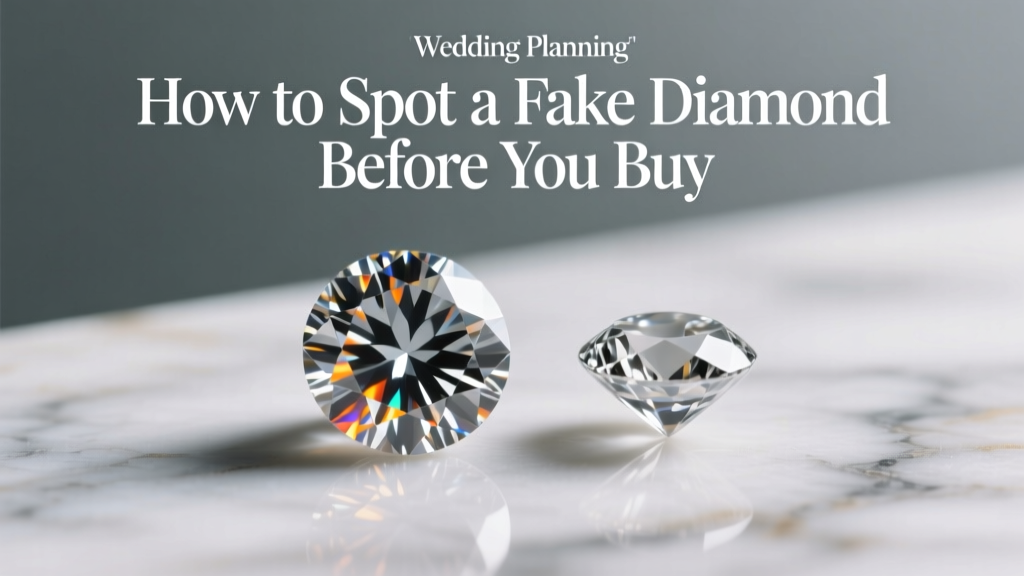
How to Spot a Fake Diamond Before You Buy
Shopping for an engagement ring or wedding band is one of the most exciting parts of planning a life together—and one of the most expensive. Diamonds are still the top choice for bridal jewelry because they’re durable, timeless, and symbolically tied to commitment. The challenge is that “diamond” has become a catch-all term online and in some storefronts, and not every sparkling stone is what it claims to be.
Between lab-grown diamonds, diamond simulants (like moissanite or cubic zirconia), treated stones, and outright fakes, it’s easy to feel unsure—especially when you’re comparing engagement rings across websites, marketplaces, and social media ads. Knowing how to spot a fake diamond (and how to confirm a real one) helps you protect your budget, choose the right quality level, and feel confident that your ring will hold up for decades of everyday wear.
This guide breaks down the most reliable ways to identify a genuine diamond, what reputable jewelers look for, and the smart buying steps couples can take before committing to a ring.
First, Know What “Fake Diamond” Can Mean
Not all “not-natural” diamonds are scams. Clarity starts with vocabulary:
Natural Diamond
Mined from the earth. Value is influenced by the 4Cs (cut, color, clarity, carat) and by documentation such as a GIA grading report.
Lab-Grown Diamond
Real diamond, grown in a lab (HPHT or CVD methods). Chemically and optically diamond; it’s not “fake,” but it should be disclosed and priced differently than a mined diamond. Many couples now choose lab-grown diamonds for larger carat sizes at a lower price—one of today’s biggest engagement ring trends.
Diamond Simulant (Not a Diamond)
Looks like diamond but is a different material. Common simulants include:
- Moissanite: Very sparkly, often shows more rainbow flashes than diamond; excellent durability.
- Cubic zirconia (CZ): Affordable, bright at first, but can cloud and scratch over time.
- White sapphire, zircon, glass: Can mimic diamond in certain lighting but behave differently.
Fake/Counterfeit Diamond
A stone sold as a diamond (often “natural”) that is actually a simulant, a composite, or an intentionally misleading product.
The Quickest Red Flag: No Grading Report
For an engagement ring center stone—especially 0.50 carat and above—a reputable seller should provide a grading report from a respected lab. The gold standard is GIA (Gemological Institute of America). IGI is also common, particularly for lab-grown diamonds, and can be reliable when matched to the stone’s laser inscription.
If the listing says “certified” but doesn’t specify the lab, or uses a lab with loose grading standards, treat it as a warning sign. A report should include:
- Carat weight and measurements
- Cut grade (for round brilliant) and polish/symmetry
- Color and clarity grade
- Fluorescence
- Plot diagram or inclusions map
- Report number (often laser-inscribed on the girdle)
At-Home Checks: What You Can (and Can’t) Trust
At-home tests can help you spot obvious fakes, but none should be your only proof—especially for a major bridal jewelry purchase.
1) The Fog (Breath) Test
Breathe on the stone like you would a mirror. Diamonds disperse heat quickly, so fog typically clears fast. CZ and glass often hold fog longer. This is a rough screening tool—metal settings, stone size, and room temperature can affect results.
2) Look for “Too Perfect” Clarity Under Magnification
Use a jeweler’s loupe (10x) or a macro camera. Many natural diamonds have tiny inclusions. A completely flawless look can be normal in a lab-grown diamond or a high-grade diamond, but it can also indicate CZ or glass. Under magnification, CZ often shows softer facet edges and a “crushed ice” look without the crispness of diamond cutting.
3) Check the Setting and Craftsmanship
Authentic diamond rings are usually set in quality metals like 14K or 18K gold (yellow, white, or rose) or platinum. Look for hallmarks inside the band:
- 14K, 18K (gold purity)
- PT950 (platinum)
- Maker’s mark
Be cautious if a “diamond engagement ring” is set in mystery metal, lightweight plating, or has poorly finished prongs. Fine stones are rarely paired with bargain craftsmanship.
4) The Sparkle Clue: Diamond vs. Moissanite
Diamonds tend to show a balance of white light return (brilliance) and colored flashes (fire). Moissanite often throws stronger rainbow flashes, especially in sunlight. Many couples love that look, but if the ring is advertised as a diamond, extra “disco ball” fire can be a clue that it’s moissanite.
Professional Identification: The Methods Jewelers Use
If you want certainty before you buy (or right after purchase during a return window), professional verification is worth it.
Diamond Tester (Thermal Conductivity)
Many jewelers use thermal testers because diamonds conduct heat extremely well. The limitation: moissanite can also pass some thermal tests. That’s why many shops use combination testers.
Moissanite Tester (Electrical Conductivity)
Moissanite conducts electricity differently than diamond. A combined thermal/electrical tester can separate diamond from moissanite far more reliably.
Microscope Examination
Under a gem microscope, experts look for facet junction sharpness, doubling (common in moissanite due to birefringence), inclusions, and growth patterns.
UV Fluorescence and Phosphorescence
Some diamonds fluoresce under UV light (often blue). Certain lab-grown diamonds can show distinctive fluorescence or phosphorescence patterns depending on growth method. This is a helpful clue, not a standalone verdict.
Laser Inscription Match
If the diamond is graded, ask to see the laser inscription on the girdle and match it to the grading report number. This is one of the simplest ways to confirm the stone is the same one described on the certificate.
Quality Factors That Influence Value (and Help Spot a Deal That’s Too Good)
Most counterfeit situations start with price. If a ring looks like a 1.50 carat diamond solitaire in platinum but costs like costume jewelry, it’s not a hidden treasure—it’s a different stone.
The 4Cs: What They Really Mean for Engagement Rings
- Cut: The biggest driver of sparkle. A well-cut round brilliant (Excellent/Ideal range) can outshine a larger poorly cut stone.
- Color: Near-colorless (G-H) is popular for white gold and platinum settings. Warmer tones (I-J) can look beautiful in yellow or rose gold—both timeless choices that are trending again.
- Clarity: VS2 to SI1 often offers strong value; many stones in this range are “eye-clean” in classic prong settings.
- Carat: Bigger costs more, but shape matters—oval, pear, and marquise can appear larger per carat, which is why elongated cuts are a major current trend.
Cut Styles and Settings: Where Fakes Hide
Some sellers use popular silhouettes to distract from weak stone quality:
- Halo engagement rings: Tiny accent stones can mask a cloudy center or make a small stone look larger.
- Pavé bands: Look closely at the uniformity of stones and bead setting. Poorly set pavé can lose stones quickly.
- Bezel settings: Sleek and secure (great for active lifestyles), but they can hide the girdle area where you’d see a laser inscription.
- Three-stone rings: Classic and meaningful, but make sure all stones are disclosed (diamond vs. simulant).
Practical Buying Tips for Couples
- Buy from a seller with clear return and upgrade policies. A fair return window lets you verify the stone independently.
- Ask direct questions: Is the center stone natural diamond, lab-grown diamond, moissanite, or CZ? Is it treated? Is it laser-inscribed?
- Request documentation: GIA/IGI report number, full grading report PDF, and close-up images or videos in different lighting.
- Consider an independent appraisal: For high-value engagement rings, an appraisal from a credentialed gemologist can confirm identity and support insurance.
- Match metal to lifestyle: Platinum is durable and naturally white; 14K gold is a popular balance of strength and price; 18K gold is richer in color but slightly softer.
Care and Maintenance: Protecting Your Diamond Ring
Even a real diamond can look “fake” when it’s dirty. Lotions, soap, and cooking oils reduce sparkle—especially in popular settings like halos and pavé.
- Clean at home: Warm water, mild dish soap, and a soft toothbrush. Rinse well and pat dry with a lint-free cloth.
- Avoid harsh chemicals: Chlorine and abrasive cleaners can damage metals and some setting styles.
- Schedule checkups: Have prongs inspected every 6–12 months, especially for dainty bands, micro-pavé, and shared-prong wedding bands.
- Store smart: Keep rings separate to prevent scratches on metal and to avoid diamonds abrading other jewelry.
Price Range Considerations and Value Tips
Diamond pricing changes with market conditions, but smart value rules stay consistent:
- Lab-grown vs. natural: Lab-grown diamonds usually cost significantly less for the same size and visible quality. If size is a priority, lab-grown can unlock a larger center stone within budget.
- Prioritize cut: For sparkle, a well-cut 1.00 carat can outshine a poorly cut 1.25 carat.
- Choose “sweet spots”: Consider carat weights just under milestone numbers (0.90 instead of 1.00, 1.80 instead of 2.00).
- Use metal strategically: 14K white gold can lower cost compared to platinum while still giving a bright, classic engagement ring look.
- Don’t overpay for invisible specs: Many couples find G-H color and VS2/SI1 clarity to be the best balance in real-life wear.
Common Mistakes to Avoid When Shopping for a Diamond Ring
- Assuming sparkle equals diamond: Moissanite and CZ can be extremely sparkly, especially under bright retail lighting.
- Skipping the certificate: A grading report is a key safeguard for engagement rings and diamond wedding bands.
- Falling for vague language: Phrases like “diamond-like,” “simulated,” “created,” or “genuine” can be used to blur the truth. Look for direct disclosure: natural diamond or lab-grown diamond.
- Ignoring the setting quality: Weak prongs and thin shanks can lead to lost stones—no matter how real the diamond is.
- Buying outside a return window: If you can’t verify, you can’t protect yourself.
- Not considering daily wear: Trend-forward ultra-thin bands and high-set stones look delicate and modern, but may snag or wear faster than classic solitaires and low-profile settings.
FAQ: Spotting a Fake Diamond
How can I tell if a diamond is real without a tester?
You can look for red flags (no grading report, too-good-to-be-true pricing, poor craftsmanship) and do basic checks like the fog test and magnification. For real certainty, match a laser inscription to a GIA/IGI report or have a jeweler verify it with proper equipment.
Will a real diamond always pass the fog test?
Not always. Most diamonds clear fog quickly, but results vary with stone size, how cold the room is, and whether the stone is already dirty. Treat it as a quick clue, not proof.
Can moissanite pass a diamond tester?
Yes, some thermal conductivity testers can read moissanite as diamond. A jeweler can use a combined thermal/electrical tester or microscope examination to tell them apart.
Are lab-grown diamonds considered “fake”?
No. Lab-grown diamonds are real diamonds with the same crystal structure and hardness. The key is accurate disclosure and appropriate pricing compared to natural diamonds.
What’s the safest way to buy a diamond engagement ring online?
Choose a reputable retailer that provides a GIA or IGI grading report, high-resolution images/video, clear metal stamps (14K/18K/PT950), a solid return policy, and responsive customer support. Plan to verify the stone during the return window if you want extra assurance.
Do diamond wedding bands get graded too?
Small diamonds in pavé or channel-set wedding bands are usually not individually graded with full reports. Instead, look for a detailed description of total carat weight, average color/clarity range, and strong workmanship—clean channel edges, secure prongs, and even stone matching.
Next Steps: Buy With Confidence
The best defense against a fake diamond is a combination of transparent documentation, realistic pricing, and craftsmanship you can see and feel. Start with a GIA or IGI report, confirm the stone matches the certificate (ideally via laser inscription), and choose a setting and metal—platinum, 14K gold, or 18K gold—that fits your lifestyle and long-term wear.
If you’re comparing engagement rings, diamond wedding bands, or trending cuts like oval and pear versus timeless round brilliant solitaires, keep your focus on verified details rather than sparkle alone. For more expert guidance on choosing the right ring, gemstone, and setting, explore more jewelry guides on weddingsift.com.
More Articles
 How to Choose a Wedding Band With a Braided Design
 Wedding Ring Sizing: Safe, Affordable Methods (2026)
 Wedding Bands Can Be Different Colors (2026)
 Morganite Engagement Rings Affordable Luxury Option
 How to Choose an Engagement Ring With a Cathedral Setting
 Lab-Grown vs Natural Diamonds in 2026
 Wedding Shower Gifts: What to Bring & How Much to Spend
 How to Identify Quality Craftsmanship in Wedding Bands
 Diamond Fluorescence What You Need to Know
 How to Choose a Wedding Band With a Brushed Finish