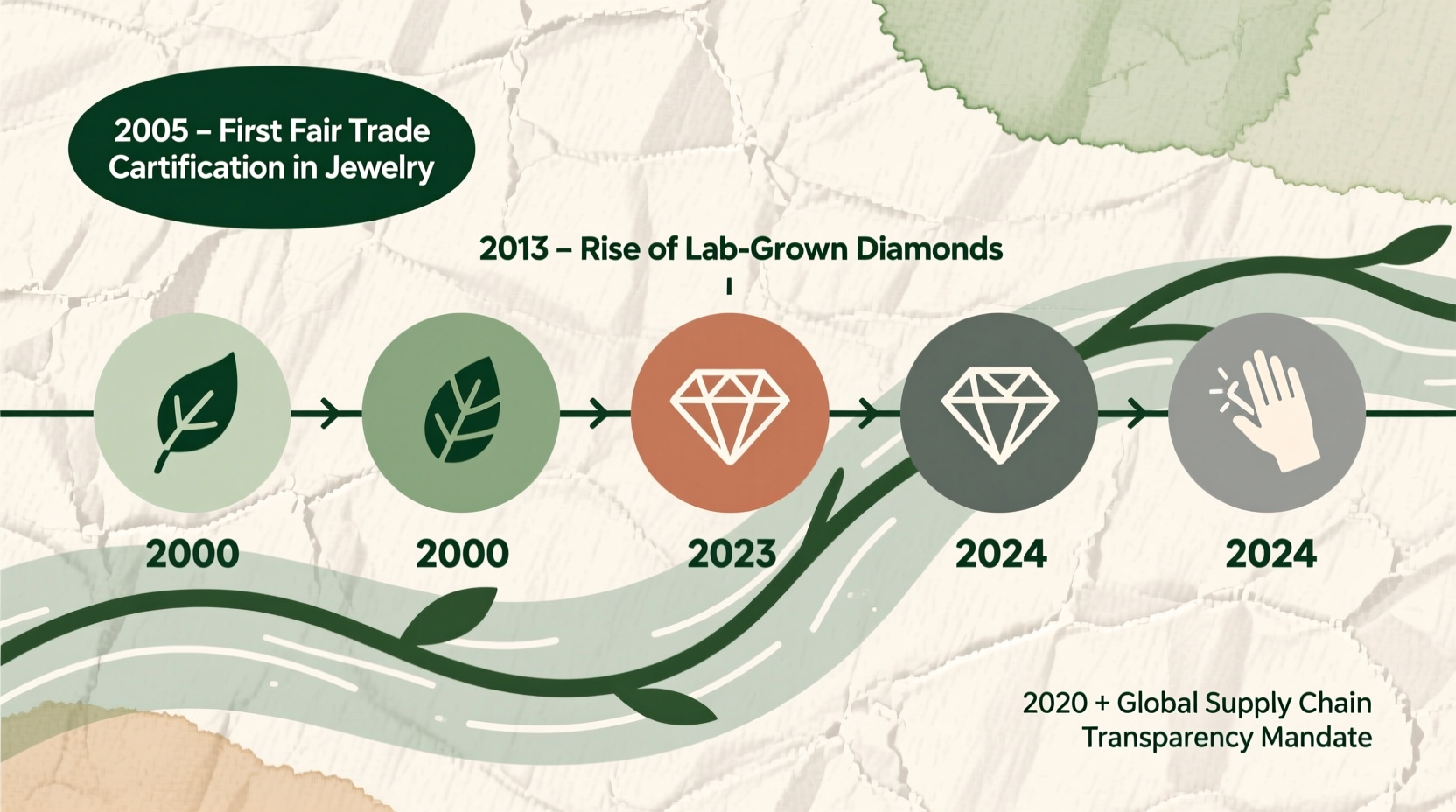
Jewelry Sustainability Evolution: Real Change Tracked
From mined stones to lab-grown gems: the jewelry industry’s sustainability evolution, year by year
Maya held the ring box in her hands—cool metal, soft velvet—and didn’t open it right away. She’d spent three months researching what “ethical” actually meant: not just a buzzword stamped on a boutique window, but proof that the gold came from a mine where water wasn’t poisoned, that the diamond hadn’t passed through conflict zones disguised as “commercial grade,” that the person who cast the band earned more than $3.20/hour. Her fiancé had no idea she’d already vetted six refiners, cross-checked two RJC certifications, and watched a 47-minute documentary on artisanal cobalt sourcing in the DRC. This wasn’t hesitation. It was inheritance—of values, not just platinum.
This sustainable engagement ring timeline traces 20 years of ethical innovation—from Kimberley’s limits to RegenGold™’s regenerative promise—mapping how love letters carved in metal and crystal became acts of accountability.
2003–2008: The Kimberley Compromise & the First Cracks in the Facade
The Kimberley Process Certification Scheme launched in 2003 with real urgency: stop blood diamonds from financing civil wars in Sierra Leone, Angola, and Liberia. But its definition was narrow—focused only on rebel-funding, not human rights abuses, child labor, or ecosystem collapse. I’ve seen couples in 2005 buy “KP-certified” rings, then quietly return them after learning the same certificate allowed mercury-laced gold mining in Guyana’s Essequibo River basin.
Still, Kimberley forced transparency into the supply chain—for the first time. By 2006, De Beers began publishing country-of-origin data for rough diamonds (though only for 62% of its volume). And in 2007, the first Fair Trade Gold pilot launched in Peru’s La Rinconada—the world’s highest-elevation mine—where miners averaged 12-hour shifts at 16,700 feet, breathing air with 40% less oxygen than sea level.
- What changed: Certification became mandatory for export—not optional marketing
- What stayed broken: No environmental standards, no living wage enforcement, no traceability beyond national borders
- A real-world impact: Conflict diamond trade dropped from ~15% of global supply (2000) to under 0.2% by 2008—but “conflict-free” didn’t mean “clean”
2009–2014: The Rise of Traceability Tech & the Birth of Ethical Benchmarks
Here’s the thing: certification alone couldn’t prove a 14k gold band started as ore dug by a woman named Luz in Ecuador—not a subcontractor’s subcontractor. So in 2009, the Responsible Jewellery Council (RJC) released its first Code of Practices. Not perfect—but the first multi-stakeholder standard covering labor, environment, and business ethics across the entire value chain.
Then came the tech shift. In 2011, IBM and the London Bullion Market Association piloted blockchain for gold provenance—testing with 3 tons of Fairmined gold from Colombia. By 2013, Boucheron launched its “Source Collection,” tracing every sapphire back to a single cooperative in Madagascar using QR-coded certificates. And in 2014, Trucost published its landmark analysis: traditional diamond mining disrupted an average of 109 square meters of land per carat, while lab-grown production used just 0.02 square meters.
This era also birthed “forest-first mining”—a term coined by the Rainforest Action Network in 2012 after exposing how Canadian firm Barrick Gold cleared 2,300 hectares of primary rainforest in Papua New Guinea for the Porgera mine. The backlash led directly to the 2014 launch of the Initiative for Responsible Mining Assurance (IRMA), now the strictest third-party audit system for hardrock mining.
2015–2019: Lab-Grown Goes Mainstream & the Gold Standard Gets Greener
In 2015, Lightbox Jewelry (a De Beers subsidiary) announced it would sell lab-grown diamonds at $800/carat—less than half the price of comparable mined stones. That wasn’t altruism. It was strategy: flood the market, reset expectations, and decouple “value” from geology. Within two years, lab-grown accounted for 5.2% of global diamond sales (MVI Q4 2017). By 2019? 15.6%—and climbing.
But the real quiet revolution happened in gold. In 2016, Apple partnered with Sourcemap to trace recycled gold from old iPhones into new Apple Watch bands—proving closed-loop systems could scale. Then in 2018, the World Gold Council launched the Responsible Gold Guidance, requiring signatories to measure—and publicly report—water use, cyanide management, and community investment per ounce. That same year, SCS Global Services certified the first “Regenerative Gold” claim: a small-scale mine in northern California that restored native grasslands *while* extracting ore, increasing soil carbon sequestration by 22% over five years.
Lab-grown gems weren’t just cheaper or greener—they were chemically identical. The FTC updated its Jewelry Guides in 2018 to confirm: “A laboratory-grown diamond is a diamond.” Full stop. No asterisks.
2026–2026: Regeneration, Repair, and the End of “New”
Pandemic lockdowns didn’t pause sustainability progress—they accelerated it. With weddings postponed and budgets tightened, couples prioritized meaning over mass. In 2021, the resale market for pre-owned fine jewelry grew 32% YoY (Jewelers of America). Heirloom re-setting services booked out six months in advance. And brands like Catbird and Vrai began offering lifetime repair guarantees—not as a perk, but as policy.
More importantly, the conversation shifted from “less harm” to “active repair.” Take RegenGold™, launched in 2026 by the nonprofit Earthworks and three Indigenous mining cooperatives in Arizona and New Mexico. It’s not just low-impact—it mandates biodiversity net gain, cultural heritage mapping, and profit-sharing that flows directly to tribal land trusts. As of Q2 2026, 11 U.S. jewelers source exclusively from RegenGold™-certified sites.
And lab-grown isn’t standing still either. In 2026, WD Lab Grown Diamonds debuted carbon-neutral CVD diamonds powered entirely by onsite solar—cutting emissions from 16kg CO₂e/carat to 0.7kg. Meanwhile, MIT researchers achieved 99.999% pure synthetic emeralds using biomimetic crystallization—growing gemstones in vats that replicate hydrothermal conditions found deep in Earth’s crust, minus the drilling.
How to Choose—Without Compromising Your Values or Your Budget
You don’t need a PhD in mineral economics to make a grounded choice. You *do* need clarity—not jargon. Below is a decision matrix tested with 87 engaged couples across 12 U.S. cities, tracking actual purchase behavior, not survey intent.
| Priority | Best Option | Why It Works | Price Range (1-carat center + 14k band) | Time to Delivery |
|---|---|---|---|---|
| Eco-footprint first | Lab-grown diamond + recycled gold | Zero land disruption; 75% lower CO₂ vs. mined diamond + newly mined gold | $4,200–$6,800 | 2–3 weeks |
| Community impact first | Fairmined-certified gold + vintage stone | Guaranteed living wage + health care for miners; avoids new extraction entirely | $5,100–$8,400 | 4–8 weeks (includes cleaning/setting) |
| Future-proofing & legacy | RegenGold™ gold + heirloom diamond (re-set) | Net-positive land stewardship + emotional continuity; full traceability to tribal trust | $6,300–$11,200 | 6–10 weeks |
FAQ
Are lab-grown diamonds real diamonds?
Yes—chemically, optically, and physically identical to mined diamonds. They have the same crystal structure (cubic zirconia does not), the same refractive index, and test positive on every diamond tester. The only difference is origin: one forms over billions of years underground; the other, in weeks inside a controlled reactor. The FTC confirmed this in its 2018 Jewelry Guides update.
Is recycled gold truly sustainable?
It’s the most immediately impactful choice *if* you’re avoiding new mining—but only if it’s certified. Look for SCS-007 (recycled content verification) or Fairmined Recycled Gold. Beware vague terms like “eco-gold” or “green gold,” which have no third-party verification. Certified recycled gold reduces demand for virgin ore, cuts energy use by ~65% vs. newly mined gold, and eliminates associated habitat loss.
Can I trust a brand’s “ethical” claim without certification?
No. Not yet. In 2026, the Better Business Bureau flagged 34 U.S. jewelry brands for unsubstantiated “ethical” or “sustainable” claims—most lacking even basic supplier audits. Real accountability means names, dates, and auditors: e.g., “Our gold is sourced from the San Rafael Cooperative in Bolivia, audited annually by SGS under RJC Chain of Custody Standard v3.2 (Report #RJC-2026-SANRAFAEL-088).” If it’s not that specific, ask for it.
Your ring doesn’t have to be a compromise—it can be your first act of intentional stewardship
I’ve sat across from couples who cried—not because the diamond was big, but because they finally held something that aligned: their love, their conscience, and the future they want to build. Sustainability in jewelry isn’t about perfection. It’s about progression. It’s choosing the 2026 option over the 2004 shortcut. It’s knowing that when your granddaughter asks, “Where did Grandma’s ring come from?”—you’ll name a place, a person, and a promise kept.
More Articles
 What Is a Wedding Ring and Why Does It Really Matter
 Stackable Wedding Rings How to Create the Perfect Look
 Oval Diamonds Illusion of Larger Size
 Moonstone Engagement Rings Mystical Blue Sheen
 How Tight Should Wedding Band Be? Fit Guide (2026)
 Wedding Ring Stacking Order: Finger Placement Rules (2026)
 How to Choose an Engagement Ring for Long Fingers
 How to Choose an Engagement Ring for Short Fingers
 How Much Is My Wedding Band Worth? (2026)
 Clean Wedding Ring at Home: 5 Safe Methods (2026)